

Martech Stack: Are Too Many Marketing Tools Hurting Your ROI?
Every new marketing challenge seems to come with the same recommendation: buy another tool.
Looking for improved attribution? Invest in yet another system. Want content generated by AI? Sign up for yet another service. Seeking insights on customers? Purchase a CDP. Eventually, marketing teams are utilizing numerous applications in their Martech Stack, with each one offering to enhance performance but merely complicating matters.
Instead of simply accelerating marketing efforts, the result may be fragmentation of information, multiple software installations, inconsistent workflows, and increasing operational expenses, all of which make it quite challenging to demonstrate the Martech ROI in marketing technology.
Leading companies understand that it is no longer about having more software subscriptions, but about having a more cost-efficient, well-integrated Martech stack used for a purpose.
So, the real challenge today is not about investing in more marketing solutions but about making sure that already-owned technologies deliver a greater return on investment. Let’s get started.
Why biggest Martech stacks becoming bigger problems
Marketing technology has changed greatly over the last ten years. Today, modern teams majorly rely on countless digital marketing tools such as automation, CRM, customer data platforms, AI systems, analytics, attribution systems, and others.
Instead of using a cohesive technology ecosystem, many businesses end up owning a worrying number of redundant technological solutions.
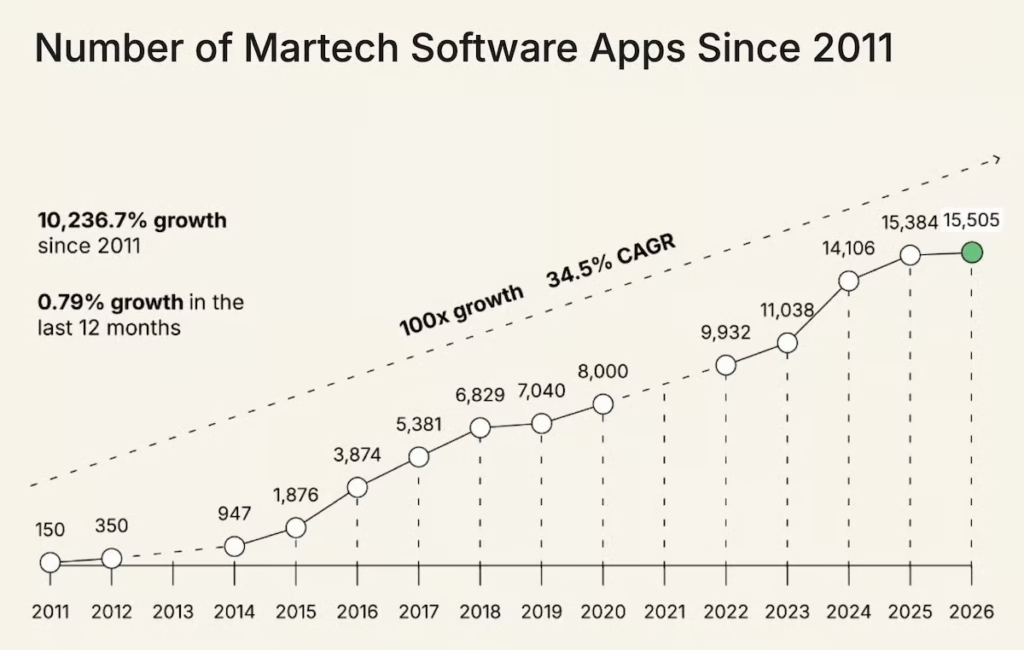
Interestingly, the industry has noticed this change. According to the research by Scott Brinker, the situation in marketing technology has grown by less than one percent this year, which is the slowest growth rate for the last fifteen years. This is a tip for changing attitudes towards the future of marketing technology: consolidation rather than expansion.
The real Martech spending problem
Numerous organizations operate under the assumption that acquiring extra software will lead to superior marketing results. However, in practice, every additional tool presents new challenges.
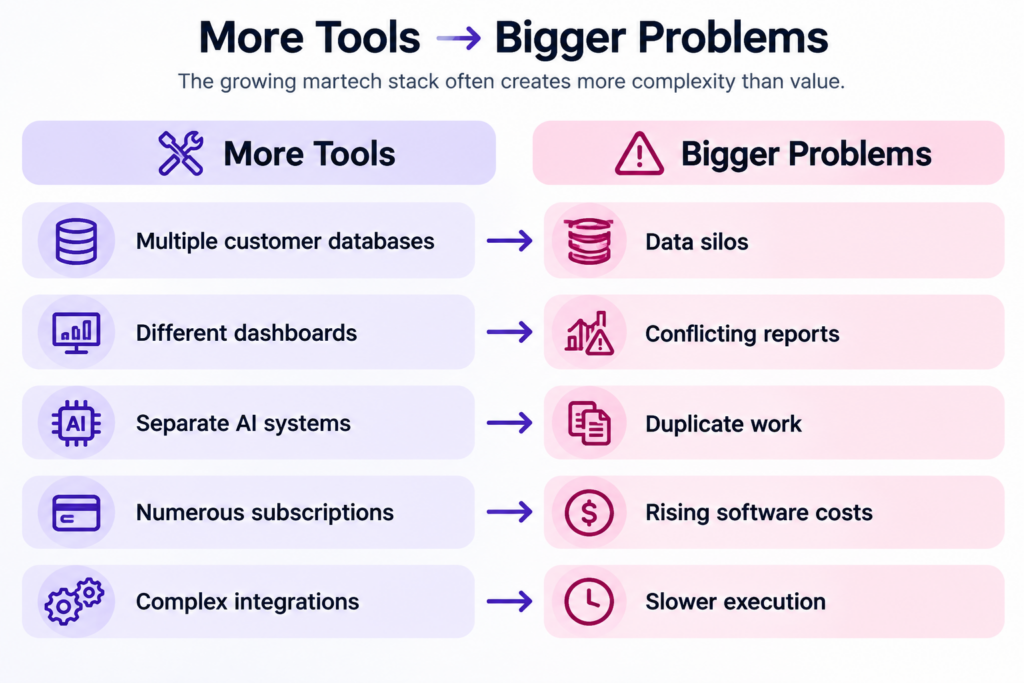
Each application results in an increase in the integrations, reports, processes, and customer information for marketers to maintain. As a result, instead of improving their productivity, many marketers are stuck managing all these processes without being able to perform their campaigns.
Why don’t more Martech tools automatically increase ROI
The struggle for most companies is not based on technology; it is about the lack of cohesion. While organizations can access many fantastic marketing tools, data must also be connected, workflows should be integrated, and processes must be clear in order to maximize these tools’ effectiveness.
According to the eClerx Marketing Report, 78% of marketing leaders claim that their Martech investments have not delivered the return they expected, despite spending money on marketing technology for years. Only a quarter of organizations see themselves as data-oriented, despite the importance of clear data for making marketing decisions; as a result, 75% continue to make decisions based on insufficient data.
The findings suggest that buying more technology isn’t the issue—activating the technology already in place is. As Scott Houchin, Chief Marketing Officer at eClerx, explains:
“Stack maturity does not always translate into activation maturity. AI has accelerated insight generation, but unless organizations connect data, analytics, and execution, those insights rarely translate into business outcomes.”
Common challenges that limit Martech ROI
- Poor integration: Devices for CRM, advertising, analytics, and automation operate independently.
- Duplicated functionality: Many systems perform the same functions, such as segmentation, reporting, and e-mail automation.
- Low adoption: Employees often use only a fraction of available features because training, governance, and adoption fail to keep pace with software investments.
- Fragmented customer data: Customer information becomes scattered across multiple platforms, making personalization, reporting, and campaign optimization significantly more difficult.
Industry research published in 2026 shows just how widespread this issue has become. 62% of marketers identify technology stack sprawl as one of their biggest operational challenges, while 65% struggle with integrating different marketing systems.
This shift in priorities is becoming increasingly clear across the marketing industry. As MarTech senior editor Constantine von Hoffman explains:
“The next phase of marketing maturity is less about acquiring technology and more about designing operations that turn insights into action.”
In other words, competitive advantage no longer comes from owning the most marketing tools. It comes from building a connected Martech stack that enables teams to turn data into action quickly and consistently.
AI is making the problem bigger, not smaller
The anticipated outcome from AI technology is that marketing processes would be easier.
However, the reality is that it has grown the technology landscape.
Marketing teams usually use various AI-based applications without replacing the old ones.
Instead of effectively replacing existing software, the AI systems add a new layer of technology to the already existing stack. Considering this, many marketing leaders are starting to change their priorities and stop buying new software.
The result is that the discussion has now shifted from “Which AI solution to purchase?” to “Which solutions do we actually need?”
Building a Martech Stacks that work
The objective should not be to have the biggest B2B Martech stack.
Rather, it should be to create the one that actually works.

Instead of buying specialized software for every new task, leading businesses use integrated systems that provide the same functions on a single platform.
This results in lower licensing costs, easier onboarding, and improved cooperation among the teams involved in marketing, sales, and customer success.
Real-world example: Salesforce is betting on consolidation
One of the strongest examples of this shift comes from Salesforce.
Instead of pushing customers to piece together numerous non-integrated marketing solutions, Salesforce has focused on integrating Data Cloud, Marketing Cloud, and AgentForce in a single solution, combining customer data, AI, automation, and analytics.
This approach mirrors today’s trend among many corporate brands that prefer fewer point solutions and more integrated ecosystems.
However, it does not mean that all companies should buy Salesforce.
Rather, market players are investing in integrated solutions rather than endlessly acquiring new software.
Marketing operations should measure outcomes—Not tool count
One of the safest techniques to find redundant applications is to stop gauging success by the size of the tool stack.
Instead of asking,
“How many marketing applications do we possess?”
Marketing professionals should pursue the following questions instead:
- “Which tools contribute to revenue generation?”
- “Which software is seldom put to use?”
- “Which platforms are performing similar tasks?”
- “Which subscriptions can be merged?
As MarTech.org has increasingly pointed out over the course of the year 2026, the main hurdle in the industry now is not technology itself. It is now the organization’s maturity level in operational ability to process customer information without hindrance and execute promptly across several channels.
This is what defines Martech return on investment.
Cut to the chase
Having a larger Martech stack doesn’t lead to better marketing outcomes; it creates disconnected data, increasing expenses, and unexploited systems. Those organizations that are getting the most from Martech investments are not purchasing more instruments or software; they are making one software work for all purposes.
FAQ’s
A martech stack is the collection of marketing technology tools a business uses for automation, analytics, customer data, content, and campaign management.
Audit existing tools, remove duplicates, consolidate platforms, and invest only in technology that delivers measurable business value.
Connect customer data, improve tool adoption, streamline workflows, and measure each platform against clear marketing and revenue outcomes.
At a Glance
- More tools don’t mean better ROI.
- Consolidate overlapping martech platforms.
- Prioritize integration and clean data.
- Use AI to simplify, not add complexity.
- Measure tools by business impact.