

AI Marketing Tools ROI in H1 2026: What Delivered Results, What Didn’t, and Why
The initial phase of AI experimentation is over. By H2 2026, the conversation around AI marketing has shifted from “What AI tools should we be trying?” to “Which AI tools are delivering us measurable results today?”
Many marketing organizations have already integrated at least some form of AI in various aspects of their workflows, from content creation and campaign optimization to audience targeting. The question is no longer whether marketers should use AI, but which tools deliver genuine business value and which generate more hype than results.
AI has become a mainstream part of the marketing mix, marking a shift from AI adoption to AI accountability. Marketers are no longer focused on which tools are the most popular. They want to know which ones are improving efficiency, driving performance, and delivering measurable returns.
With that in mind, we recently spoke with Supriya Umrao, Assistant Manager at Wildnet Technologies, to understand which AI tools delivered the strongest ROI in H1 2026 and what lessons marketers can take from their performance when shaping future strategies.
Where do you see AI making the biggest impact in marketing right now?
Umrao: Currently, I believe that AI’s most significant achievement is the way it has changed how we create and analyze our materials. These areas include research, planning the creation of content, optimizing content, analyzing our data, and creating reports/analytics; in the past, much time and effort were used in each of these working phases.
AI has enabled teams to speed up their ideation phase by helping them generate ideas for briefs, create those briefs, and optimize their workflows for creating content. On the analytics side, teams can now process massive amounts of data at a faster rate, allowing them to quickly identify actionable insights.
The greatest benefit of AI is that it will not only save you time because it automates repeated tasks; it will also give you the clarity you need to use the saved time on strategizing, understanding the audiences you want to reach, and making data-driven decisions.
The gap between adaptation and measurable impact
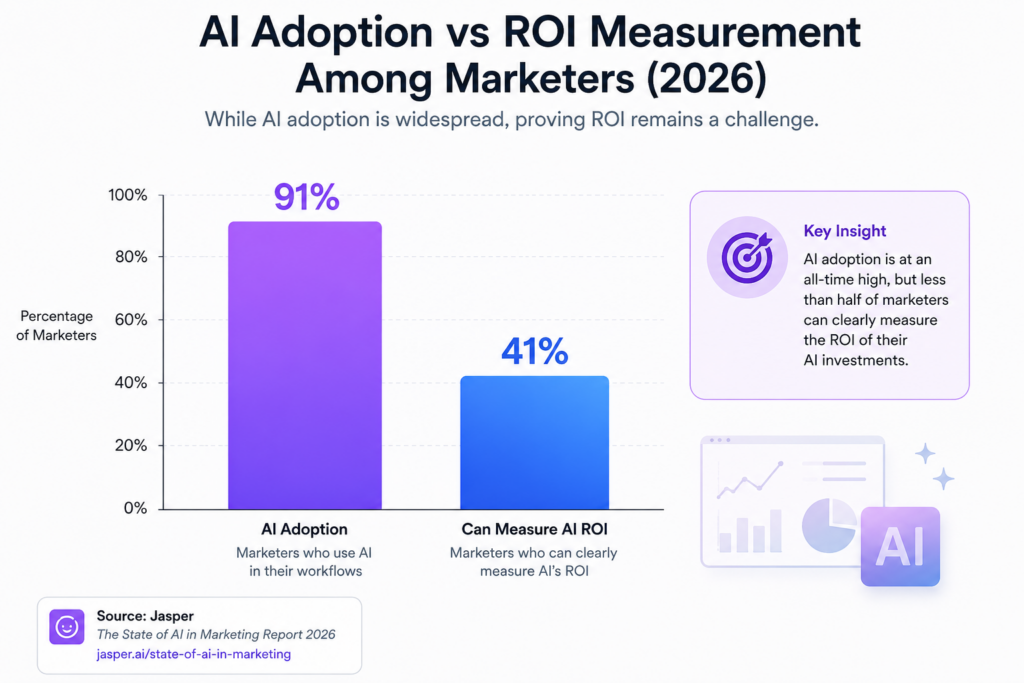
This transition can be seen in the numbers. Jasper’s 2026 AI State of the Art in Marketing report states that over 90% of marketers have adopted AI technology. Yet only 41% of marketers can confidently state that they are able to measure the return on investment associated with their investments in artificial intelligence technology.
The contrast between the two phases highlights a significant change occurring in the AI journey for this industry. In many ways, the shift towards accountability and business impact has replaced the previous phase focused on adoption and experimentation. Now that AI is a common member of marketing departments, teams must demonstrate which tools are producing measurable results and which are failing to meet their expectations.
The gap between AI adoption and the ability to prove its measurable impact will influence how marketers review their AI expenditures in 2026. The success of marketers using AI will no longer be based solely on their use of AI; it will be determined by how effectively they demonstrate that the AI they’ve implemented is delivering value.
To find out where marketers are seeing results from their use of AI, we asked Umrao which tools actually moved the needle for her team.
Can you tell me about an AI marketing tool that really helped your team this year?
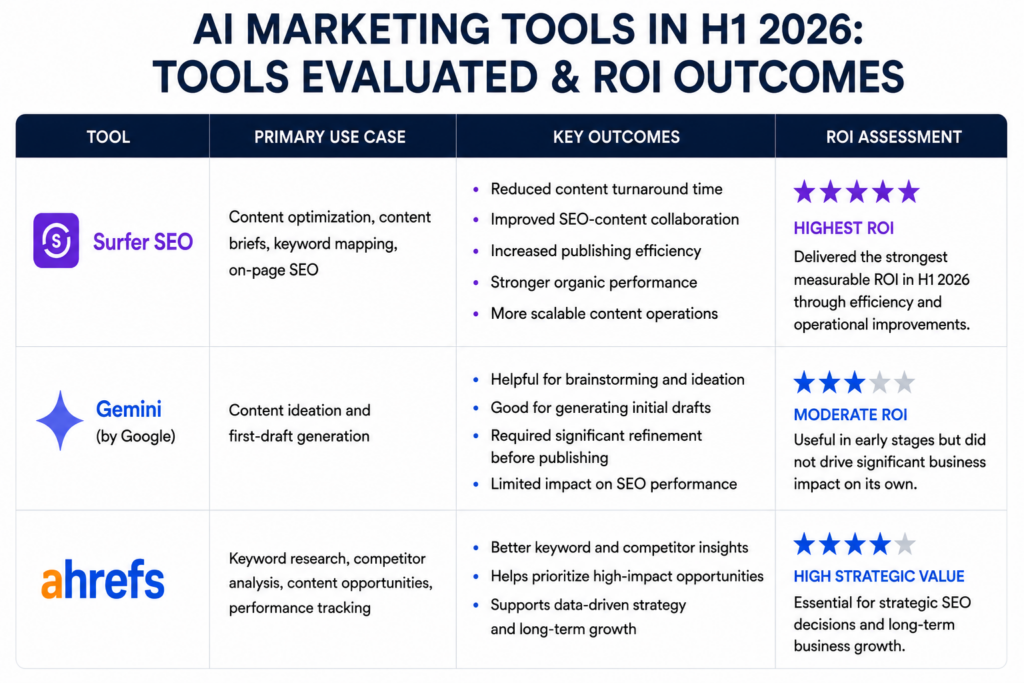
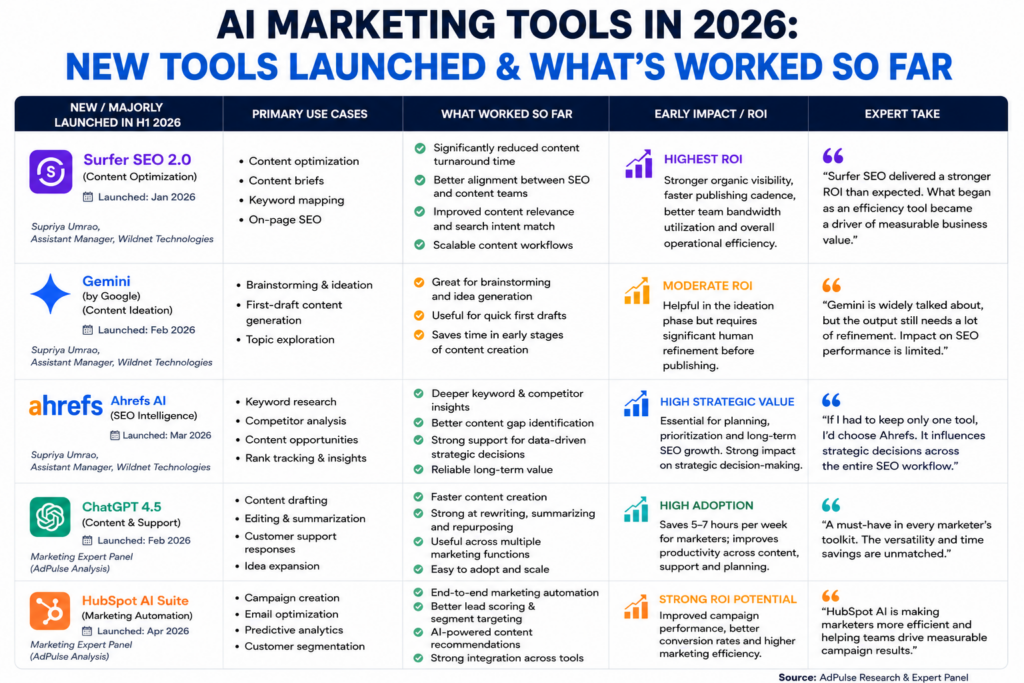
Umrao: Surfer SEO was one of the AI Tools I used this year that really helped me out. We included this tool in our day-to-day SEO and Content workflow to improve content planning, optimization, scalability, and quality.
I used Surfer mainly for AI-driven content optimization, keyword mapping, creating content briefs, and improving on-page SEO. What was particularly helpful about the Surfer platform was that it had the capabilities to take a lot of search and competitor data and create actionable recommendations from it. We were previously spending hours manually reviewing SERPs and developing content guidelines. By using Surfer, we could create optimized briefs within minutes, find gaps in content, and uncover opportunities much more easily than before.
Overall, the Surfer tool has significantly reduced content turnaround time while creating a stronger organic presence on all of our projects. In addition to reducing turnaround time. One of the biggest benefits of Surfer has been helping with the alignment between SEO and content teams.
The writers have had clearer direction from the beginning, resulting in fewer review cycles, faster execution times, and more alignment. Between the search intent of content and the topical relevance of the content we produce.
Did you use any AI tools during the first half (H1) of 2026 that gave you more return on investment (ROI) than you expected?
Umrao: Yes. In H1 2026, Surfer SEO delivered a stronger ROI than I initially expected. We adopted it primarily to improve efficiency, but its impact extended far beyond time savings.
The greatest return from Surfer was through the operational improvements we experienced. Our content turnaround time was greatly diminished, giving us the ability to publish and optimize content at a much faster rate without needing to put more resources in place to do so. Surfer helped us standardize our workflows, which ena came from the operational improvements we achieved e we were maintaining consistency.
The financial benefits to our company from Surfer have created stronger organic results, increased ceiling of team bandwidth, and created a more scalable content business. Ultimately, what was an efficiency tool, has created a measurable value to our company’s ROI, which has proven the value it can create through AI solutions when used in an established workflow.
Has AI reduced costs or simply changed marketing in H2
Not every widely discussed AI tool has translated into measurable business value.
Marketers report saving an average of 6.1 hours per week because of the automation associated with artificial intelligence, providing them with more time available for strategy, optimization, and performance analysis. However, marketing also suffers without human creativity.
We asked Umrao whether any heavily promoted platforms failed to meet expectations.
Have AI tools decreased your team’s costs, or just transferred work from one person to another?
Umrao: In my experience, AI has not replaced people during business operations or moved job responsibilities. From one employee to another, but rather primarily increased efficiency and reduced operational costs.
Prior to the introduction of AI, many of these activities had required significant manual labor. For example, keyword research and competitive analysis, creation of content briefs, and optimization of initial content were very labor-intensive. And now occur much more quickly because AI assists in completing these tasks.
Overall workflow has increased as a result of AI, which has provided teams with significant time they would have otherwise spent on repetitive execution of these tasks.
The true value of that saved time, however, is in what an organization chooses to do with its saved time.
Instead of decreasing the headcount. We redirected those saved hours toward higher-value activities such as SEO strategy development, performance analysis, client communication, testing, and experimenting with new ideas for growth opportunities.
For us, AI has served as a multiplier in terms of productivity instead of a tool for cutting costs. It has allowed our team to produce more output with the same level of resources. While staying consistent with quality, making better decisions, and providing a scalable method for future growth.
Why measuring AI ROI remains a challenge
As AI becomes embedded across marketing workflows, measuring its business impact remains difficult. Because these tools influence multiple stages of execution, organizations often struggle to isolate their contribution and accurately quantify ROI.
This challenge reflects a broader industry trend. Marketers want to know whether AI is saving time, improving campaign performance, increasing conversions, or driving revenue growth. The answer often depends on which metrics teams prioritize and how effectively they track them.
As a result, a gap remains between AI adoption and business accountability. While many organizations use AI daily, far fewer can clearly demonstrate how it contributes to business performance.
To better understand how marketers evaluate AI success in practice, we asked Umrao what metrics she prioritizes when determining whether an AI investment is actually paying off.
Which is the most talked-about AI tool that has not produced any significant results for your company?
Umrao: Gemini was one of the AI tools that received a lot of attention. But our team found it didn’t provide us with the results we’d hoped for.
We tried using this tool to accelerate our content production and support ideation during the earliest stages of content planning. In terms of generating first drafts and brainstorming ideas, it was helpful. However, outside of this initial stage of the process, we didn’t see any significant impact on SEO or the overall success of our business.
Most outputs lacked the necessary level of detail(search intent alignment). For creating content that would perform well, we had to spend considerable time refining many of them before they were ready to publish.
This experience served as a great reminder that AI alone rarely delivers the level of success we all seek. Conversely, we received the most value from combining AI-generated input with human expertise, search intent analysis, content strategy and SEO best practices.
Rather than replacing existing processes, Gemini worked best as a supportive tool within our workflows. In other words, while it had some value in terms of improving efficiency, it did not function as a stand-alone solution for creating net new growth through measurable outcomes.
What metric do you look at first when deciding whether an AI tool is delivering ROI?
Umrao: The first metric I focus on is the amount of time saved and the overall efficiency created throughout a workflow. A metric indicating the tool adds value is whether it minimizes manual work, eliminates repetition, and enables the team to execute more quickly without sacrificing quality.
That said, I also don’t measure ROI primarily based on productivity alone. Once efficiency has been established through this metric. I evaluate its impact on your overall business outcomes, such as your organic traffic growth, lead generation, content performance, campaign results, and your overall contribution to your business goals.
Reassessing what success looks like in the AI era
Research from HubSpot’s 2026 AI Trends Report found that marketers using AI save an average of 5–7 hours per week, allowing teams to shift their focus from manual execution to strategy, optimization, and customer insights. Is there a preference for marketers?
If you could keep only one AI marketing tool today, which would it be and why?
Umrao: If I could keep only one AI marketing tool today, I would choose Ahrefs. It delivers value across multiple stages of the SEO and content marketing workflow. From keyword research and competitor analysis to content opportunity discovery and performance tracking.
The fact that Ahrefs can integrate insight with execution on a single platform provides me with the ability to prioritize my next steps based on TRUE search demand and where my competitors stand—not based on what I suspect.
Ultimately, the AI marketing tool. I would rely on most will be determined by its impact on both the marketing strategy and the overall business’s ability to grow revenues. Consequently, Ahrefs consistently enables me to develop superior strategies and grow my organic traffic.
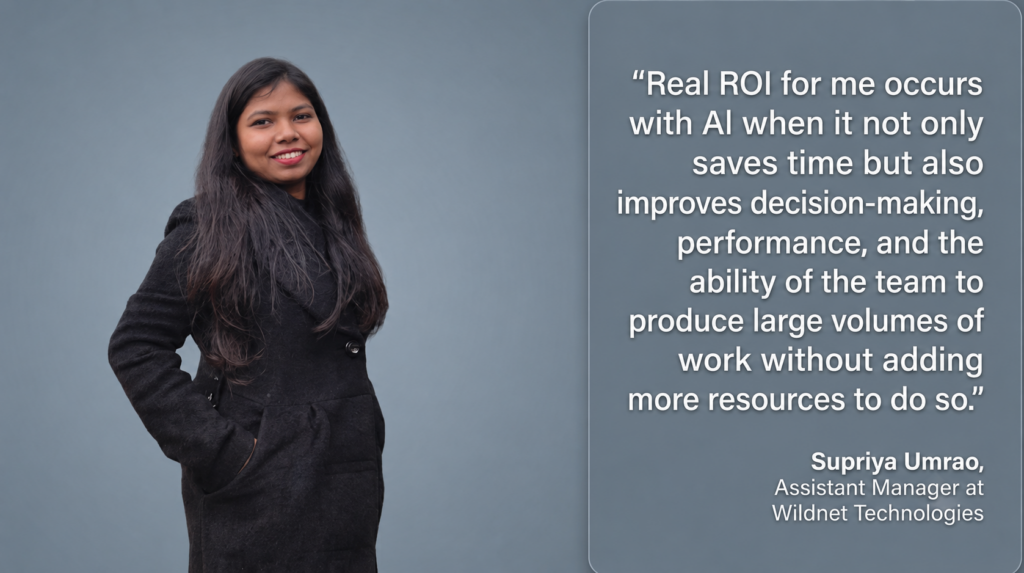
“Real ROI for me occurs with AI when it not only saves time but also improves decision-making, performance, and the ability of the team to produce large volumes of work without adding more resources to do so.”
Cut to the chase
The strongest ROI from AI isn’t coming from replacing marketers. It’s coming from helping them work faster, make better decisions, and scale proven processes. As this interview suggests, the tools delivering the most value aren’t necessarily the ones generating the most buzz. They’re the ones that fit naturally into existing workflows and produce measurable business outcomes.