
Everyone’s Using AI Tools. Few Are Using Them Right
Yes, you heard it right: Google has just launched its entire suite of AI marketing tools that is about to change the marketing game. The statement isn’t simply proclaiming the launch of a new product; rather, it reflects the evolution taking place within the overall marketing universe.
Thank you for reading this post, don't forget to subscribe!Not too long ago, AI tools were viewed as something experimental in the world of marketing, a cutting-edge feature only for early adopters. Nowadays, however, they are in all marketing communication; there is no escaping them. From customer relationship management (CRM), analytics, e-mail platforms and ad management software, there isn’t a single marketing tool that does not have the “Powered by AI” label attached to it.
So, then the ultimate question remains… Is this actually changing the way we do marketing, or have all existing capabilities simply been given a new name by putting an AI label on top of it?
At this point, while all marketing tools are now described as being AI-driven, the real question about the impact of all this AI being included in marketing tools will be about its effects on marketing and the return (impact) they deliver versus just “getting on the bandwagon.”
The great AI rush: why every tool suddenly feels smart
The overwhelming number of artificial intelligence (AI) capabilities embedded into marketing tools isn’t a coincidence—it’s driven by three core forces shaping the industry today:
1. Pressure for ROI: Marketers are under a microscope—vanity metrics are being replaced by revenue impact. AI enables deeper insights, predictive forecasting, and measurable contributions to business outcomes. If tools cannot prove ROI, they risk becoming irrelevant.
2. Staggering Amounts of Data: The volume of data being generated today is impossible to process manually. AI enables real-time interpretation of complex, unstructured data, delivering actionable insights at a speed human teams simply cannot match.
3. Competitive Necessity: When one platform introduces AI-driven automation and personalization, competitors are forced to follow—creating an industry-wide race not to innovate, but to keep up.
This is the reason why: all companies, both start-ups and multi-nationals, continue to include (or will soon include) AI within the base offering of their products.
What AI in Marketing Tools actually means
Let’s be clear: marketing tools didn’t suddenly become intelligent—the way they process and act on data has evolved.
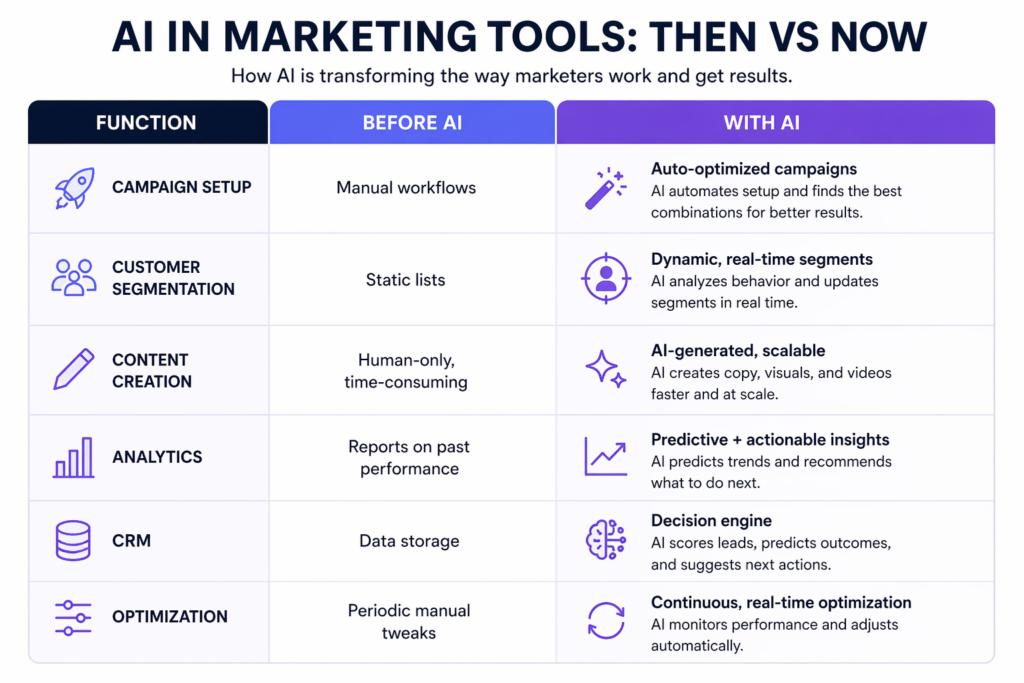
Modern marketing tools with AI now do three things:
- Automate commonly repeated tasks (set up campaigns, segment lists, generate reports)
- Create content (emails, online ads, graphics)
- Forecast outcomes (how customers behave, how likely they are to leave or convert)
The most effective tools combine all three seamlessly.
Today’s platforms use machine learning to continuously refine targeting, improve engagement, and optimize campaigns in real time—not just at launch, but throughout the campaign lifecycle.
AI in marketing automation: from workflows to “autopilot”
Marketing automation once meant building workflows manually. Today, AI is turning automation into autonomy.
Today, AI is changing the game. Marketing automation with AI can help marketers:
- Select the best time to send out email messages.
- Tailor messages to individual customers across multiple channels.
- Change the way campaigns are run based on results received in real-time.
These systems don’t just execute instructions—they learn from outcomes and improve continuously.
This transformation means that instead of being an operator, the marketer has become a strategist.
AI-Driven CRM platforms: the brain behind customer relationships
CRM systems have observed one of the most significant changes in evolution. Traditional CRMs were data storage systems. AI-driven CRMs are now decision engines. The Benefits of an AI-Driven CRM System.
Modern AI-driven CRM systems can:
1. Automatically score prospective leads.
2. Predict whether a deal will close.
3. Provide recommendations for the best next actions.
4. Simplify the process for following up with customers.
They reduce manual tasks like data entry and scheduling, allowing teams to focus on closing deals. This creates more time for sales representatives to implement new strategies to close more sales.
This shift is already delivering measurable impact—companies using AI in their CRM are 83% more likely to exceed their sales goals, highlighting its growing influence on revenue in 2026.
Some of the most popular CRM systems that utilize AI technology are:
1. Salesforce – Predictive Analytics.
2. Hubspot – Conversational AI.
3. Zoho CRM – ID-based Assistants.
The purpose of the CRM system itself is not just to track customer interactions, but also to assist in providing guidance on the best ways to interact with those customers.
AI features in analytics tools: from reports to predictions
Analytics was previously focused on providing an answer to a singular question:
“What has happened?”
AI-powered analytics answers a far more valuable question: What will happen next—and what should you do about it?
Analytics tools are now beginning to incorporate many features powered by modern artificial intelligence, including:
- Predictive Modeling
- Customer Journey Mapping
- Real-time Anomaly Detection
- Generates automated insights
Instead of marketers spending hours digging through dashboards, they will start receiving prebuilt insights and recommendations, thereby significantly reducing the time they spend analyzing data and speeding up their decision-making process.
AI in content and creative tools: scale meets personalization
Artificial intelligence (AI) is changing how we create content and other creative tools. Some of the most visible ways this transformation has occurred include new capabilities such as AI tools that can:
- Produce advertising copy
- Create social network posts
- Design graphics
- Create videos
Many generative AI applications enable marketers to scale up their production of content without sacrificing the sense of personalization.
This is why the speed and volume of content being produced have accelerated dramatically, and therefore, brands are producing more content than ever before. But while content volume has increased, quality hasn’t always kept pace.
The hidden truth: not all AI features are created equal
At this point, we’ve reached our point of interest! Not every “AI feature” actually delivers value. Features within AI can often be:

(i) Surface/Basic automation rebranded as ‘AI’;
(ii) Features that aren’t maximized by the customer/user; or
(iii) Features that are over-promised but not delivered on.
For example, even within many CRM systems, the sheer number of features used by customers is a small percentage of the available features, including artificial intelligence based/computed features. So, when it comes down to differentiating amongst competitors in AI, the real differentiator isn’t who has AI; it’s who uses AI in a meaningful way.
An increasing number of marketing tools are AI
Instead of using one All-purpose tool~ all marketers today are building AI-driven ecosystems from multiple tools. Today’s ecosystem generally includes both AI tools for content creation and design; AI driven CRM systems; AI Analytical tools; and AI enabled Marketing Automation Systems.
The real value of these tools is derived from integrating/disconnecting the use of APIs and connectors, where APIs and connectors allow the different from these tools to work together as one (intelligent) marketing workflow.
This explains why every marketing tool appears to have some element of AI~ because these days it is no longer a unique selling point (UI); it must be part of every offering due to the amount of data produced and growing demand for individualized service and performance.
AI is the layer that connects data, decisions, and execution across the entire marketing stack. Ultimately, AI is no longer just an additional feature in each marketing tool, but rather the workhorse that provides intelligence to all marketing tools and drives efficiency across the entire marketing ecosystem.
The real question: Is this sustainable?
At this point, we are at the height of “AI feature inflation.” All tools seem to want to add:
- AI Assistants
- AI Copilots
- AI Recommendations
In the next phase, hyped tools will be differentiated from value-based tools.
The tools that succeed in achieving growth and developing a viable business will be the following ones:
- Generate a measurable impact on the business
- Have a natural, seamless integration into user workflows
- Continue being used by numerous teams.
Cut to the chase
AI isn’t a feature anymore—it’s the foundation of every marketing tool. From CRM to analytics to content, AI is the layer connecting data, decisions, and execution in real time. The real advantage isn’t having AI—it’s using it in a way that drives actual business results.
FAQ’s
AI in marketing tools refers to the use of machine learning and automation to analyze data, predict customer behavior, generate content, and optimize campaigns in real time.
AI marketing tools are used for tasks like lead scoring, personalized messaging, campaign automation, predictive analytics, and content creation—helping marketers work faster and more efficiently.
Yes—but only when used strategically. While many tools offer AI features, the real value comes from how effectively they are integrated into workflows and used to drive measurable results.