
‘You Can’t Prompt Your Way to a Feeling’: How AI is Redefining Modern CMO
For years, every major shift in marketing has raised the same question and prediction about the CMO’s influence. Is it shrinking or adapting to new levers? Ask two marketing leaders from opposite corners of the industry the same question about AI, and the safe bet is two different answers.
Vanessa Chin, SVP of Marketing at System1, comes from a company built on measuring emotional response and brand memory.
Sangeeta Prasad, CMO at Slalom, comes from a global consultancy built on rebuilding how enterprises operate.
Ad Pulse asked each of them, separately, what happens to the CMO once AI can plan, personalize, and optimize its own. Their answers landed in nearly the same place!
At a Glance
- AI absorbs execution: planning, personalization, optimization, but not the judgment behind it.
- Neither leader wants marketing reduced to an “AI operating model” disconnected from the customer.
- As AI makes content and campaigns cheaper to produce, brand trust and distinctiveness become the real differentiator.
- CMOs are increasingly judged on business outcomes and cross-functional alignment, not campaign output.
- AI exposes organizational fragmentation faster than it fixes it.
AI is taking over the “how”, not the “why“
There’s a growing assumption in marketing circles that AI agents will eventually run end-to-end campaign planning, media buying, personalization, and optimization. Ad Pulse put that assumption to Chin and Prasad directly: once AI owns the how, what’s left for the CMO?
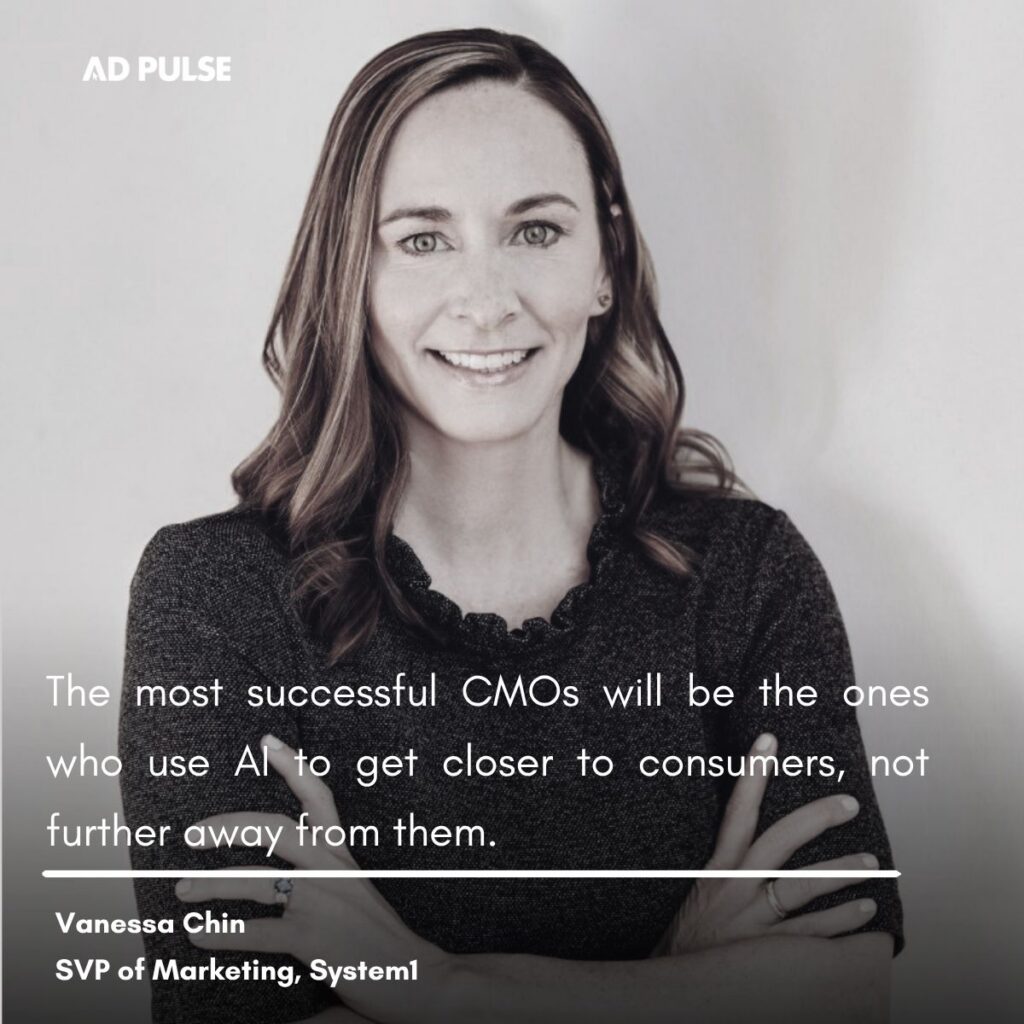
Chin’s answer draws a clean line between execution and meaning. “AI will likely automate much of the ‘how’ of marketing,” she says. “The CMO will remain responsible for the ‘why’ — and, more importantly, for how a brand makes people feel.”
AI can optimize media plans, generate endless creative variations, and personalize content at scale, she argues, but growth doesn’t come from efficiency alone.
It comes from building the kind of positive emotional associations that make a brand easy to notice, easy to remember, and easy to choose.
As AI makes execution cheaper and more accessible, she says, competitive advantage shifts from production to brand-building —and “the winning brands won’t necessarily be those creating the most content. They’ll be those creating the strongest emotional impact.”
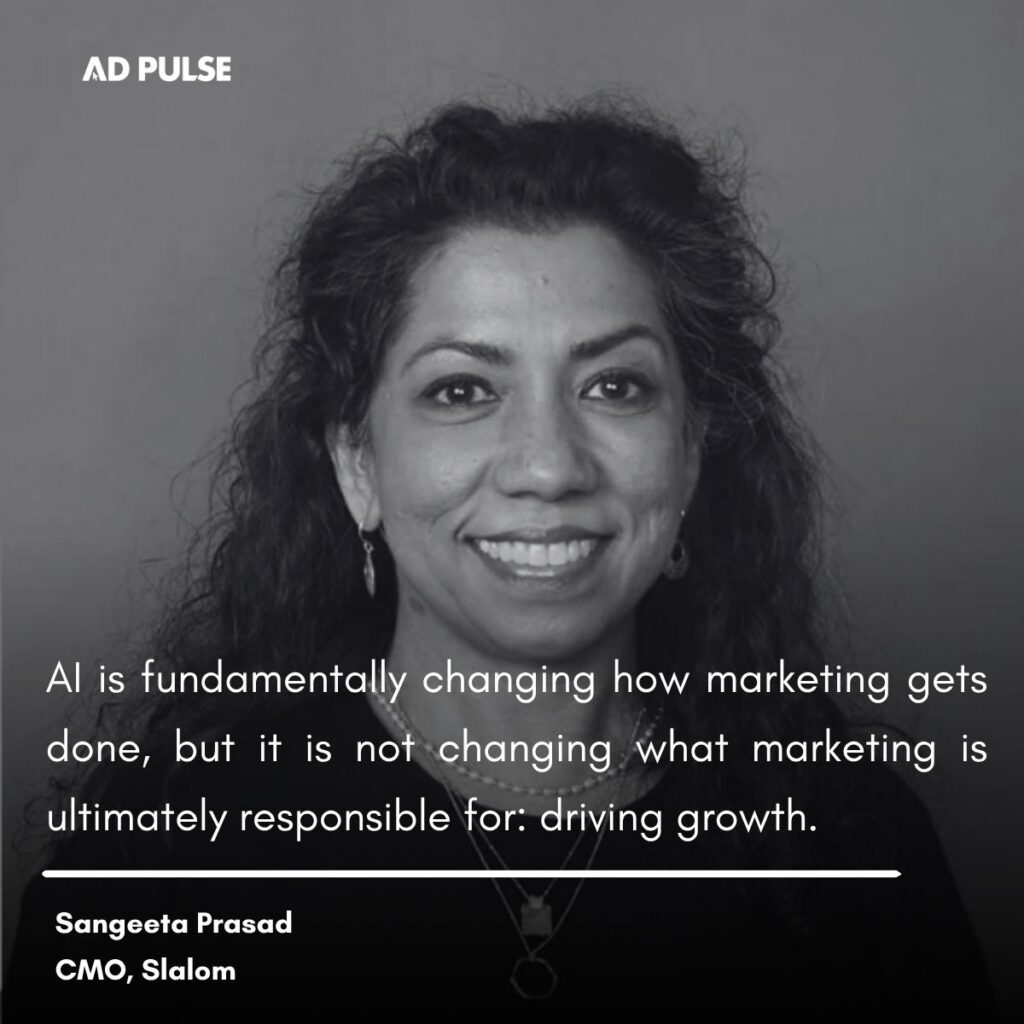
Prasad arrives at nearly the same boundary from a different discipline. Her frame isn’t emotional memory so much as accountability. “AI is fundamentally changing how marketing gets done,” she says, “but it is not changing what marketing is ultimately responsible for: driving growth.”
Setting vision, understanding customers, making strategic trade-offs, and aligning the organization around business outcomes — in her view, none of those translate into a model. AI can plan campaigns, generate content, and optimize execution; leadership, judgment, and accountability, she says, remain uniquely human.
“The winning brands won’t necessarily be those creating the most content, they’ll be those creating the strongest emotional impact.”
Vanessa Chin, System1
Marketing doesn’t get outsourced to an algorithm
If AI is doing more of the work, does the CMO’s job eventually become managing the AI itself — owning the company’s AI operating model rather than marketing properly? Both leaders reject the framing, though from different angles.
For Chin, the objection is almost philosophical: consumers don’t buy because an algorithm tells them to. “AI should not become a standalone operating model that’s disconnected from the customer,” she says. Instead, she wants CMOs using AI to understand consumers faster, test ideas at greater scale, and allocate investment more efficiently — reducing guesswork without replacing judgment.
“The most successful CMOs will be the ones who use AI to get closer to consumers, not further away from them.”
It’s a version of the same boundary Prasad draws when she describes the CMO’s evolving role as connecting people, data, technology, and teams, so marketing functions as a genuine growth engine — not a showcase for whichever AI tools the company has bought.
The skills that get more valuable, not less
Ask either leader about which human skills matter more as AI adoption accelerates, and the lists barely need translating between industries.
Chin points to creativity, empathy, cultural intelligence, and judgment — the qualities, she says, that separate great marketers once every brand has access to similar tools. “You can’t prompt your way to a feeling,” she says. “Technology can help identify patterns, but people still decide what stories are worth telling, what ideas are worth pursuing, and what will resonate emotionally with consumers.”
Prasad’s list runs to curiosity, influence, communication, creativity, and the ability to navigate ambiguity. Her framing is pointed: “AI is changing the work, but humans still write the brief.” She sees an opportunity in that, not just a defense of it — a chance to reimagine what the marketing role could be, rather than simply using AI to make today’s work faster.
“Technology fluency will absolutely matter, but human skills will be what elevates technology, not the other way around.”
Sangeeta prasad, CMO, Slalom
AI doesn’t fix broken organizations, it exposes them
Integrated marketing has been a stated goal for at least a decade, and silos, misaligned teams, and underinvestment in brand building have persisted anyway. Prasad’s diagnosis is that AI doesn’t solve that problem — it makes it visible faster than anything that came before it.
“AI exposes fragmentation,” she says. “If your systems are disconnected, your data is not accessible, or your teams are not aligned, AI will only amplify those challenges.”
Slalom’s own research backs up: 57% of CMOs cite workforce skill gaps as a top barrier to realizing AI value — evidence, in her view, that successful transformation is as much about people as it is about technology.
That diagnosis lines up with what’s surfacing elsewhere in the industry this year. An IDC survey cited in Microsoft’s research on what it calls “Frontier Firms” found GenAI adoption is now widespread — around 68% of organizations use it in some form — while only 22% qualify as Frontier Firms with the operating discipline to convert that adoption into measurable business value. The gap, the research suggests, isn’t the technology; it’s whether decision rights, governance, and data foundations were redesigned around it or simply left in place underneath it.
Impact at Cannes Lions 2026
At Cannes Lions 2026, that same gap got a sharper name. Analyst Weronika Oesterreicher argued that AI tools are accelerating already-flawed media strategies because the leadership evaluating them often lacks the technical-commercial literacy to govern them — a dynamic she traced to a kind of executive FOBO, or fear of being obsolete, that pushes boards to treat AI adoption as a procurement decision rather than an architectural one.
Nestlé Canada’s CMO, Tracey Cooke, raised a related warning from the same stage: chasing AI too aggressively, without a distinctive brand foundation underneath it, risks producing marketing that is efficient and interchangeable at the same time.
Prasad’s closing point ties the diagnosis together: brand becomes more valuable, not less, in an AI-driven world. “AI can help create content, but it can’t create authenticity or earn trust,” she says. A clear brand purpose, in her view, is now the foundation for every customer interaction — and every business decision that follows it.
“AI exposes fragmentation. If your systems are disconnected, your data is not accessible, or your teams are not aligned, AI will only amplify those challenges.”
— Sangeeta Prasad, Slalom
Where the next two quarters go
Asked where she expects leading brands to spend, and where they’ll pull back, over the next two quarters, Prasad points toward deeper customer understanding —
- connecting with people at the moment
- channel that actually matters to them
- and a shift from discrete campaigns toward always-on marketing that can respond to customers in real time
She expects brands to get more disciplined about AI itself, treating it less as a destination and more as a tool for delivering on a vision that’s already set, which means investing first in the unglamorous foundation: clean data, connected systems, adaptable organizations.
And she expects marketing org charts to keep changing, as brands restructure agility rather than defending the org chart they already have.
The common ground
Chin and Prasad – their vocabularies, reference points, and even the shape of their answers differ throughout. But set side by side, a System1 executive built around emotional measurement and a Slalom executive built around enterprise transformation land on the same three commitments: AI absorbs execution, not judgment; brand trust becomes more valuable as content gets cheaper to produce; and the CMO’s real job is increasingly to connect — customers to brand, and teams to outcomes.
As Prasad puts it, “Marketing is no longer adjacent to growth, it is increasingly expected to help shape it.”
Chin’s version of the same idea is more emotional than operational, but it points the same direction: “The CMO’s job is to create those feelings and reinforce them consistently over time.”
Between the two, that’s a fairly complete description of what’s left for a CMO to do once the AI is doing everything else.
Meet the Speakers
Leads System1’s global marketing strategy, focusing on brand growth, AI-powered marketing, and expanding the company’s presence across the U.S. market.
Leads external and internal marketing at Slalom, bringing leadership experience from Russell Reynolds Associates, JPMorgan Chase, American Express, and Procter & Gamble.