

Is AI Overhyped: The Productivity Promise That Hasn’t Paid Off—Yet
Despite massive investment and widespread adoption, the data on AI’s real-world productivity impact is far messier than the marketing suggests. That raises the question, ‘Is AI overhyped?’
Everyone is using AI. Almost no one is getting paid more for it. And the economy, stubbornly, isn’t moving much faster because of it. That’s the uncomfortable reality emerging from two new reports, one surveying B2B marketing professionals directly, and one digging into the broader economic data.
Together, they paint a picture of a technology that has dominated boardrooms and budgets without yet delivering the transformational productivity leap its advocates promised.
In this article, we will dig deep to find the answer to ‘is AI overhyped’.
Adoption is wide, while the impact is narrow
Start with the numbers that should give pause. According to the 2025 B2B Tech Marketing Salary & AI Career Impact Survey, prepared by Metadata.io and VPMarketing.com, a full 90 percent of B2B marketers have moved beyond experimentation and actively use AI in their work.
More than half (56 percent) use it regularly for specific tasks, and 22 percent say it is integrated into their daily workflow. On the surface, this looks like a success story.
But scratch deeper, and the cracks appear.
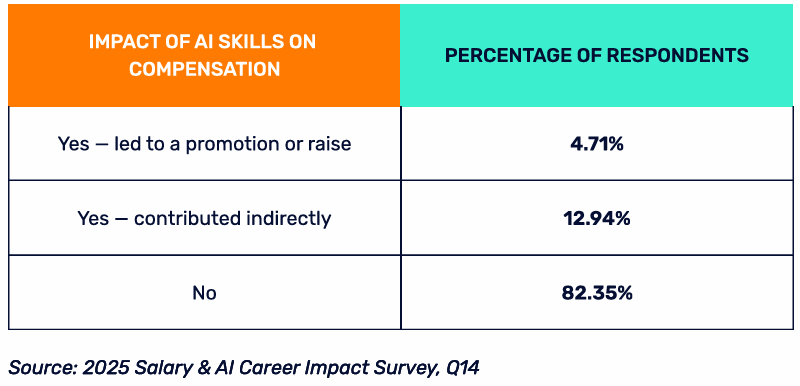
The same survey found that 82 percent of respondents have seen no impact on their compensation from their AI skills. Only 4.71 percent report that AI proficiency led to an explicit promotion or raise.
While 58 percent expect AI skills to command a salary premium in the next one to two years, the present reality is that most marketers are investing time, energy, and often their own money. 70 percent are self-funding their AI education with no employer support and receiving little financial recognition in return.
This gap between adoption and reward is more than just a compensation story. The productivity gains are also proving difficult to measure, uneven in practice, and smaller than the hype suggests.
The productivity illusion
EMARKETER analysts Jacob Bourne and Grace Harmon, speaking on the Behind the Numbers podcast in March 2026, put it plainly: the impact of AI on productivity is “incremental and task-specific rather than broadly transformational.”
Bourne noted that AI’s speed creates what he called an illusion of productivity; the output arrives fast, but the human review process required afterward, checking for errors, correcting context, and validating outputs, can erode those gains substantially.
The macroeconomic data backs up. Bureau of Labor Statistics figures show that US non-farm business productivity in 2025 was slightly lower than the five-year average from 2020 to 2024, a period before GenAI went mainstream.
Researcher Jason Furman of Harvard estimated that roughly 90 percent of GDP growth in the H1 of 2025 came from data center and AI infrastructure spending, not from productivity improvements in the broader economy.
Research from the Federal Reserve Bank of San Francisco found that once those capital investment effects are stripped out, underlying productivity gains come close to zero. Meanwhile, only 10 percent of US businesses reported a letup in AI usage in any capacity, according to Census Bureau data cited in a WSJ analysis.
EMARKETER forecasts that by 2029, more than half of Americans still won’t use genAI. The technology is not yet widespread enough to move macro-level productivity numbers, even if early adopters are seeing task-level benefits.
The hidden trade-offs
What makes this conversation more complicated is that some workers are experiencing genuine speed gains and are penalized for it.
An eight-month Harvard Business Review field study of 200 workers at a US tech firm, cited in EMARKETER’s analysis. It found that employees who learned AI voluntarily saw their work speed up but also watched their responsibilities multiply. AI-assisted tasks spilled into more working hours, not fewer.
This mirrors what the Metadata.io survey found on the organizational side. While 79 percent of marketers say AI functions as a productivity multiplier, 38 percent of companies have nonetheless reduced their marketing headcount in the past year.
Nearly 26 percent of respondents say their employer has explicitly or likely made AI-related cuts. Rather than using AI gains to free teams up for higher-value work, many executives are deploying productivity arguments to justify doing more with fewer people and less pay.
| Approach | What They Do | Short-Term Impact | Long-Term Outcome |
|---|---|---|---|
| AI + Talent Investors | Combine AI tools with skilled teams and strategic thinking | Faster execution, better decision-making | Sustainable competitive advantage |
| AI as Cost-Cutting Tool | Use AI to justify layoffs and reduce headcount | Immediate cost savings | Weak strategy, loss of depth, declining performance |
What companies actually value, data answers
For marketers wondering where to focus their energy, the Metadata.io survey offers a clear signal.
When asked what proficiency employers value most, 76 percent of respondents cited the ability to use AI tools to increase productivity or reduce costs. That beat out applying AI in analytics and customer insights (45 percent) and leading AI strategy or integration projects (38 percent).
| Priority Rank | What Companies Value | Percentage | What It Really Signals |
|---|---|---|---|
| 1 | Strategic thinking & business impact | 69% | Outcomes > tools |
| 2 | Productivity & efficiency | 64% | Execution still matters |
| 3 | (Implied others in between) | — | Skills beyond just AI |
| 4 | AI proficiency | 30% | AI is a tool, not the strategy |
The implication is pointed out: AI skills matter most when layered on top of strategic judgment, not as a substitute for it.
The marketers who are feeling most secure, the 11 percent who say they are more confident in their careers than a year ago, are not simply the most AI-proficient. They are the ones combining AI fluency with the kind of analytical thinking and business acumen that tools cannot replicate.
The anxiety that doesn’t show up in productivity reports
The EMARKETER analysts raised a dimension that rarely surfaces in productivity debates: the psychological toll of rapid, politicized AI change.
Bourne noted that the rapid pace of AI is paradoxically slowing adoption. Workers are stuck in juggling anxiety about keeping up, uncertainty over tools, and pressure to deliver speed gains that may not even happen.
Another EMARKETER analyst, Grace Harmon noted that anxiety is leading some young workers to quietly undermine AI initiatives. They under-report effectiveness or intentionally deliver subpar outputs to avoid being seen as replaceable.
A recent Anthropic study analyzing 10,000 AI conversations found that only 9 percent of users’ fact-checked outputs, while 16 percent questioned the reasoning. The gap signals growing over-reliance and a potential hit to real productivity.
This counterproductive behavior is a rational response to an environment in which productivity gains are being used to justify job losses rather than reward contribution. As long as that dynamic persists, the gap between AI’s promise and its measurable impact will remain difficult to close.
Cut to the chase
The data from both reports converge on the same uncomfortable conclusion: AI adoption in marketing and the broader workplace is real, widespread, and generating genuine task-level benefits for many practitioners.
For B2B marketers in particular, the path forward is not to resist AI or to oversell it, but to invest in the strategic skills that make AI outputs meaningful. It is to push back on organizations that treat efficiency gains as an excuse to compress teams rather than an opportunity to do better work.