Facebook Privacy Settlement: The $725M Wake-Up Call Marketers Can’t Afford to Ignore
Every marketer wants to have better targeting capability. At the same time, every consumer wants privacy. These two factors are colliding with each other faster than ever before.
For years, digital advertising has depended on collecting, tracking, and analyzing huge amounts of personal data. Most users were unaware of how much information reaches companies and how that information affects the ads they see. The lack of transparency has become one of the biggest problems for the advertising industry today.
Facebook’s $725 million privacy settlement is not simply a new case in court. It is a signal for every advertiser, platform, and brand that has relied on personalized advertisements.
The settlement confirmed the reality that has been developing for some time, the future of advertising cannot be based on the unlimited use of third-party data. Instead, we need to talk about trust, transparency, and consent. Let’s take a closer look at why this settlement matters and what it means for the future of ad targeting.
The Facebook privacy settlement that changed the conversation
The Facebook settlement, worth $725 million, has ended the years-long class action lawsuit that accused Meta of improperly sharing user information with third parties, particularly in light of the Cambridge Analytica scandal. Although Meta denied the allegations, this settlement has become one of the largest decisions on privacy rights in U.S. history.
The essence of this litigation was that users believed their confidential information should be protected, while technology firms such as Meta did whatever they pleased with their data.
- Facebook and others have seen it as more than just a legal battle.
- It showed that regulators, consumers, and the courts expect companies to act responsibly and take care of their users’ privacy.
- This all changes the overall discussion about data collection from the question of whether companies can collect data from their users, to whether they even should do it or not.
This change will have a big impact on digital advertising in the future.
Why this matters beyond Facebook
At first, marketers thought the Facebook lawsuit over data privacy would be a matter of the platform rather than one with general consequences.
But it turns out not to be the case. The same issues of privacy are now present in practically all areas of digital advertising.
- Google is limiting cross-site tracking.
- The company Apple has implemented App Tracking Transparency (ATT) to track users only after they give permission.
- Around the world, governments are tightening the rope of privacy regulations.
- Consumers are becoming increasingly careful about what information they share.
Thus, one can conclude that advertising is becoming more about explicit consent-based tracking rather than invisible tracking technologies.
Brands that prepare earlier will gain greater advantages than those that wait for the next law.
Consumers are paying more attention than ever
Privacy has become an aspect of customer experience.
Today, consumers realize the importance of their data. They inquire why a particular advertisement is shown to them, what information a company with access to their data collects, etc.
- Such worries are not limited to privacy activists.
- More and more consumers choose brands that care for their personal information.
- Trust has turned into a measurable business resource.
When customers trust the company due to its respect for their privacy, they are more eager to share their information.
The end of unlimited third-party tracking
For almost two decades, the widespread use of third-party cookies has been an essential segment of the digital advertising ecosystem.
With these cookies, advertisers have had the capability to trace users across the internet, construct accurate profiles, and create tailor-made ads.
That model is steadily disappearing.
Browsers, mobile operating systems, and privacy regulations have all reduced advertisers’ ability to track users without explicit consent.
This doesn’t mean personalized advertising is disappearing.
It means personalization is evolving.
Instead of relying primarily on third-party tracking, brands are investing in direct customer relationships and consent-based data collection.
Why first-party data is becoming marketing’s most valuable asset
The migration to a first-party data approach is among the major changes occurring in marketing today.
As Kevin Dunn, Chief Revenue Officer, Experian said, “The marketers making the most progress today are the ones building flexibility into their data and identity strategies.”
First-party data refers to data shared by customers willingly through:
- Website registration
- Newsletter enrollment
- Buying records
- Loyalty schemes
- Customer service communication
- Mobile apps
- Event registration
Compared to third-party data, first-party data comes from a customer’s direct interactions.
First-party data is generally:
- More precise
- Better controlled
- Easily manageable
- More private
More appropriate for personalized marketing in the future
Rather than purchasing audience segments from multiple vendors, as successful companies do, businesses build their own audiences.
Zero-party data vs. first-party data: What’s the difference?
As privacy becomes increasingly important, marketers are also discussing zero-party vs first-party data.
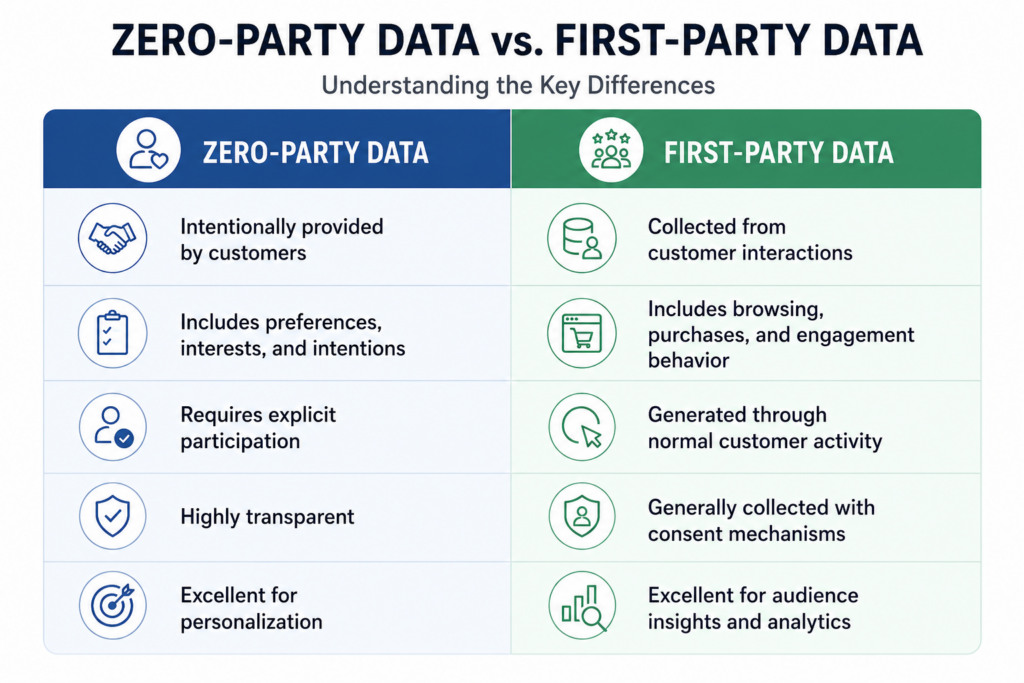
For example, Many Shopify brands are using interactive product quizzes to gather zero-party data, such as customers’ wishes and goals. At the same time, the customers’ actions, like browsing, purchasing, and returning, allow the brands to gather the first-party behavioral data. Hence, both empathy and data collection can go hand in hand without causing trouble in the era of cookieless life.
Privacy-focused advertising is becoming better advertising
Initially, marketers expressed concern that increased privacy measures would reduce the effectiveness of advertising campaigns.
However, this is not the case.
The practice of privacy-centric marketing forces marketers to:
- Increase creativity
- Deliver messages that resonate better
- Build relationships with consumers
- Gain the trust of consumers
- Implement contextual targeting instead of dispassionate tracking
By using valuable content rather than anonymous users across numerous websites, more and more brands are choosing to target their desired audience through loyalty programs, communities, and media properties owned by the brand.
This leads to more meaningful communication with customers.
How Facebook ads targeting works after privacy changes
Due to privacy changes, it is understandable that many advertisers are unsure of how Facebook advertisement targeting works.
With the help of sophisticated targeting capabilities, advertisers now gather information on privacy-based signals.
These include the use of:
- Audiences uploaded by customers
- Engagement with Facebook and Instagram content
- Actions taken on Facebook
- Making use of conversion APIs
- Using aggregated event measurement
- Having AI in place
- Using customer information-based on providing consent.
The future of ad targeting without cookies
Without the use of cookies, the next stage of targeted advertising is entirely different from that of the last ten years. Here are some of the new options:
AI-driven predictive targeting: Using aggregated data patterns instead of tracking single individuals, machine learning models identify buyers.
Contextual advertising: Advertising is determined by the content that consumers provide, instead of their previous online behavior.
Retail media networks: Retailers monetize their purchase history to provide advertisers with relevant audiences, while adhering to data privacy regulations.
Clean rooms: Platforms that protect privacy by giving brands and publishers an opportunity to analyze audience overlap without sharing private consumer data.
Consent-first personalization: Consumers increasingly control how their data can be used and what kind of ads they should analyze.
What this means for programmatic advertising
Advertising using programmatic technology remains constant. It is simply changing the form. The effectiveness of programmatic advertising will depend on how well it incorporates:
- Audience Modeling with the Help of AI
- Contextual Intelligence
- Privacy-Friendly Identifiers
- Relations With First-Party Publishers
- Consent Management Tools
- Secure Data Collaboration Solutions
Advertisers will stop using commercial databases and instead increasingly use trusted data in a compliant environment. In conclusion, programmatic purchasing becomes more intelligent and less intrusive.
What brands should do next?
The Facebook privacy lawsuit offers several insights for marketers.
Make sure to put first-party data collection at the top of your priority list. Don’t forget to connect to customers directly via subscriptions, loyalty programs, membership, and useful content.
Make communication transparent. Ensure that customers know what data you collect from them, why you collect it, and how they benefit from it.
Use AI responsibly. Machine learning is very effective and helps marketers target customers correctly without violating their privacy principles.
Use multiple advertising channels. It is better to use email, communities, websites, and owned media rather than rely heavily on one advertising platform.
Make privacy one of the factors of your brand. More and more customers appreciate companies that take good care of their data.
Cut to the chase
The Facebook privacy settlement marks a significant change in the world of digital advertising—from monitoring individuals at all times to gaining their trust. Companies that focus on first-party data, transparency, and consent-driven private advertising will have the upper hand in the age of privacy.
FAQ’s
It was a $725 million settlement resolving claims that Meta improperly shared user data with third parties.
It encourages brands to rely more on first-party data, transparency, and consent-based advertising.
First-party data is information collected directly from customers through interactions like purchases, website visits, and sign-ups.