

Explainer: The Internal Challenges Limiting Marketing’s Multiplier Effect
The Multiplier Effect research by WARC makes a compelling case for integrating brand and demand marketing. Brands that combine the two consistently outperform those treating them as separate disciplines.
Yet understanding the theory is much easier than putting it into practice. For many organizations, the real barriers are not creative or media-related at all. They are structural, cultural, and operational.
WARC identifies eight common blockers that prevent brands from realizing the multiplier effect. Together, they explain why so many companies struggle to turn an evidence-backed strategy into everyday marketing practice.
Let’s find out what each one looks like in practice, why it happens, and how to dismantle it.
PS: We will list the blockers in 3 categories, and in each category, you can find the challenge and its fix.
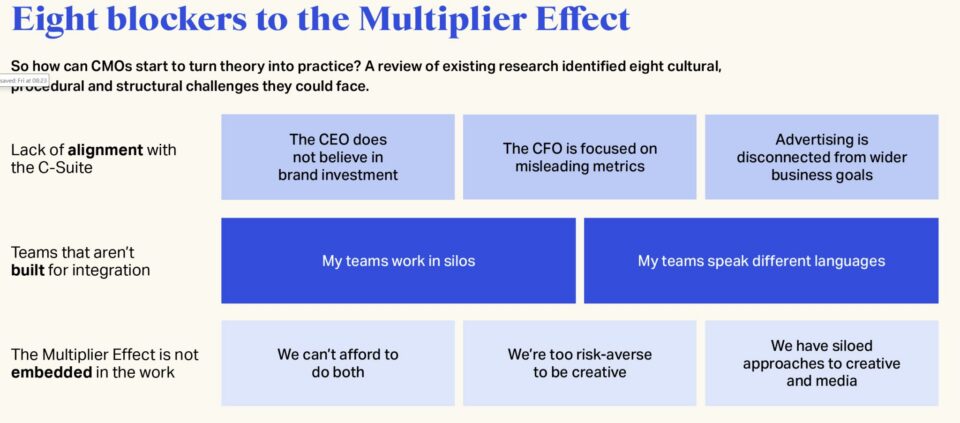
Category 1: Non-aligned Leadership
Even the strongest marketing strategy struggles without executive support. When CEOs, CFOs, and business leaders measure success differently from marketers, integration rarely survives beyond the planning stage.
Blocker 1: The CEO does not believe in brand investment
Nowadays, brand investment has fewer takers. One of the recent cases is Unilever’s influencer marketing budget. The brand is pouring money on influencers and creators, but very little on branding. This is more common than the industry would like to admit. The logic behind no-brand-investment-psychology was born in the post-pandemic era.
Blocker 2: The CFO is focused on misleading metrics
CFOs are optimizing for what can be measured, and in most organizations, that means short-term ROAS, cost per acquisition, and quarter-over-quarter revenue. Brand-building investment does not show up cleanly in these dashboards. Its returns are diffuse, delayed, and largely invisible to attribution models that can only read last-click conversions.
Blocker 3: Advertising is disconnected from wider business goals
When advertising disconnects from business strategy, the multiplier effect cannot function because the amplification has nowhere to go. You might generate demand for something the business is not prioritizing or build brand associations that actively conflict with the company’s actual strategic direction.
CATEGORY 2: Teams that are not built for integration
Executive buy-in solves only part of the problem. Many organizations remain structured in ways that make collaboration difficult, leaving brand and performance teams operating as parallel businesses rather than one marketing function.
Blocker 4: Teams work in silos
In most large organizations, brand teams and performance teams are separate functions. Different managers, different budgets. Different agency relationships. A campaign can be technically “integrated” at the brief stage and completely fragmented by the time it reaches execution.
A brand campaign runs across TV and out-of-home with one message. The performance team simultaneously runs social and search with discount-led messaging that directly contradicts the brand narrative. The result is just pure noise.
Blocker 5: Teams speak different languages
Brand teams speak in terms of emotion, salience, storytelling, and resonance. Performance teams speak in CPMs, CTRs, ROAS, and conversion rates. When these two groups are in the same room, they often function unintelligible to each other.
And it produces organizational friction that slows decision-making, breeds mutual distrust, and prevents the kind of collaborative creative development the multiplier effect requires.
CATEGORY 3: The multiplier effect is not embedded in the work
Even with aligned leadership and collaborative teams, the multiplier effect can still fall apart during execution. The strategy has to be reflected in creative development, media planning, and budget decisions.
Blocker 6: “We cannot afford to do both”
The assumption is that brand-building and demand-generation require separate, substantial budgets. The reality is that the multiplier effect specifically about making a given budget work harder — not about having a bigger budget.
Binet and Field’s research through the IPA consistently shows that brands attempting to do both; with integrated creative and media planning — outperform those exclusively prioritizing one or the other. The 60/40 ratio they identify as broadly optimal (60% brand, 40% activation) is a call for smarter allocation of the money.
Blocker 7: We Are Too Risk-Averse to Be Creative
Performance marketing has made risk quantifiable and therefore manageable. You can test creative, optimize toward winners, and kill losers quickly. But when the playbook is “test and optimize,” the incentive is to produce creative that is safe enough to test, not creative that is bold enough to build a brand.
Dollar Shave Club’s original launch video is the counterexample everyone points to for a reason. It was a genuine creative risk — irreverent, cheap-looking by conventional standards, and entirely out of step with how grooming brands had communicated for decades. It worked because it was distinctive, and earned attention rather than simply buying it. Crucially, it also drove direct conversion. Brand and demand are inseparable from a single piece of creative.
Blocker 8: Siloed Approaches to Creative and Media
The multiplier effect is at its most powerful when creative and media strategy come together. It is not when a creative concept is handed off to media planners after it is locked, or when media teams optimize placements that were never built for the channels they are running on.
A vertical video built for TikTok will perform differently in a static Facebook placement. A 30-second TV spot compressed into a 6-second pre-roll loses most of what made it effective. A campaign creative brief written without knowledge of where the work will actually live produces assets that are technically present across channels but strategically incoherent.
WARC explains where organizations get stuck. But recognizing the blockers is only half the equation.
To understand how brands can overcome them, we spoke with Vanessa Chin, SVP of Marketing at System1, whose research focuses on why advertising loses effectiveness long before it reaches consumers.
How System1 thinks brands can break the cycle
One recurring theme in System1’s research is that dull advertising rarely has a single culprit. Creative decisions are shaped by leadership, procurement, agencies, testing processes, and marketing teams alike.
We asked Vanessa Chin where responsibility ultimately sits.
The false divide that is costing brands on both sides
Perhaps the most persistent structural problem Chin identifies is the industry’s insistence on treating brand building and performance marketing as separate disciplines with competing objectives. The tension is real — brand teams chasing emotional resonance, performance teams chasing clicks — but Chin argues the framing itself is part of what produces dull advertising.
“A lot of the tension comes from treating brand building and performance as isolated disciplines, when the strongest brands know they need both,” she said. “Not necessarily in the same campaign but working together as part of the same growth strategy.”
The data bears this out. Strong brand campaigns create future demand. Performance campaigns convert it. Running them as separate operations means neither delivers its full potential.
When pressed on what a CMO should actually change first, her answer is direct. “Stop treating emotion and sales as opposing forces. The strongest campaigns skew towards showmanship because emotion drives memorability and long-term growth, but they do not neglect the fundamentals of selling.”
She flags a failure mode that is common even in emotionally strong work. “A lot of highly emotional campaigns fail because they forget attribution. If audiences remember the feeling but cannot remember the brand, the commercial impact is weakened.” Showmanship without clear brand linkage is, in effect, advertising for the category rather than the brand.
“If audiences remember the feeling but cannot remember the brand, the commercial impact is weakened.”
The resolution, in her framing, is not a formula or a budget split. It is a mindset shift. “The goal is not choosing between showmanship and salesmanship but making sure they work together. Showmanship builds emotional memory and future demand, while salesmanship features ensure that emotion translates into attribution and commercial impact.”
Fixing the system before the strategy
Warc’s study is not pessimistic about the multiplier effect. If anything, its value as a framework has grown as the media environment has become more fragmented, and attribution has become more contested.
But the honest accounting of these eight blockers is a necessary corrective to the idea that understanding the multiplier effect is the same as being positioned to implement it.
Dismantling them requires organizational will more than marketing technique. But for brands that do the structural work — aligning leadership, building integrated teams, and embedding the multiplier logic into how creative and media decisions are actually made — the upside is exactly as compounding as the research promises.
Cut to the chase
The marketing multiplier effect is less about finding a better marketing formula than building an organization capable of executing one. Until leadership, teams, and creative processes begin working toward the same objective, even the best evidence will remain in theory.