
Gen Alpha Marketing Has One Ancient Driver: Pester Power
Gen Alpha marketing has brought panic to the boardrooms of many brands and agencies. Every few months, a new Gen Alpha explainer lands in your inbox. The new digital-natives, AI-first, born into an algorithm, are taking over agencies’ attention. Brands are rewriting consumer playbooks, commissioning fresh research, and hiring consultants to decode a generation that depends on their parents.
The tension between how dramatically this generation is being framed and how familiar the underlying mechanic actually is deserves a hard look. Because the engine brands are activating when they market to Gen Alpha, it has a name, and it is as old as Mr. Potato Head’s first television spot: pester power.
Here’s what you need to know about Gen Alpha marketing: There is no need to panic over it.
Who is Gen Alpha, really?
Gen Alpha is the first generation born entirely inside the era of AI search, social platforms, and always-on content. The internet was their first educator.
A child today may recognize Ms. Rachel and SpongeBob before they see their grandparents. Their frame of reference is built from YouTube thumbnails, Roblox lobbies, and short-form video. That part is genuinely new, but still not very new.
This requires a reframe only if the channel has changed, not the child. Gen Alpha still wants things and asks their parents, but now, the desire is sparked through new platforms.
Migration of ‘pester power’
Cereal mascots led to cartoon-character brand tie-ins, which in turn led to YouTube influencers. The mechanic at every stage is identical: place something desirable in front of a child and let the child ask a parent to follow. The medium rotates. The loop does not.

Precisify’s 2026 Kids USA Insights report, based on a panel of 2,000 US children aged 2–12, puts numbers behind the migration. YouTube drives pester power for 80 percent of kids, with broadcast TV close behind at 78 percent. Influencer content converts just as reliably. 80 percent of kids have asked for a product after seeing a creator talk about it, with toys and games making up more than half of those requests. And 77 percent of parents report their child has asked for something during a co-viewing session.
The ask is the same. MrBeast unboxings have replaced Disney characters eating cereal. New face, same function. Yet, relying solely on influencer strategies presents limitations that are important to address next.
The influencer playbook is incomplete
The brand’s pivot toward influencers is in the right direction. A third of kids aged 6–12 watch influencer content on YouTube, and 76 percent of kids aged 10–12 remember influencer-created ads. That recall is real and earns its media spend.
The mistake is treating influencers as the whole strategy rather than one node in a broader presence. Kids are not only watching creators. They are watching cartoons, playing mobile games, and doing much of this alongside their parents.
A brand that shows up only on creator channels is present for part of the journey, not all of it.
Diversification: not new and not negotiable
Relying only on influencers is limited. Channel diversification matters, but it is not a new idea.
Brands kept moving from radio to television to mall hoardings to pamphlets over the last century. The playbook has always been present where attention lives and adapts the message to fit the medium. What has changed is the number of channels, their rate of adoption, and the age of the audience.
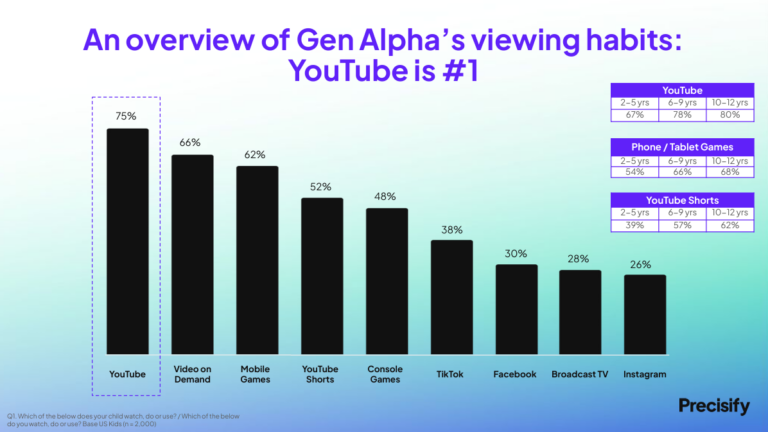
Precisify’s data maps where Gen Alpha’s attention is distributed: YouTube at 75 percent, mobile games at 66 percent, YouTube Shorts at 62 percent, and console games at 52 percent. No brand has ever followed a single-channel strategy.
Here is what the actual channel mix for Gen Alpha marketing looks like — and what each one demands:
- YouTube (Long-Form Video): The dominant platform for every age group in the cohort. For kids aged 2–5, 88 percent of parents say YouTube is preferred over VOD and broadcast TV. Brands need a sustained presence through channel sponsorships, creator integrations, and content that earns organic co-viewing matter.
- YouTube Shorts (Short-Form Video): Adoption climbs sharply from 39 percent among 2–5-year-olds to 62 percent for 10–12-year-olds. 38 percent of older kids watch influencer content on Shorts while second screening. Short-form here is a discovery-and-recall driver that feeds upstream intent.
- Console Gaming and Platforms Like Roblox: Console games reach 52% of the cohort and offer an immersive, longer-session experience. Roblox in particular has become a branded world-building space where experiential marketing, virtual stores, character tie-ins, and limited-edition in-game items translate directly into offline desire.
- AI Search and Conversational Discovery: Gen Alpha is growing in an era where AI-assisted search answers questions before a browser result is clicked. Brand discoverability in AI-generated responses is an emerging priority that most Gen Alpha playbooks have not yet accounted for. The children asking Alexa, Google, or ChatGPT what to watch or what toy to ask for are already here.
- Broadcast TV and VOD: Broadcast TV still drives 78 percent of pester power, nearly matching YouTube. VOD platforms maintain relevance, particularly for co-viewing. Cartoons remain the most-watched content type for children aged 2–9 and the most popular co-viewing category. Character-led branded content here is nostalgia; it is still active and converting.
The message cannot be identical across all of these. A YouTube pre-roll is not a Roblox experience and is not a 15-second Short. Curating messages by medium is standard media planning applied to a broader and faster-moving channel set.
The emerging co-viewing window
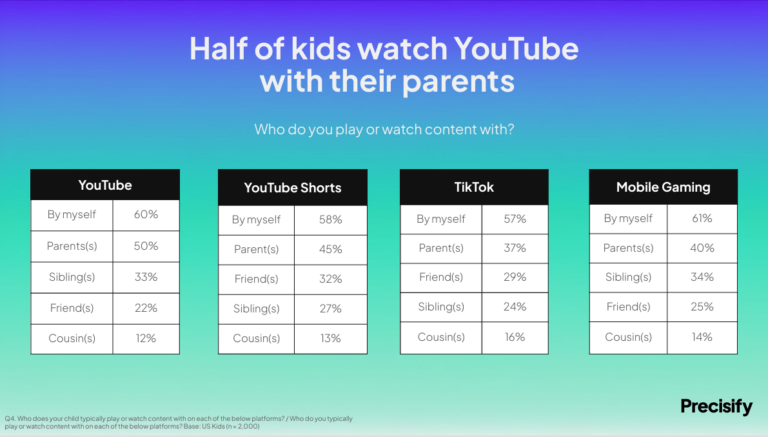
Co-viewing is the most underexplored insight in the Gen Alpha conversation. Precisify’s data shows 55 percent of parents co-view YouTube with their children, with cartoons the most popular shared content type at 48 percent.

Co-viewing is not just a viewing behavior. It is the moment when pester power becomes a live purchase decision — the child sees a product; the parent sees it too, and the ask happens in real time.
YouTube ads drive 50% of parents to make purchases for their kids. This is not a children’s media play. It is a household conversion play. Brands targeting Gen Alpha without building for co-viewing are skipping the most friction-free purchase moment in the channel mix.
As we reach our conclusion, remember that overthinking the Gen Alpha marketing strategy can obscure fundamental truths.
Stop overthinking, start understanding
Brands panicking over “Gen Alpha” are reacting to jargon. The fundamental pattern — children pester, parents buy — is unchanged.
Focus on three recommendations: identify which channels prompt the ask, recognize moments when co-viewing drives purchases, and tailor messages to each medium’s requirements.
The instinct to be authentic, to show up consistently, to let the brand’s character do the work that Disney characters once did. Influencers work because they have replaced mascots, not because this generation is fundamentally different from any child who ever watched Saturday morning cartoons and then asked for what they saw.
Cut to the chase
Gen Alpha marketing is about understanding influence and pester power. Map the loop and place your brand with the right message on the right channels.