
Why Audiences Are Letting AI Choose Their Next Stream
Streaming services like Netflix and Hulu made it possible for viewers to watch content in an endless stream, but now audiences are growing bored of scrolling. With thousands of options to choose from, opening an app may give viewers thousands of potential videos to watch. This is leading viewers to make quick, smart choices about what they want to watch.
This is where AI tools for determining what to watch are going mainstream throughout the entertainment sector. Instead of browsing content libraries manually, audiences are increasingly asking AI assistants questions like: “What should I watch tonight?” “Suggest a funny comfort movie,” or “Recommend something similar to Gone Girl.”
As viewer behavior shifts, AI is transforming content discovery, streaming recommendations, and even the future of entertainment marketing. The streaming economy is no longer just about content abundance — it is about intelligent discovery. Let’s deep dive in.
The scroll fatigue
Streaming has a new problem: the access of content!
We see 100s of 1000s of people arrive and leave platforms like Netflix, Disney+, Amazon Prime, Hulu, HBO Max, YouTube, and smaller social video platforms throughout the day.
Unfortunately, the large number of options has made finding entertainment even more difficult.
In fact, according to research from Gracenote, younger audiences prefer using a conversationally based AI chatbot over regular menu-based streaming services when making their choices of what to watch.
Tyler Bell, SVP of Product at Gracenote, explained this shift perfectly when he said, “People are rapidly embracing AI as a new way to search, discover, and decide what to watch.”
This shift from scrolling to searching is where looking for a solution could be beneficial.
No longer do audiences have a desire to scroll; they now prefer the creative-based recommendations of AI Movie Recommendation Tools and Search Personalization based on mood, context, or intent. Looking for content is no longer about searching for a category; it is more about asking.
AI knows your mood
The traditional recommendation systems have relied on a user’s viewing history to match them with other similar types of programming. For example, if someone watched a lot of action films, then the service will make recommendations based on their action history.
Today’s intelligent recommendation engines exist due to an explosion of data coming from thousands of users. It’s true that traditional recommendation systems have failed to utilize vast amounts of data. Outside of a user’s watch history to help make recommendations.
As a result, users will no longer receive simple recommendations, such as “Here are other recommendations based on what you watched.”
AI will now say to users, “Here is exactly what you should watch based on your emotions in this day and time.”
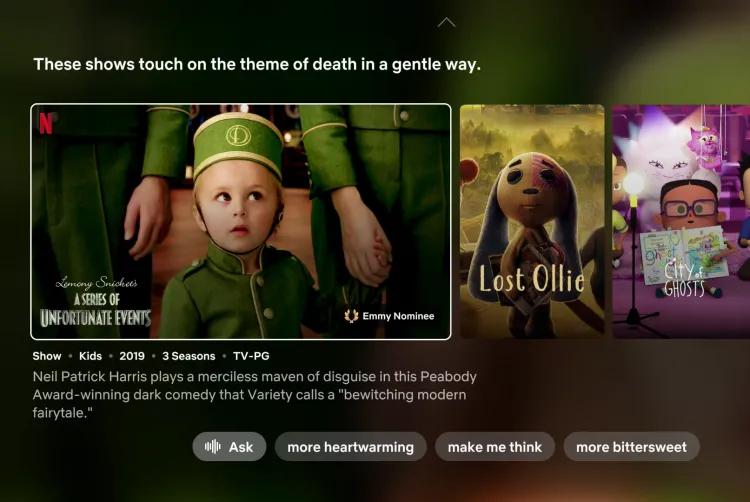
As an example, Netflix has begun testing a new conversational AI search feature that allows users to make specific requests. These requests may include something along the lines of “I would like something cozy,” “Please recommend me an emotional movie,” or “Please recommend me a short, funny movie.”
These new examples prove how AI media streaming recommendations are developing away from simply being algorithms. But now also beginning to serve users as personal digital assistants.
Discovery is leaving the app
The future of content discovery is seeing a major shift from the traditional way of finding content. Where platforms like Netflix and Disney+ offer their own recommendations, to a much more open-ended approach.
AI assistants (Google Assistant and Siri), smart TVs, voice search, and chatbots are rapidly becoming the new point of reference for users looking to discover new content.
According to industry analysts at Looper Insights, AI-powered platforms (like TVs and operating systems) will soon be the primary means by which consumers discover/consume entertainment.
Francesca Pezzoli, VP of Marketing at Looper Insights, captured this future clearly when she said, “By 2026, discovery will no longer live inside apps; it will live above them.”
This represents a significant shift in the entire streaming landscape. In the past:
1. Users opened Netflix to search for Netflix content.
2. Users opened Disney+ to search for Disney titles.
Today:
- Users ask AI what to watch next.
- AI determines where content should be found.
This has fundamentally altered the power dynamic between platforms.
The future of content discovery will be agnostic of the platform. Consumers will care much less about what apps they use and more about instant recommendations tailored to their current mood.
Streaming personalization gets smarter
Emotional intelligence is the focus of the next generation of AI systems in streaming personalization. Currently, AI platforms are successfully identifying and using the following predictive behaviors to inform users about viewing patterns.
- Comfort viewing
- Binge-watching
- Viewing is determined by external stressors
- Weekend vs Weekday
- Seasonal mood of entertainment
An example of how this predictive model works is the difference between a user who opens the application at 12:00 AM and a user who opens it around 12:00 PM. The development and implementation of hyper-personalization are expected to be among the key topics of discussion surrounding artificial intelligence in the entertainment space.
In the future, hyper-personalization could lead to a lack of shared experiences when viewing entertainment; everyone could find themselves in a unique, tailored viewership environment.
In addition to shaping how users view entertainment, recommendation engines and systems will increasingly influence culture.
Recent examples, already happening
There is strong evidence that the transition to using AI as part of marketing strategies for entertainment (such as TV, music, etc.) is underway.
AI Search Development for Netflix: One of the most exciting aspects of Netflix’s current fleet of experience-enhancing innovations is their exploring the use of conversational AI. When it comes to using search, as opposed to using keyword searches to find shows people want to watch. Users can describe how they are feeling or the genre or environment of a show they’d like to watch, using their natural human language.
Utilizing AI to Discover Music on Spotify: In a similar way, Spotify is developing its recommendation/remix features utilizing artificial intelligence, with their publisher group (Universal Music Group). While Spotify is primarily a music platform, its practice modeling aligns with other streaming platforms’ goal to provide entertainment. Without having to manually search for music by utilizing various tools to simplify entertainment experiences.
According to Kiran Mani, CEO – Digital at JioStar, “AI is changing how we discover and interact with entertainment”, and more importantly, users have become accustomed to faster, easier, and more intuitive experiences with respect to entertainment.
These are compelling reasons that conversations surrounding the future of marketing regarding using artificial intelligence to reach audiences in entertainment cannot be ignored.
AI creates a new marketing battle
AI-driven content recommendation systems are changing the way entertainment brands market their movies and television shows. In the past, success relied on factors such as:
- Homepage banners
- Trending lists
- Social media buzz
- Trailer launches
Now, content must work within AI recommendation systems. Studios are increasingly required to have metadata and tagging strategies that are effective for:
- Emotional discovery
- Conversational prompts
- Mood-based recommendations
- AI-readable categorization
In a simple way, marketers must now ask themselves, “How will AI recommend our content?” This is why an AI entertainment marketing strategy is becoming a top priority for both streaming platforms and studios.
It’s possible that tomorrow’s entertainment brands will not only make the most content. But they will also create the most effective recommendations for their content through AI systems.
Too much AI content?
While AI enhances the recommendation of content via AI Streaming, it has also made discovering new content more complicated by providing too much content to choose from. The rate of Generative AI tools is accelerating by creating AI generated:
- Music generated by AI.
- Videos created through AI technology.
- Synthetic Influencers.
- Auto-generated Video Trailers.
- Mass produced entertainment materials.
Streaming Services have already begun to see massive increases in AI-generated content uploads.
This leads to a very strange paradox:
AI creates more content, and AI has now created a need to filter that content. Therefore, future solutions to finding new content will be focused on intelligent curation systems. Rather than simply the volume of content available in streaming libraries.
The future is asking, not browsing
Streaming has taken a long time to make scrolling easy for its users. However, as we can see from the increase in search-by-conversation, instead of searching endlessly through options. Users value quick access, emotional relevance, and convenience over large collections of content.
The use of AI tools to help decide what to watch, AI tools that provide you with recommendations for films. And AI tools that help you search for certain types of content demonstrate that users increasingly prefer quick and easy ways to engage with the media instead of searching through all options.
Moving forward, the streaming landscape will be a much less visible experience.
Users will no longer have to open applications to search. Instead, they will ask AI chat tools how they can fulfill their criteria for their current mood, availability of time, and/or level of energy. Ultimately, the platform that can deliver the smartest answer, in the quickest way possible, will have a significant advantage to win in the battle for future entertainment.
Cut to the chase
Streaming audiences are transitioning from scrolling endlessly through content to utilizing AI to decide what to watch. There are so many possibilities of what to watch that using AI tools to recommend what to watch and discover content using AI will help speed up, improve, and personalize the process of discovering content. As viewer behavior changes, AI is reshaping content discovery, streaming personalization, and the future of entertainment marketing.
FAQ’s
What to watch AI uses artificial intelligence to recommend movies, shows, and videos based on a viewer’s preferences, mood, and viewing habits.
AI analyzes watch history, search behavior, and user preferences to deliver personalized content recommendations.
AI helps viewers find relevant content faster, reducing endless scrolling and making entertainment discovery more personalized.