

What AI Shopping Assistants Mean for the Future of Retail Media?
Online shopping has never offered more choice—but making the right purchase has never felt more overwhelming. Shoppers often bounce between search results, product pages, reviews, and comparison sites before deciding what to buy. AI shopping assistants are changing that by comparing products, summarizing reviews, and recommending the best option in a single conversation.
The shift is already underway. According to Adobe Analytics‘ Q2 2026 AI Traffic Report, traffic from generative AI sources to U.S. retail websites grew 393% year over year, highlighting how quickly AI-assisted shopping is becoming part of the buying journey.
For retailers and marketers, this changes the rules of retail media. As AI becomes the starting point for product discovery, brands will compete not only for search rankings and sponsored placements but also to become the products AI recommends. Let’s dive in.
The rise of retail media changed everything: Here’s how
Retail Media Networks (RMNs) are among the fastest-growing channels of digital advertising. Retailers use their first-party customer data to deliver digital advertisements to brands. With this, they can deliver products to customers at the time when they’re ready to make a purchase. Brands can reach customers through digital advertisements presented via websites, mobile applications, search results, email messages, and connected television.
Retail RMNs have created multi-billion-dollar advertising businesses for retailers such as Amazon, Walmart, Target, and Instacart by turning their e-commerce platforms into major media networks.
Until now, retail media has been primarily associated with searches, categories, and sponsored listings. However, due to the rise of artificial intelligence (AI) as the new starting point for the discovery of products, brands will now be competing not just for ad placements but to be the products that AI recommends.
AI assistants don’t display products. They recommend them.
Instead of typing “running shoes,” customers now ask AI relevant questions. For example: “I’ve got flat feet and I’ve been training for a marathon. My price limit is $150. What shoes do you recommend?
AI shopping assistants find the best shoes to buy based on all the same criteria as traditional search engines (price, user reviews, product specs, customer preferences) but they deliver personalized results as if they were an in-store salesperson instead of a traditional search engine. They help customers compare options and confidently purchase the items they want, all through one conversation.
This is the direction retailers are actively investing in.
As Rajiv Mehta, Vice President of Search and Conversational Shopping at Amazon, explains, “Our goal is to save customers time and money by making online shopping even simpler with real-time information and insights.” Amazon’s AI shopping assistant, Rufus, is one example of how conversational AI is reshaping product discovery.
For brands, this shifts how they think about becoming visible. The new criteria for success will not only be findable but also being the brand/product that AI feels confident recommending.
Conversation is taking over the shopping funnel
For two decades, online shopping followed a familiar journey.
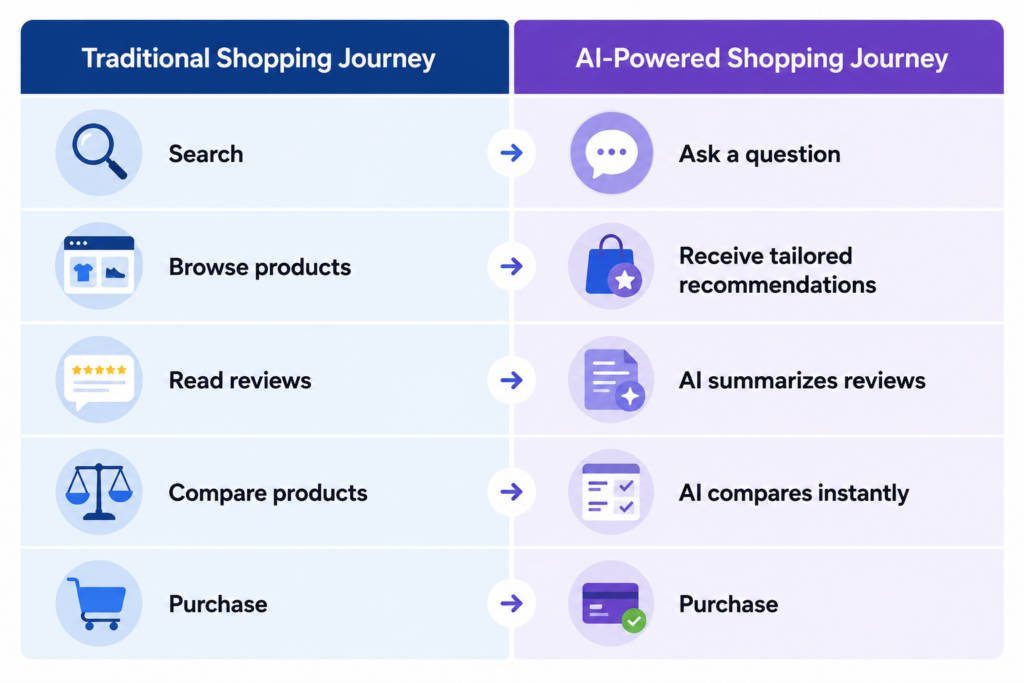
Using a single conversation, AI compresses all of the experience of shopping into one single point.
No longer will customers have to jump back and forth between product pages, product review sites, or price comparison sites — use this same method of communication to ask follow-up questions to their initial question such as, “Does this come in a wide size?” Or “Can you help me find a less expensive alternative?”
AI shopping is not limited to retailers
Before entering an online store, customers are increasingly starting their purchasing trip outside of retailer’s websites, utilizing AI assistants to compare products, summarize reviews, and receive tailored suggestions.
Consuming products, for example, are also being researched via platforms such as ChatGPT. Consumers can use these platforms to compare products, as well as receive customized purchasing advice via chat.
Google is also expanding into AI Mode, where consumers can compare products, refine their decision-making process, and discover brands within Search prior to clicking through to a retailer’s site.
Collectively, these platforms will represent a broader movement from retailer-first to AI-first product discovery.
AI product recommendations are becoming the new digital shelf
Today’s AI assistants (e.g., Siri, Amazon Alexa) are helping customers discover products. Tomorrow, however, Shopping Agents powered by Artificial Intelligence could help consumers actually complete their purchase. A consumer’s purchase experience will improve significantly when purchasing agents are able to not only answer their questions but also provide continuous support with:
- Monitoring prices across multiple retailers
- Comparing product features, prices, and availability to get the best deal on the desired item
- Automatically applying discounts when available
- Automatically placing an order based on the shopper’s preferences and budget
Today’s brands are focused on optimizing their search ranking. With the evolution of AI shopping assistants to purchasing agents, however, brands will need to focus their marketing efforts on securing a position within AI-generated recommendations.
Amazon exhibits where this is heading
AI assistance to shopping is evolving rapidly at Amazon, a retailer that provides one of the clearest examples of this evolution.
Rufus, Amazon’s AI shopping assistant, helps shoppers compare products, understand product classifications, answer questions about what would work best for their needs, summarize customer reviews, and recommend products that match their preferences or provide solutions to their problems.
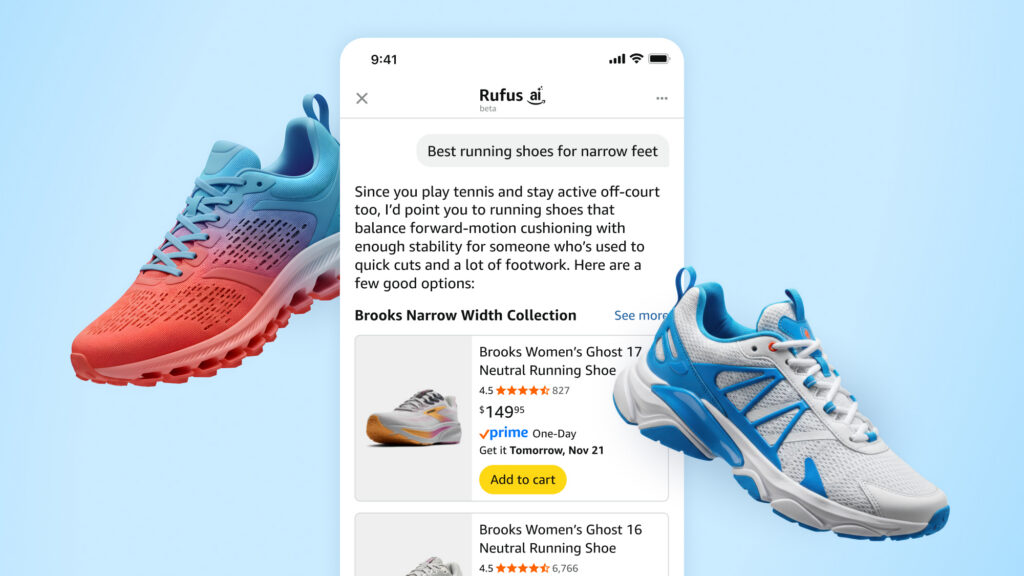
Currently, Rufus is only found in the Amazon ecosystem; however, it is a small representation of where the AI shopping assistants throughout the industry are headed.
Brands will need a new optimization strategy
The opportunity is vast; however, so is the challenge. If brands provide AI recommendations through an advertising lens, rather than being relevant to that particular shopper, it may cause consumer trust to break down. Achieving a balance between monetizing to offset costs, while at the same time being open and credible, will be the key to success.
As brands start using AI as a source for discovery, optimization will need to occur not only for engines but also for AIs to make recommendations—this new piece of terminology is called AI Optimization (AIO) or Generative Engine Optimization (GEO).
AI will likely favor products that have rich descriptions, structured and complete data, trustworthy and authentic reviews, accurate specifications, well-designed images, and up-to-date prices and inventory. Therefore, in this new world, success will be measured by the completeness, accuracy, and credibility of product content rather than keywords.
The future belongs to trusted recommendations
Trust will be as important as intelligence in determining how successful the future of AI will be in terms of commerce. If consumers can easily tell the difference between organic and sponsored recommendations made by AI shopping assistants, they will be more likely to trust them.
Trust can quickly diminish when paid placements are given priority over relevancy. Retailers need to balance revenue generation and provide trustworthy information to their customers.
Ultimately, the long-term victors will not only be those with large amounts of marketplace inventory, but also retailers that provide customers with relevant, truthful, and transparent information.
Cut to the chase
As shopping becomes conversational, winning AI recommendations may become more valuable than winning search rankings. Brands that invest in trusted product data, transparency, and relevance will be best positioned to influence tomorrow’s buying decisions.
FAQ’s
An AI shopping assistant helps shoppers discover, compare, and buy products through personalized, conversational recommendations.
They analyze product data, reviews, and shopper preferences to recommend the most relevant products, making purchase decisions faster and easier.
As AI becomes a key product discovery channel, brands must optimize their product content and data to increase their chances of being recommended.