

The Long-Form Content Comeback: Why Depth Is Winning Again
For years, marketers have been told that attention spans are shrinking. The logic seemed simple: shorter videos, shorter posts, shorter everything.
Yet some of the most successful content formats today are moving in the opposite direction.
Three-hour podcasts attract millions of listeners. Newsletters are building loyal paid audiences. Long-form YouTube videos regularly outperform traditional media productions. Even as short-form content dominates feeds, consumers are increasingly making time for content that offers something many social platforms struggle to provide: depth.
The resurgence of long-form content isn’t a rejection of short-form media. Rather, it’s a response to an internet overflowing with surface-level information. As audiences become more selective about where they spend their attention, context, expertise, and original thinking are becoming increasingly valuable.
So, what is driving this resurgence of long-form content? And what does that mean for both brands and creators? Let’s dive in.
What counts as long-form content today?
Long-form content provides an in-depth analysis of the subject rather than a simple overview.
Generally accepted definitions of long-form content vary, but typically you will find articles with more than 1,000 words; newsletters with in-depth content; research papers; white papers; podcasts (longer than 20 minutes each); documentaries (features or short); and much longer videos (such as those found on YouTube or similar sites).
Long-form and short-form differ greatly in how quickly you can consume the information contained within. Short-form content is intended for quick consumption and will be educational, entertaining, analytical, and provide more extensive engagement.
Long-form content provides brands the opportunity to establish themselves as an authority in their industry, which in turn gives the audience a much more comprehensive understanding of a topic than is usually found on the web
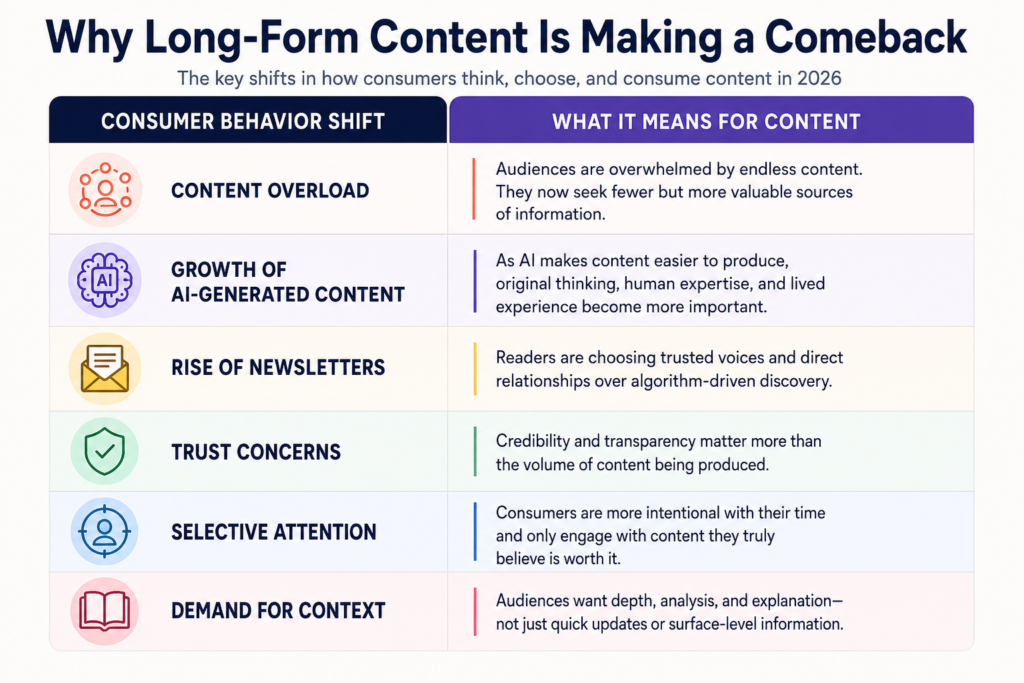
Content overload created an opening for long-form content
Today, more than ever before, there is an abundance of content available online.
Generative AI has made it easier for publishers to generate content across multiple channels. Social media platforms are now filled with similar advice, recycled opinions, and virtually identical content. As a result, consumers are becoming increasingly selective about where they invest their attention.
According to marketing and communications strategist Julien Ricciarelli-Bonnal, audiences are shifting away from endless streams of information and seeking trusted sources that provide structure and insight. He argues that people are no longer looking to consume more content—they are looking to understand more deeply.
This shift in mindset accounts for the increasing popularity of long-form content.
As the ability for anyone to create content continues to grow, depth has become one of the few remaining competitive advantages.
More and more, consumers are valuing articles that go into great depth and are written by experts as evidence of expertise and credibility. Instead of scrolling through numerous fragmented posts from different sources, they want to go to one place to see how they all connect.
Short-form wins attention. Long-form builds trust
Short-form and long-form content are often compared to determine which is better. In actual fact, these types of content serve very different purposes in online marketing.
Short-form content is great for discovery. It introduces a new idea to the audience, creates interest and curiosity, and typically appeals to a wide audience. Long-form content, on the other hand, builds trust.
For example, a 30-second video can raise awareness and promote an idea, while a 2,000-word article can establish that idea as an authoritative source.
A social media clip can generate a new follower, whereas a newsletter may help establish a loyal subscriber from that same follower.
This difference is becoming increasingly relevant to brands navigating a crowded digital space. Each day, consumers are flooded with thousands of marketing messages. Creating and maintaining a long-term customer relationship is about more than just getting a brand in front of a potential customer. It is about creating a relationship, and that takes time.
Today, many successful content creators have decided to use short-form content to introduce consumers to a business or brand, and then use long-form content to demonstrate the value of that brand.
AI is making depth more valuable
Interestingly enough, artificial intelligence has played an instrumental role in the emergence of long-form content. AI has greatly increased the amount of available content on the web. We can create informative articles with short summaries that include only the basic information for each topic.
As more surface-level content becomes available, consumers increasingly value human expertise, unique perspectives, and lived experiences over generic, frequently created content.
Long-form content gives creators space to present these qualities. Long-form content allows a creator to provide insight that cannot be produced with simple, auto-generated content.
As AI makes information easier to produce, audiences are placing greater value on perspective rather than information alone. Facts are increasingly abundant. Interpretation, experience, and original thinking are becoming real differentiators.
Why newsletters are thriving in the algorithmic era
The continued rise of newsletters is one of the top indicators of an evolving content consumption landscape.
Platforms such as Substack and conventional email newsletters have transitioned into a viable media business model. Substack reportedly exceeded five million paid subscriptions by 2025. Substack reportedly surpassed five million paid subscriptions in 2025, highlighting the growing demand for direct, in-depth content experiences. As a result, Substack has generated significant income for independent authors and publishers.
Due to the popularity of newsletters, there’s a notable change in consumer behavior.
Consumers are now making voluntary choices to consume content sent directly to them rather than relying on algorithms to help them discover it.
Newsletters are thriving because they remove the algorithm from the equation. Readers actively choose which insights they want delivered to their inboxes, creating a stronger, more direct relationship between creators and audiences.
In contrast, social media feeds employ an unintentional reading experience. The subscriber selects a newsletter based on their own individual preferences.
The newsletter subscription model rewards readers with more in-depth content beyond viral hits.
The newsletters that are most successful are those that offer thoughtful analysis, original perspectives, and niche expertise rather than simply reacting to the latest trend. As consumers become increasingly discerning about how they spend their time, newsletters focused on high-value content are becoming increasingly valuable.
Consumers have become selective
For many years now, conversations about digital content have been largely focused on decreasing levels of attention. However, reality is likely much more complex than that.
The truth is that consumers haven’t lost their ability to focus. They have simply become more selective about what deserves their attention.
Thus, if the content in question is valuable enough, people will easily sit through 3 hours’ worth of podcasting, watch a 90-minute YouTube documentary, and read a long-form news article.
As such, the problem has never really been a one-time thing — it has always been a problem of relevance.
This explains why long-form video/long-form newsletters, and long-form podcasts continue to flourish alongside short-form content, despite the overwhelming dominance of short-form platforms.
People are increasingly inclined to devote time to content aimed at teaching them something new, entertaining them or helping them make better purchasing decisions.
Attention is abundant. Trust is scarce.
The benefits of long-form content for audience retention
The return of long-form content presents various strategic benefits for both marketers and publishers.
Firstly, it leads to more prolonged engagement with content. When an individual spends more time (e.g., ten minutes) engaging in an article or similar piece of content, they tend to have a greater degree of investment than when watching a video clip that takes approximately one-tenth of that amount of time.
Secondly, long-form content can strengthen loyalty. Audiences who spend more time engaging with valuable content are more likely to return, subscribe, and continue interacting with a brand over time.
Thirdly, long-form content increases brand authority. Companies can demonstrate expertise and become more credible within their industries by providing detailed information through long-form articles.
Lastly, long-form content will be accessible much longer than short-form content. Short-term social media posts live for only a few hours; high-quality long-form articles and newsletters remain available, attracting new readers for months, if not years, after initial creation and release to the audience.
Brands that are focused on sustainable growth rather than temporary spikes in attention can barely ignore the benefits of long-form content.
The future belongs to both formats
Just because long-form content is gaining popularity doesn’t mean that short-form content isn’t still alive! Short videos/ social media posts/ quick updates are great ways to capture an audience’s attention and help them find the content they want in a cluttered digital world.
However, when it comes to engaging with an audience on a deeper level, that’s where long-form content shines. Articles that provide in-depth and detailed explanations, newsletters that provide context, podcasting that allows for storytelling, and in-depth videos that present viewers with valuable insight and information — all of these forms of long-form content allow for the connection, trust, and loyalty between audiences and brands to develop.
The most successful brands of 2026 will have used both short- and long-form formats to create interest with short-form content and build trust and loyalty through long-form material.
Cut to the chase
The attention-span narrative has dominated marketing for years. But the success of newsletters, podcasts, documentaries, and in-depth analysis suggests the problem was never attention itself. It was relevance.
Consumers will still invest time when the content feels worth it. In a digital environment increasingly flooded with AI-generated summaries and endless scrolling, depth may become one of the few remaining competitive advantages.
FAQ’s
Long-form content is detailed content, such as articles, newsletters, podcasts, and videos, that explore a topic in depth.
Consumers are seeking deeper insights, credibility, and context instead of quick, surface-level information.
Both formats serve different purposes—short-form drives discovery, while long-form builds trust and loyalty.