AI Content Explosion 2026: Why Organic Reach Is Collapsing on Social Media
Is it me, or have you also noticed that social media suddenly feels louder? Not necessarily more interesting, just louder. This shift is part of the AI content explosion happening across platforms right now. Scrolling through social media feels like an infinite stream of motivational carousels created by AI, duplicate trends, simulated influencers, auto-edited reels, and generic “thought leadership” posts written with no distinct style, but that sound perfectly alike.
The result is that the surge in AI-created content is steadily dismantling the economics of attention within digital content, and brands/creators/marketers are paying a heavy price through reduced visibility and declining engagement. What was previously seen as a creative outlet for discovery has now become a combat zone fighting for mere survival.
And more evidence supports the conclusion that there is no longer any short- or long-term way back to the trial period of decline in organic reach (on social media), as it is shifting to a linear pattern.
The internet has entered its ‘Infinite content’ era
For a long time, social media has rewarded you for being consistent with your posting, engagement, and growth.
That formula worked because producing video-quality content took a lot of effort, time, editing skills, and ingenuity. This, however, was turned on its head by generative AI.
Today, one person can now create:
- 50 LinkedIn posts/hour
- Hundreds of AI-generated images every day
- Automated TikTok scripts
- Multiple caption variations
- AI voiceovers and cloned video formats
The barriers to publishing have come down.
And because every person on the planet now has access to the same AI tools, there is an explosion of algorithmically optimized AI-generated content flooding the Internet that is emotionally unoriginal.
A recent report showed that distinguishing between AI-based advertisements is going to become increasingly more difficult as brands use the same prompts, styles, and creative patterns.
Thus, this is the lesser-known aspect to the content saturation that has resulted from AI:- AI didn’t just increase the volume of content but it produced flatter original content.
Why social media reach is declining across platforms
Many marketers think of reach as a measure of the quality of the content that is being shared, so it may seem that because there’s less reach, it’s because the content has become lesser.
The truth is that there is a significant shift occurring between how platforms evaluate content reach and how they are changing.
1: Algorithms are prioritizing retention, not reach
Today’s social media feeds no longer display posts chronologically or by number of followers. Instead, they have now become “prediction engines”. The major players, like (but not limited to) Facebook, Instagram, TikTok, LinkedIn, and YouTube, are using some form of AI model to figure out:
- The factors that keep users engaged longer
- The factors that generate user engagement quickly
- The amount of time users spend using the application
- The factors that elicit an emotional response from users
As soon as your content fails on any one of those four areas, your distribution will decrease significantly.
Within the years of 2025 and 2026, many industry analyses reported that social media platforms were placing more and more emphasis on usage and engagement (velocity and watch time) as the measuring criteria for determining a platform’s success or popularity versus follower count.
In summary, your audience may follow you; however, the social media algorithm will determine whether they actually see you.
2. Content supply is growing faster than human attention
At this point, it’s impossible to ignore the crisis of the attention economy.
There have been many credible studies done recently on the explosion of content production and the minuscule growth in user attention. One such report tells us that the amount of content published by companies has increased over 40% from 2023 to 2025, while the time users spend on these same platforms has grown by only 9%.
All that imbalance fundamentally alters the entire industry:
- Limited Space in Social Feeds
- Increased Amount of Competing Content
- Limited Amount of User Attention on All Competing Content
- Limited Visibility for Each New Piece of Content
This is simple economics being used to inform social algorithms.
Even very high-quality social posts will begin to disappear from the feed much quicker now, due to the dramatic reduction in content shelf life.
3. AI content overload is creating “Digital Sameness.”
One effect of the proliferation of AI-generated content is that we now have a concept called Content Fatigue.
You have seen it!
- Identical LinkedIn storytelling formats
- Repeated “hook” structures
- The same carousel designs
- AI-generated reels using identical pacing
- Captions that sound strangely polished but emotionally empty
We have moved beyond creating low-quality content. There is an issue of predictable content.
As a result, many users have started to subconsciously notice the same patterns and templates in AI-generated content. It has also been reported that the increased amount of conversations generated by AI will result in a decrease in perceived authenticity and trust.
This is why even the most polished or highest quality content now has difficulty generating an audience or engagement.
People are not only overwhelmed with the amount of content produced using AI-generated processes, but they have also stopped connecting on an emotional level.
The rise of “AI Slop” is polluting discovery feeds
One of the major concerns arising from 2026 is the growth of what researchers refer to as “AI sludge.”
AI sludge consists of:
- mass-produced AI videos
- synthetic storytelling accounts
- fake motivational content
- AI-created celebrity videos
- endless low-effort viral bait
Researchers have begun researching AI-created content farms and how they are overwhelming recommendation systems on platforms like TikTok and YouTube.
The scary thing is that algorithms often struggle to distinguish between quality and quantity in content.
When AI-generated content keeps users scrolling, platforms will distribute it.
This creates a vicious cycle, where:
- AI keeps producing more content.
- Platforms reward volume and user engagement.
- More creators are automating their content creation process.
- Platforms will become saturated with content.
- Organic reach will decrease for everyone.
The platforms will create environments optimized for how quickly a user can consume content rather than for how original the content is.
How social media changed after the AI content explosion
The way we see visibility, engagement, and organic reach in Social Media has changed completely as we move from traditional growth to AI-generated content.
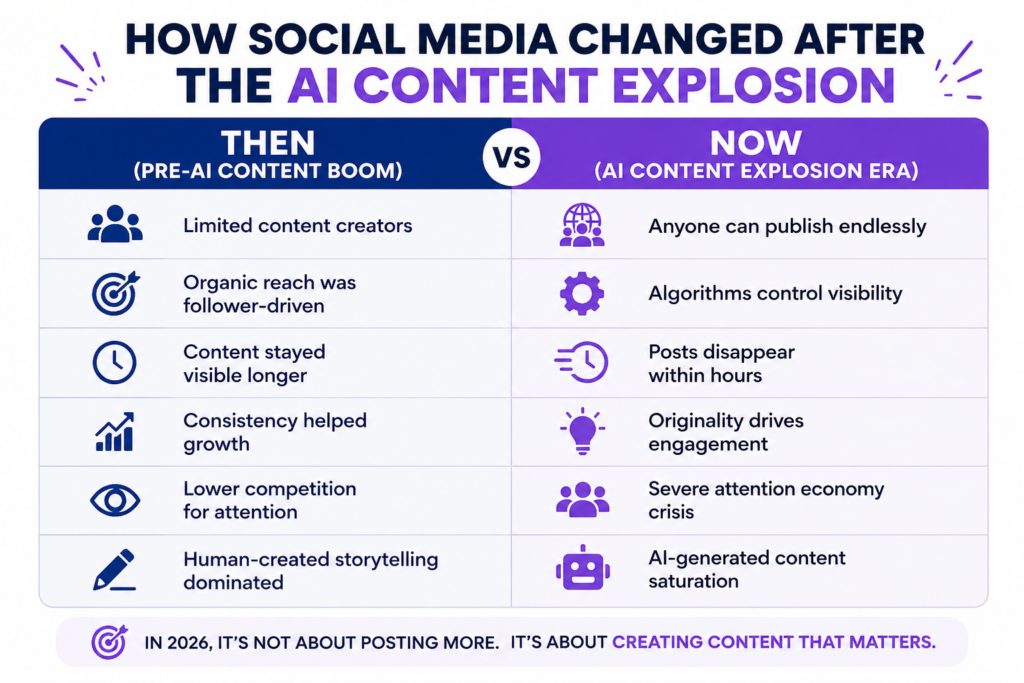
This placement makes sense, as the image visually summarizes the information from the previous section before shifting to actual first-hand examples.
Recent examples showing the organic reach crisis
The decline in organic reach has become more than a disgruntled creator’s issue; the diminishing number of organic impressions is now a measurable trend across all platforms.
The increased use of A.I. to produce content casually placed in social media feeds has made social media platforms more selective about what to display, making it difficult for Brands to achieve organic reach with their audience.
Instagram organic reach continues to drop even while posting more content
A Metricool study shows that Instagram Reels have dropped 35% year-over-year in organic reach; however, the amount of content being created by content creators remains at an all-time high.
The report illustrates that the vast number of published posts on social media and increased competition from social media algorithms are negatively impacting organic impressions.
LinkedIn social media algorithms favor personal stories over corporate media
According to a report from Imapro Research, LinkedIn has seen a noticeable decrease in organic reach for B2B brands due to an algorithmic shift favoring personal stories over traditional corporate-generated content. The use of polished corporate media has increased the difficulty of achieving organic reach.
Cut to the chase
The time of free organic reach has come to an end. For example, AI is now generating much of the content that fills users’ feeds in 2022. Therefore, if your content is not perceived to be genuine or different than everyone else, then people will no longer stop their scroll when they reach your post. Because in 2026, authenticity is no longer just a branding advantage — it’s becoming a visibility strategy.
FAQ’s
Because social media platforms are overloaded with content and algorithms now filter posts more aggressively.
AI is increasing content volume rapidly, leading to content saturation and lower visibility for many creators.
Yes — but authentic, original, and engaging content matters more than ever in 2026.