
Post-2020 Retail and eCommerce Reset and Role of AI Disruption
When the world shut down in 2020, commerce found a new avenue to grow: digital ecosystems and mobile phones.
Shopping shifted to apps. Grocery orders became digital. QR codes replaced paper menus. Consumers who had never considered online as a mainstream channel began adopting new habits. Brands rushed to e-commerce. Retailers discovered that their websites were becoming advertising businesses.
What started as an emergency response gradually became the new operating system of commerce. Six years later, that transformation entered a second phase, powered by AI.
Today, AI is influencing search results, product discovery, retailers’ pricing and inventory, where advertisers spend budgets, and even how customer service interacts with shoppers. Commerce is becoming predictive rather than reactive.
According to multiple eMarketer analyses of retail commerce trends, the post-2020 period fundamentally reshaped ecommerce, retail media, mobile shopping, and consumer expectations.
Let’s explore the post-2020 era of commerce and retail media.
Pandemic didn’t create digital commerce
It removed the barrier.
Before 2020, e-commerce was growing steadily but still competing against decades of physical shopping habits.
The pandemic compressed years of digital adoption into months.
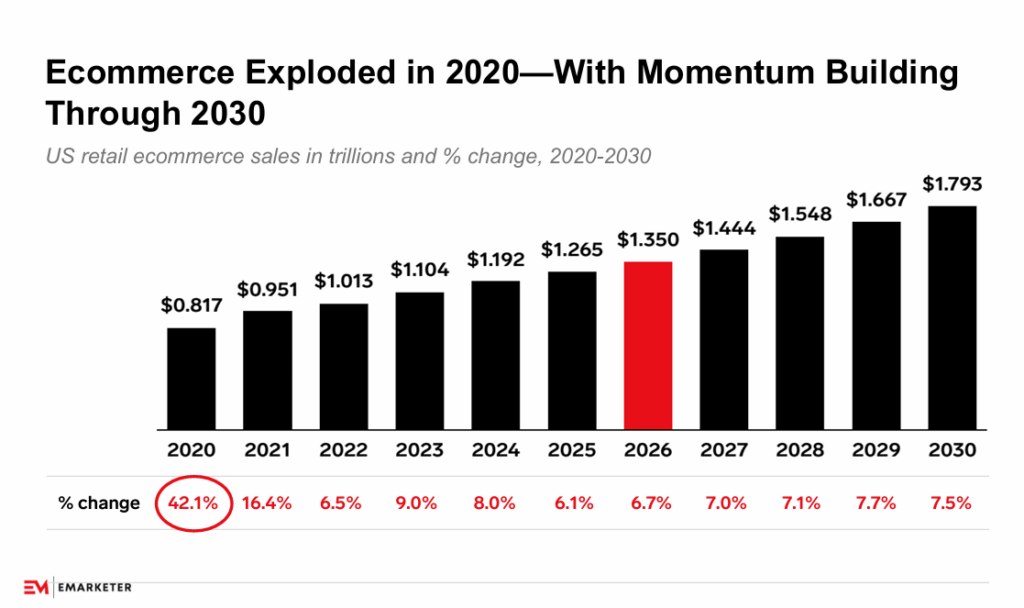
Consumers who hesitated to shop online became comfortable ordering groceries, medicines, restaurant meals, luxury goods, and household essentials from their phones. Businesses invested heavily in digital storefronts because they had no alternative.
After the pandemic ended, some restrictions remained, along with the fear of infection in public spaces. Consumers gained the reassurance of safety and the convenience of speedy delivery.
The result is a marketplace where online and offline shopping increasingly complement each other. Consumers might discover a product on social media, compare prices on Amazon, read reviews on Reddit, and, via AI, finally purchase through a retailer’s app or visit physical stores.
Commerce became omnichannel by necessity.
QR codes became the symbol of digital adoption
One of the most unexpected winners of the post-2020 era was the QR code.
Initially introduced as a contactless safety measure, QR codes evolved into a permanent infrastructure across retail, restaurants, payments, loyalty programs, product packaging, and advertising campaigns.
Instead of typing website addresses, consumers simply scan.
Brands now use QR codes to connect physical products with digital experiences, personalized promotions, first-party data collection, product authentication, and post-purchase engagement.
It is one of the clearest examples of how a temporary solution became a permanent consumer habit.
Ecommerce is still expanding
Despite predictions that physical retail would fully recover after lockdowns, e-commerce continues to gain market share.
According to eMarketer research, retail ecommerce has steadily increased its share of overall retail sales, while mobile shopping has become the preferred purchasing channel for millions of consumers.
Certain categories have experienced especially dramatic changes.
Food and beverage ecommerce, for example, grew from roughly 3 percent of category sales before the pandemic to nearly 9 percent within just a few years. On paper, that increase may appear modest.
In reality, tripling digital penetration in one of retail’s largest categories represents billions of dollars shifting online and permanently changes how brands compete for consumer attention.
Rather than replacing stores, e-commerce has become another essential storefront.
Retail Media became retail’s fastest-growing business
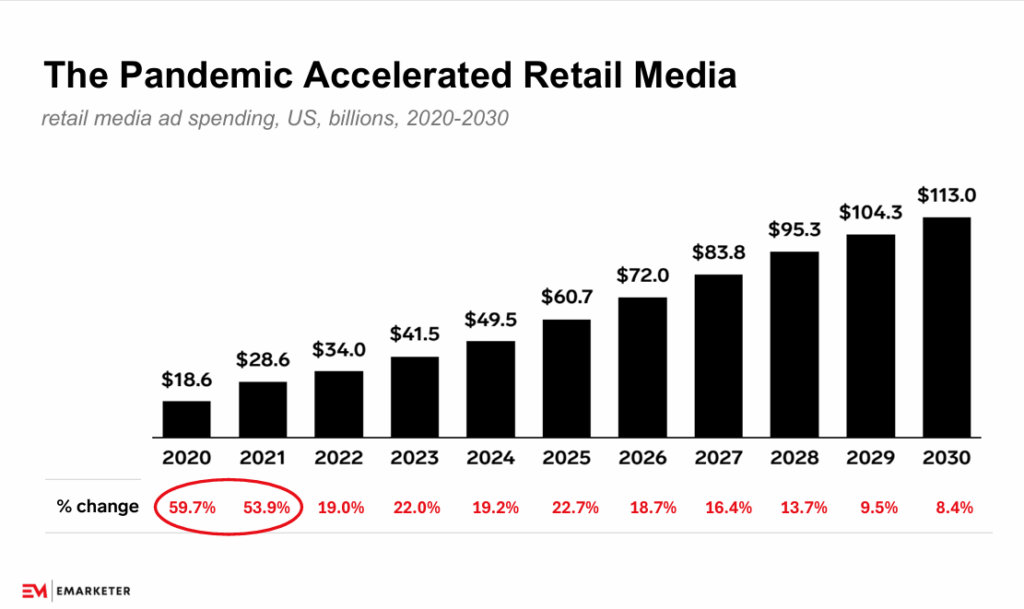
Perhaps the biggest commercial transformation after 2020 wasn’t ecommerce itself. It was advertising. Retailers realized they possessed something advertisers desperately wanted: purchase data.
Instead of selling only products, retailers began selling access to their audiences.
Amazon had already demonstrated the potential. Walmart, Target, Kroger, Instacart, DoorDash, and hundreds of other retailers rapidly expanded their own retail media networks.
The business model was compelling.
Brands could advertise directly where purchasing decisions happened, while retailers generated higher-margin advertising revenue alongside product sales.
Retail media has since become one of advertising’s fastest-growing channels, attracting budgets that once flowed primarily toward search and social media.
Amazon set the blueprint
Amazon entered the pandemic with a mature e-commerce ecosystem. It emerged with something much larger: a broader role in commerce.
The company strengthened logistics, expanded Prime membership, invested heavily in AI-powered recommendations, and continued scaling its advertising business into one of the world’s largest digital media platforms.
Its success fundamentally changed retailer strategy.
Retailers no longer view themselves simply as merchants. Increasingly, they operate simultaneously as media, technology, and advertising platforms.
That shift explains why nearly every major retailer today offers some form of retail media.
Mobile commerce became the default shopping experience
The smartphone quietly became the center of commerce. Consumers browse, compare prices, watch creator recommendations, redeem loyalty rewards, pay through digital wallets, and complete purchases without switching devices.
The customer journey has collapsed into a single screen. For marketers, this means creative assets, landing pages, checkout experiences, and customer support must all be optimized for mobile-first behavior.
Consumers rarely distinguish between e-commerce and mobile commerce anymore.
To them, shopping simply happens wherever they are.
AI is changing commerce faster than the pandemic did
If the pandemic digitized commerce, AI is making it autonomous.
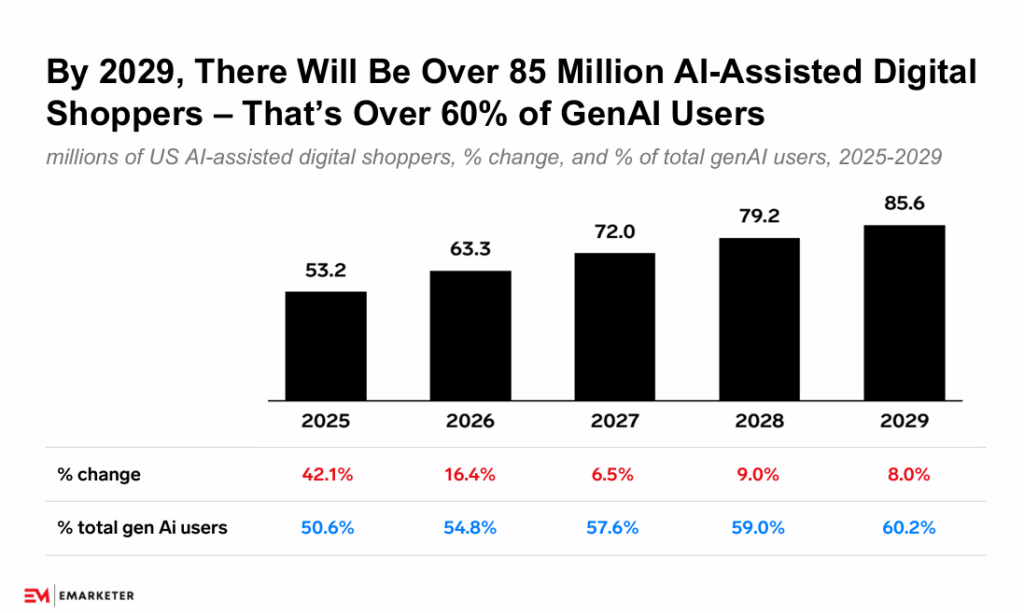
Retailers increasingly rely on AI for inventory forecasting, dynamic pricing, demand prediction, recommendation engines, customer service automation, content generation, and campaign optimization.
Consumers are also changing their shopping behavior. Instead of browsing endless product pages, shoppers increasingly ask AI assistants for recommendations.
- Search is becoming conversational.
- Discovery is becoming personalized.
- Advertising is becoming algorithmically optimized in real time.
This creates new opportunities but also new challenges.
Brands must now optimize for AI-powered search experiences alongside traditional SEO. Product information needs to be structured for machine understanding. Creative production is becoming significantly faster, allowing marketers to test more campaigns than ever before.
The competitive advantage increasingly belongs to companies that can combine human strategy with AI execution.
Cut to the chase
The next few years will likely bring AI shopping assistants, conversational commerce, hyper-personalized retail media, and even greater integration between physical and digital shopping experiences. Retailers will continue evolving into media businesses.