
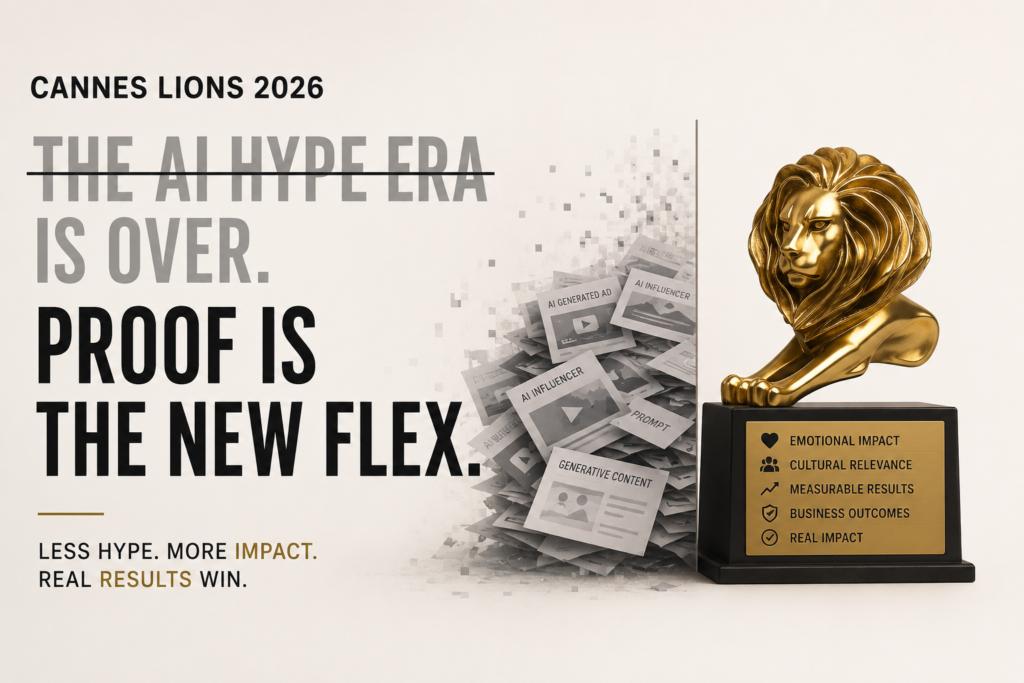
Cannes Lions 2026: The AI Hype Era Is Over, Proof Is the New Flex
Cannes Lions 2026 arrives at a turning point for advertising. The fascination with AI remains, but the mood around creativity and automation has clearly changed. Over the last couple of years, every agency presentation, every marketing conference, and every brand presentation has promised AI that would reinvent creativity, transform campaigns, and redefine the way consumers engage with brands.
After two years of AI-generated ads, synthetic influencers, and automated content flooding timelines, marketers are finally asking a less glamorous question: Did any of this actually work?
And that is exactly where things get interesting. Could Cannes Lions 2026 become the industry’s first real post-AI-hype moment?
The AI gold rush made every campaign feel like a tech demo
Advertising has seen an influx of AI over the past 2 years due to increased investment capital and Clients’ desire for innovation. As a result of this move:
- “AI” was quickly embedded into every media channel
- “Generative” was assigned to every creative/tool
- “Predictive” was assigned to every personalization engine
- “Machine Learning” was added to all creative strategy presentations
The result was an AI gold rush where hype often overshadowed actual performance.
There are campaigns that are truly innovative, and others that just use AI as an accessory. A chatbot was a “brand experience,” and AI-generated images were deemed “creative disruption” by some.
However, consumers rarely care about the tech itself. They care about whether it is relevant, emotionally meets their needs, serves a purpose for them, and builds trust in the company. With an influx of low-quality AI-generated content on social media, brands are realizing that having something new isn’t enough anymore.
This is why AI used in advertising is shifting from innovative to impactful by 2026. Both creativity and automation are important considerations when making advertising decisions; however, brands now need evidence to demonstrate the effectiveness of their efforts.
Cannes 2025 has already revealed where the industry is headed
Cannes Lions 2025 had an interesting twist: the big winners were not necessarily the loud AI campaigns, but rather those that focused on emotional intelligence, societal relevance, and impact.
The shift in all of this already offers a clue about where Cannes Lions are headed in 2026.
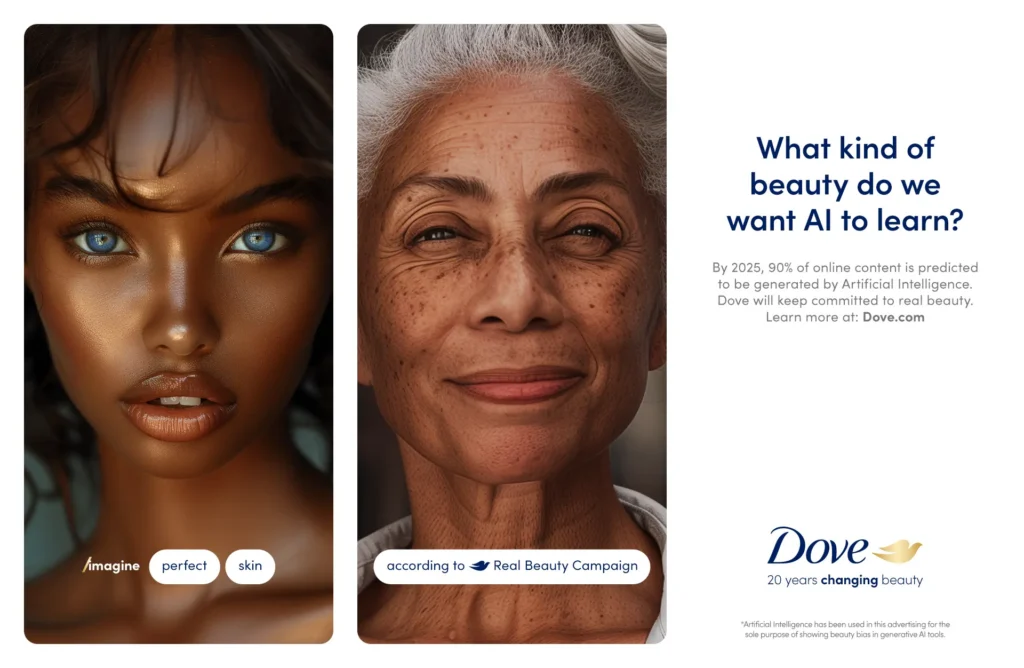
Consider Dove’s “The Code” commercial, which explores how online beauty standards are changing with generative AI. Dove addressed a genuine cultural concern about identity, self-image, and algorithmic bias rather than employing AI as a futuristic spectacle. Instead of viewing AI as a novelty, the advertisement linked technology to human implications, which is why it resonated.
Then there was Microsoft’s Super Bowl AI campaign, which focused more on how AI could help regular people realize their ideas than on ostentatious automation. The advertisement anchored AI in human aspiration and accessibility rather than promoting “the future.”
Coca-Cola’s “Masterpiece” campaign, which combined storytelling, art, and AI-enhanced production without emphasizing the technology itself, also attracted international notice. Because people could relate to the campaign’s inventiveness and cultural familiarity, it was successful.
The pattern across these campaigns was hard to ignore: the strongest work used technology quietly while keeping emotion, usefulness, and cultural relevance at the center.
Cannes Lions 2026 dates and the industry signals everyone is watching
The Cannes Lions 2026 dates are officially set for 22–26 June 2026, but the advertising industry is already discussing the type of work that will take over the Palais as this year’s festival approaches.
There are several key factors influencing the industry’s outlook going into this next festival:
AI’s transition from being the hype to becoming an infrastructure
We are witnessing the end of the novelty period, and AI tools have now transitioned into standard operating systems across agencies and marketing departments. What this means is that simply “using” an AI tool will no longer be considered “award-winning”.
Just like Photoshop eventually became standard creative infrastructure, AI is becoming invisible, too.
Creative intelligence is expanding, elevating creativity
We have seen more companies use AI for creative performance marketing use cases than ever before. For years, Cannes celebrated emotional storytelling while performance marketing lived in spreadsheets and dashboards. Now AI is forcing both worlds into the same room.
However, that divide is rapidly closing.
More brands now expect their campaigns to:
- Attract cultural attention
- Optimize targeting
- increase conversion rates
- Optimize the media spend
- Evidence ROI
This has led to increased collaboration among creative teams, data scientists, automation specialists, and performance strategists. AI is accelerating this convergence.
Futurism is being replaced by accountability
The feeling in this space has shifted –
“Check out what AI can do.” To “Demonstrate what AI has done.”
This slight shift could be indicative of all future AI marketing trends in 2026.
AI vs creativity advertising was always the wrong debate
For too long, marketers have framed the conversation on AI vs. human creativity as a competition between the two. However, at Cannes 2026, that manner of framing may finally be proven exceedingly flawed.
AI can generate assets, automate production, analyze audiences at scale, and test creative variations faster than any human team. It still lacks what is fundamentally required for successful campaigns to operate: emotional tension derived from real-life experiences of real people.
People rarely remember campaigns because they were technically advanced. They remember campaigns because they felt emotionally true. They remember them because those campaigns accurately reflected a reality we all relate to.
This is why AI will not be the greatest threat to creative marketers; rather, the most significant threat to the creative marketing business will be the availability of mediocre automated idea generation.
The brands winning attention today are not the ones using the most AI. They are the ones using it to remove friction while preserving emotional clarity. They are identified by how many times they use AI to eliminate inefficiencies not only in their processes, but also in the emotional clarity of their creative process.
That is very important for the future success of AI within advertising. People can always perceive when a marketing message is emotionally empty, even if it is visually pleasing.
Creativity with measurable impact is becoming Cannes’ new currency
One of the significant transitions taking place presently is the increasing use of measurable creativity. This includes evidence-based case studies for advertising using AI.
No longer do brands want to hear about new innovations that aren’t measurable; they want proof they can measure.
- Will more people engage?
- Will more people stay?
- Will more products get sold?
- How much did it cost to acquire customers?
- Did it change perception?
This is part of the reason AI account-based marketing is seeing rapid growth in B2B advertising today—because AI helps marketers tailor their messages, predict buyer intent, and optimize outreach at scale. And once again, how effectively an AI campaign performs is more important than how creatively it was produced.
Ironically, the most mature AI-powered campaigns are often the ones where consumers barely notice the AI.
And strangely enough, the less visible an ad is that’s been aided by AI, the more it may be viewed as representing a mature approach to advertising.
Cannes Lions 2026 predictions: the year advertising stops applauding AI for existing
In the future, we may see award-winning creative work that is no flashier than high-emotion storytelling, demonstrating measurable business results, and achieving a demonstrable change in people’s behavior as a result of ethically using AI to create projects that will generate an experience that is more human and less automatic.
The most impressive creative work that will be eligible for a Cannes Lion in 2026 (or any of the awards presented at Cannes) will feel much less like a machine-generated output than it will feel like something created by an actual human being. As artificial intelligence becomes more deeply integrated into the advertising ecosystem, advertisers are moving beyond the novelty of using AI.
Rather, in the coming years, we will see that advertising values results over novelty as a benefit of using AI technologies. Therefore, the brand recognized at Cannes will not necessarily be the most noticeable for its use of AI technologies; it will be the one that uses them in the most meaningful way.
Creativity is no longer competing against AI. It is competing against forgettable automation.
Cut to the chase
The Cannes Lions Festival in 2026 could be when advertising no longer rewards AI for existence; rather, it rewards ideas that connect with people. In marketplaces overwhelmed with generated content, proof, impact & emotional relevance might become the new creative currency.
FAQ’s
The Cannes Lions 2026 Festival is officially scheduled to take place from 22–26 June 2026 in Cannes, France.
Cannes Lions 2026 is expected to reflect a major industry shift from AI hype to measurable creative effectiveness, emotional storytelling, and real business impact.
Some major AI marketing trends in 2026 may include AI-powered personalization, predictive creative testing, AI tools for performance marketing, ethical AI frameworks, and measurable ROI-focused campaigns.