AI Slop Is Becoming a Brand Risk, Not Just a Content Problem
AI has made content production effortless, but it has also made originality harder to find. As low-value AI content floods the internet, marketers are discovering that preserving trust is the real competitive advantage.
AI has dramatically lowered the cost and effort required to create content. Marketers can now publish blog posts, social captions, email campaigns, landing pages, and product descriptions in minutes rather than days.
But the same technology has also created an unintended consequence: an internet increasingly filled with content that looks polished but may not offer original thinking, accurate information, or genuine value. The industry has a name for it, AI slop.
For marketers, the issue extends beyond content quality. Generic AI-generated content can dilute brand identity, undermine credibility, and even create brand safety concerns when it appears alongside misinformation or low-value material.
To understand where the real risks lie, Ad Pulse spoke with Akanki Sharma, Associate Editor at Omnimedia, about why AI slop is becoming a marketing challenge, and why human judgment remains the competitive advantage.
AI slop isn’t about AI, it’s about editorial judgment
Over the past two years, marketers have embraced AI for everything from blog writing and campaign ideation to product descriptions and customer emails. But scale has created a new challenge. Much of the discussion around AI slop focuses on technology, but that may be looking in the wrong direction.
AI doesn’t decide whether content deserves to exist; people do. We asked Akanki Sharma how she defines AI slop and why marketers should care.
Everyone seems to have a different definition of AI slop. How do you describe it?
Akanki: AI slop is content created with little human thought, creativity, or editorial effort. The problem isn’t AI itself—it’s our growing dependence on it. Many people are so focused on speed and productivity that they stop thinking deeply about what they want to say or how they can make it meaningful.
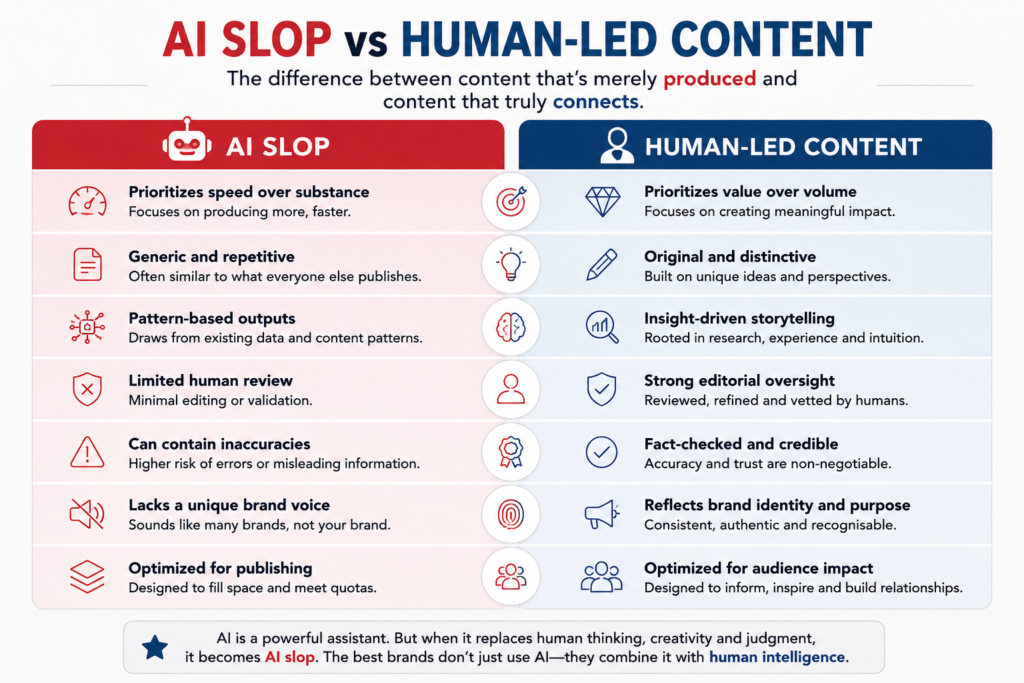
As a result, content may be grammatically correct and well-structured, but it often lacks originality, insight, and real value. AI was designed to make our work easier, not replace human creativity or judgment. When we use it to support our ideas, it can produce excellent results. But when we rely on it to do all the thinking, that’s what I would call AI slop.
Marketers should care because there’s constant pressure to publish more content. In that race, AI can easily become a shortcut instead of a creative partner. But great marketing has never been about producing the most content—it’s about producing content that people remember.
Think about some of the most iconic campaigns from the 1980s and 1990s. Many of those campaigns remain memorable today because brands built them on strong consumer insights, originality, and emotional storytelling—not speed.
AI can certainly speed up research, ideation, and execution, but strategy, creativity, and brand voice still need a human touch. The brands that will stand out in the AI era won’t be the ones using the most AI—they’ll be the ones using it thoughtfully to enhance, rather than replace, human creativity.
The conversation has moved beyond content quality
AI slop is often discussed as a writing problem. Increasingly, marketers are realizing it’s also a reputation problem. When every brand has access to the same models, prompts, and workflows, differentiation becomes harder.
Generic messaging doesn’t just disappear into the noise; it gradually weakens brand identity.
At what point does low-quality AI content become a brand safety issue rather than just a content quality problem?
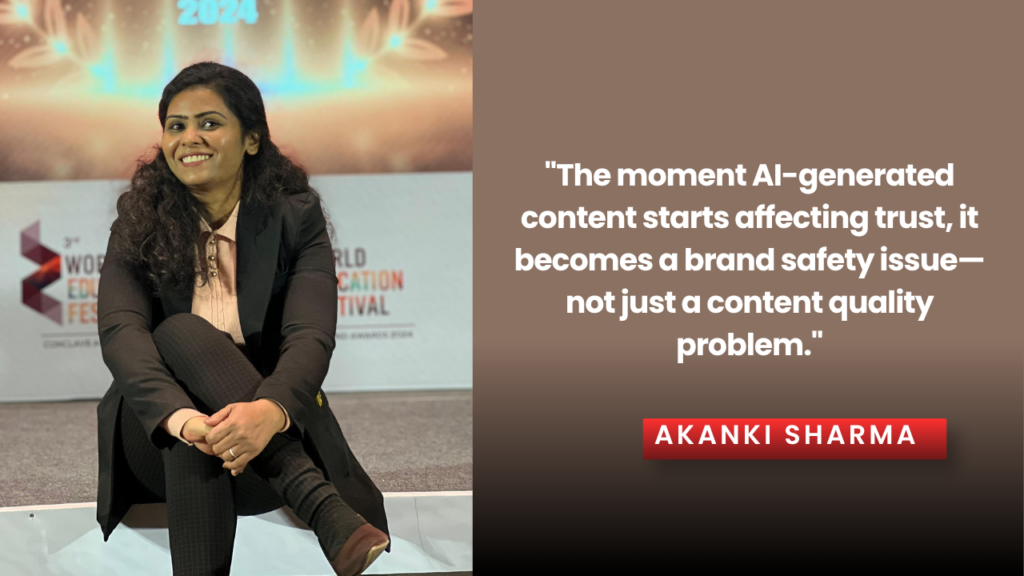
Akanki: Low-quality AI-generated content becomes a brand-safety issue the moment it undermines trust. A brand’s reputation is built on credibility, and if AI-generated content is published without proper human review, it can contain factual inaccuracies, misleading information, or superficial insights. When that happens, audiences don’t just question the content, they question the brand behind it.
Another challenge is originality. Today, many companies use the same AI tools to generate copy, social media posts, and campaign ideas. Without adding their own perspective or creative direction, brands risk sounding generic and losing the distinctive voice that sets them apart.
Take Coca-Cola, Pepsi, Fevicol, and Surf Excel. They built their most memorable campaigns on consumer research, creativity, and cultural understanding rather than simply filling content calendars. AI can certainly support that process through research, ideation, and execution. But it cannot replace human experiences, intuition, or emotional understanding.
When brands compromise on accuracy, originality, or credibility for the sake of speed, it stops being just a content quality issue, it becomes a brand safety issue that can damage consumer trust and long-term brand value.
Do you think originality matters now more than ever?
Akanki: As mentioned earlier, the biggest risk is the loss of a brand’s goodwill. A brand’s reputation is built over the years through thoughtful communication and meaningful consumer engagement. If AI-generated advertisements or content are published without enough human refinement, they can feel generic and fail to reflect a brand’s unique identity.
The risk becomes even greater when those advertisements appear alongside low-quality or misleading AI-generated content. Consumers often associate brands with the environments in which they encounter them. If that environment lacks credibility, it can influence how people perceive the brand itself.
That’s why AI should be used to strengthen the creative process, not replace it. Creative professionals don’t simply accept the first AI-generated output; they question it, refine it, and build it with their own insights. Ultimately, the biggest risk isn’t just producing average content. It’s losing consumer trust. Once trust is compromised, it can affect brand reputation, customer loyalty, and business performance.
Brand safety has traditionally focused on adjacency, ensuring advertisements don’t appear beside harmful content. AI slop introduces a different challenge. A brand may appear in a technically “safe” environment that nevertheless feels untrustworthy because the surrounding content lacks credibility or substance. That’s a much harder problem to solve.
Can the industry keep up?
Technology companies are racing to develop AI detection, content verification, and brand safety solutions. But identifying AI slop isn’t the same as detecting misinformation or harmful speech. The challenge isn’t simply knowing whether AI was involved. It’s determining whether the content deserves an audience.
Do current brand safety tools have what it takes to handle AI-generated content, or is the industry playing catch-up?
Akanki: I think the industry is definitely playing catch-up. Brand safety tools have become much better at identifying risks like hate speech, explicit content, violence, and misinformation. But AI slop is a different challenge because it often looks polished, well-written, and convincing. The real issue is that it may lack originality, credibility, or depth of fact.
Technology alone can’t solve this problem. AI is evolving rapidly, and brand safety tools are constantly adapting to keep pace. The bigger challenge isn’t detecting harmful content; it’s identifying genuinely valuable and trustworthy content.
That’s where human judgment becomes essential. AI can flag potential risks, but marketers, editors, publishers, and advertisers still need to ask important questions: Is this accurate? Does it reflect our brand values? Does it genuinely help the audience?
I believe the brands that stay ahead will be those that combine AI with strong editorial standards, responsible marketing, and human oversight rather than relying on automation alone.
Who needs to take the lead in tackling this problem: platforms, publishers, advertisers, or someone else?
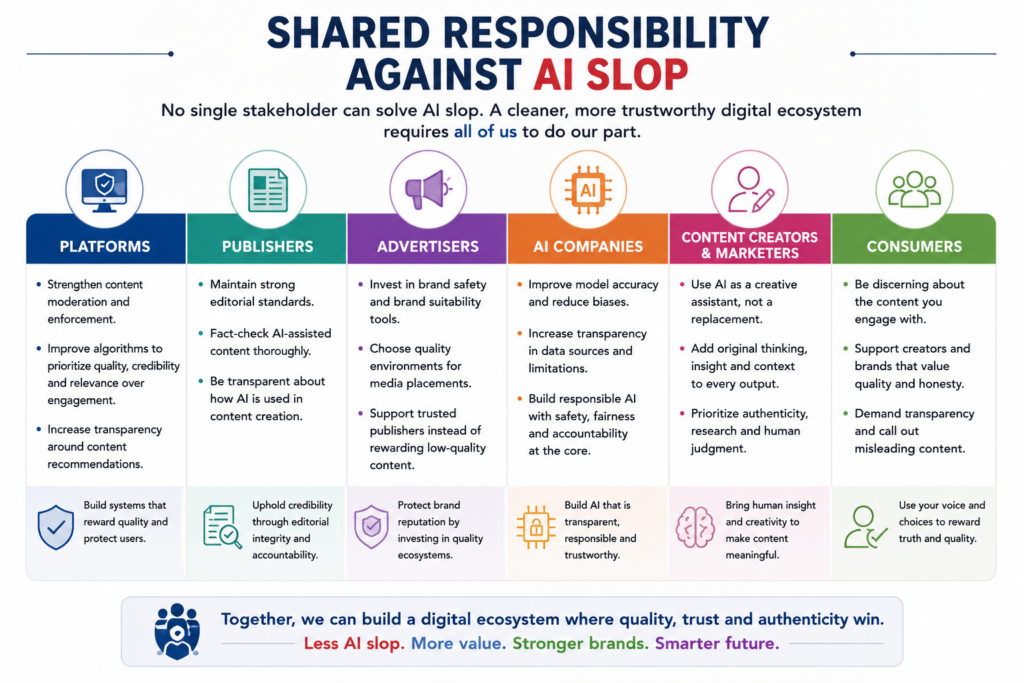
Akanki: In my opinion, tackling AI slop is a shared responsibility. No single stakeholder can solve this challenge alone.
Platforms need to strengthen content moderation and ensure their algorithms reward quality and credibility rather than simply prioritizing engagement. Publishers should maintain strong editorial standards, fact-check AI-assisted content, and be transparent about how they use AI. Advertisers should invest in brand safety and brand suitability tools while supporting trusted publishers rather than rewarding low-quality content created solely for clicks.
AI companies also have a responsibility to improve accuracy, transparency, and responsible AI development.
At the same time, every writer, journalist, marketer, and creator has a role to play. AI should be treated as a creative assistant—not a replacement for human thinking. Readers still recognize authenticity, research, and original perspectives. If we continue to value quantity over quality, we risk filling the internet with content that informs less and confuses more.
Ultimately, tackling AI slop requires a collective commitment to rewarding originality, credibility, and authenticity.
As AI-generated content continues to grow, what should brands be doing now to stay ahead of the risk?
Akanki: I think brands need to shift from being reactive to proactive. As AI-generated content becomes more common, it’s no longer enough to focus only on where advertisements appear. Brands also need to evaluate the quality, credibility, and authenticity of the content surrounding those advertisements because consumers often associate brands with the environments in which they encounter them.
To stay ahead of the risk, brands should invest in strong brand safety and brand suitability tools, work with trusted publishers, and regularly audit where their advertisements appear. They should also establish clear internal guidelines for how AI is used in content creation and ensure that important communications go through human review.
AI can support research, brainstorming, and execution, but fact-checking, editorial oversight, and transparency should never be compromised for the sake of speed.
Above all, brands must remember that trust is their greatest asset. AI should be used to improve efficiency and enhance creativity—not replace originality, accuracy, or authenticity. The brands that succeed in the long run will be those that combine AI’s capabilities with human judgment and creative thinking.
Key takeaway
While artificial intelligence has the potential to increase the speed of generating content, it still cannot duplicate the judgement, creativity, and authenticity found within human beings. Therefore, brands that effectively use AI together with a robust amount of editorial direction and creativity will have the greatest opportunity to build and maintain consumer credibility.