
AI Marketing ROI: From Cool Tech to Cash Impact
AI has moved beyond experimentation in marketing and is now being tested on one thing: its ability to drive revenue. In 2026, the decision is clear. If AI cannot prove financial impact, nothing else matters.
Thank you for reading this post, don't forget to subscribe!The Ad Pulse puts it like this: The industry is moving away from quantitative measures that are surface-level (e.g., impressions, clicks) towards deeper levels of accountability for generating revenue through AI technology.
“Dashboards show movement; revenue shows truth.”
That single distinction is now how companies will assess their ROI related to their AI investments in marketing by 2026. In this article, we’ll deep dive into how to measure, optimize, and prove the real impact of AI in marketing.
The AI illusion: why activity ≠ impact
AI tools allow speedy content generation, automated workflow execution, and the ability to personalize user experiences on a large scale. Speed and scale alone do not lead to success. An AI-enabled brand generating content will likely produce the following outputs:
- Increased number of blogs published
- Higher number of emails sent
- Greater turnaround time between campaign creation and delivery
Unless these outputs translate into revenue, engagement, or cost savings, they’re just vanity metrics. Many strategies fail because they track activity instead of real impact.
Defining AI marketing ROI (Beyond the Buzzwords)
To understand how successful AI marketing investments are, one needs to look past the hype and define their True Value. In essence, an AI Marketing investment has value; in order to quantify that value accurately, one must measure the number of financial returns produced versus their respective costs. An easier way to conceptualize this is as follows:
ROI = (Return – Investment) / Investment)
However, when it comes to AI Marketing, “True Returns” are not always immediate cash revenues. They also include:
- Increased Converging Rates
- Reduced Cost to Acquire Customers (CAC)
- Improvement in Customer Lifetime Value (CLV)
- Operational Savings
- Increased Accuracy in Decision-Making
Therefore, it is critical to define what your own “True Returns” will be, based on how you plan to use your AI Marketing Tools.
The metrics that actually matter
If you want to measure AI’s real impact, you need to look beyond surface-level KPIs and focus on what drives revenue.
1. Performance metrics (Direct impact)
These types of metrics will measure whether AI will produce better results than before.
- Conversion Rate Uplifts
- Click Thru Rate (CTR) Improvements
- Revenues/User
- Lead Quality Scores
2. Efficiency metrics (Operational gains)
AI performs extremely well in these areas, but you cannot stop once you have these metrics to measure.
- Campaign Time Saved
- Cost per Acquisition Reduction
- Content Creation Speed
- Media Spend Optimization
3. Predictive accuracy metrics
This is where you will see AI produce its greatest value – by predicting results.
- Forecast Accuracy
- Audience Targeting Accuracy
- Recommendation Engine Performance
4. Customer experience metrics
Marketing that produces better experiences will have a higher lifetime value (ROI).
- Engagement Rates
- Retention Rates
- Net Promoter Score (NPS)
- Personalized Experience Effectiveness
AI’s true impact: from acquisition to growth
The biggest misconception in AI marketing is that its value lies at the top of the funnel. In reality, the strongest ROI shows after conversion, where revenue is actually generated.
AI-powered budget allocation helps brands target high-intent users and cut wasted spend, leading to 41% lower acquisition costs and significant conversion uplift. This is where AI moves beyond efficiency and starts delivering real business impact.
However, real growth occurs after the purchase through the use of AI. By identifying top-performing creatives, eliminating low-performing creatives, and optimizing spend in real time, the biggest impact of AI is across the lifecycle of a customer (e.g., churn predictions, personalized upsells). AI compounds value over time, with companies reporting up to 50% higher ROI and $8.30 return for every $1 spent.
AI marketing (ROI) methodology: going from conceptualization to realization
To accurately measure the impact of AI marketing efforts, follow this methodology:
Phase 1: Identify the business goal
Revenue? Retention? Cost reduction? Start with the outcome, not the tool.
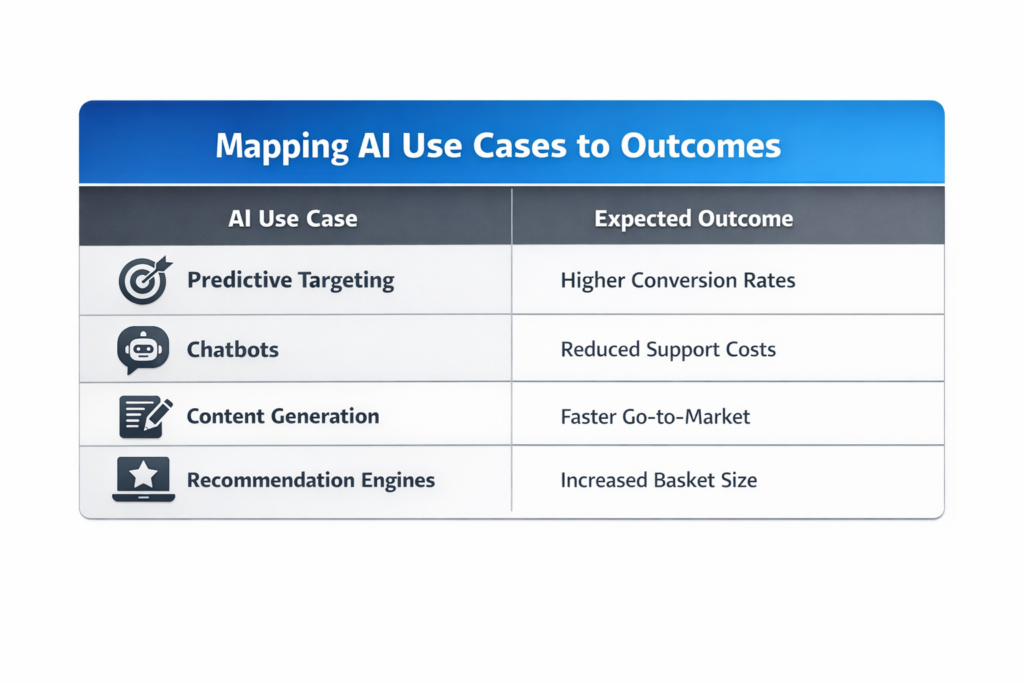
Phase 2: Link AI technology to the outcomes/results
For example, every AI use case should link directly or indirectly back to a form of measurable outcome, such as:
- Personalization leads to increased conversions.
- Automation leads to decreased costs.
- Predictive analytics lead to better decision-making.
Phase 3: Create a baseline
No baseline = no proof.
Phase 4: Track incremental success
Utilize the following techniques to measure incremental success:
- A/B testing;
- Holdout groups;
- Controlled experiments.
Phase 5: Convert measured outcomes into financial value
Convert your measured outcomes into measurable financial benefits, including:
- Increased revenues;
- Cost avoidance;
- Improved margins.
Phase 6: Constantly improve your AI ROI process
AI ROI compounds over time—if you keep refining it.
Many marketers are making a big mistake
Many marketers still measure AI by clicks, impressions, and content output rather than real business outcomes.
While activity metrics are indeed good indicators of momentum in regard to your AI efforts, they do not demonstrate business impact. This creates a false sense of progress—AI looks effective but doesn’t actually drive revenue.
The real issue lies in failing to tie AI projects to measurable returns. AI tools can become very costly projects and experiments without proper return attribution and revenue linkage. As a result of having both of these factors tracked and reported, you will see that future success in 2026 will come from proving that the implementation of AI produces actual financial results.
From experimentation to accountability: evaluating AI investments in 2026
In 2026, smart brands aren’t debating AI adoption—they’re focusing on where it can drive measurable revenue. They understand what works: AI is effectively applied when it is incorporated directly into pricing structures, targeting mechanisms, and personalization strategies; it has been fully integrated into the customer’s journey through seamless interaction with all channels; and there is a substantial attribution model to support the use of AI for making financial decisions. Each of these investment categories moves beyond efficiency; they deliver tangible business impact.
However, it is equally important to understand what does not work. Tool-oriented approaches, metric-based tracking, and isolated use cases that lack a link to revenue continue to waste money without demonstrating a return on investment (ROI).
The transition from using AI merely as an experimental tool to one that will hold every dollar invested in AI accountable through measurable, tangible results is clearly underway.
Cut to the chase
AI isn’t your competitive advantage anymore—measurable impact is. If you can’t tie AI to revenue, it’s just an expensive noise. Stop tracking activity and start proving ROI—because in 2026, only what pays off survives.
FAQ’s
By comparing revenue gains or cost savings from AI with the total investment made.
Conversion rates, ROAS, CAC, retention, and revenue impact.
Because they track activity (clicks, impressions) instead of real ROI.