
Meta One and the Rise of AI Ad Infrastructure
Meta is making artificial intelligence a bigger part of how creators publish, businesses operate, and audiences discover brands. Its latest move, Meta One, brings premium AI capabilities and professional tools into the company’s social media ecosystem. The subscription service signals a broader shift in how Meta wants creators and businesses to work across its platforms.
Launched on September 15, 2026, Meta One offers subscription plans for individuals, creators, and businesses. Meta introduced more than 50 features across Facebook, Instagram, WhatsApp, and Meta AI, with further expansion planned. The company also reported 15 million subscriptions and trials during its phased rollout.
For advertisers, the launch raises a bigger question. How is AI changing advertising infrastructure, and what happens when content creation, audience insights, customer engagement, and business management increasingly operate within one platform ecosystem?
Meta One does not replace Meta’s existing advertising-buying systems. Instead, it adds a subscription layer to the tools surrounding them. Understanding this distinction is essential to understanding the next phase of AI ad infrastructure.
Meta One brings AI and business tools together
Meta One combines premium features and expanded AI access across Meta’s applications. Its offerings span individual subscriptions, bundles for AI power users, and packages for creators and businesses.
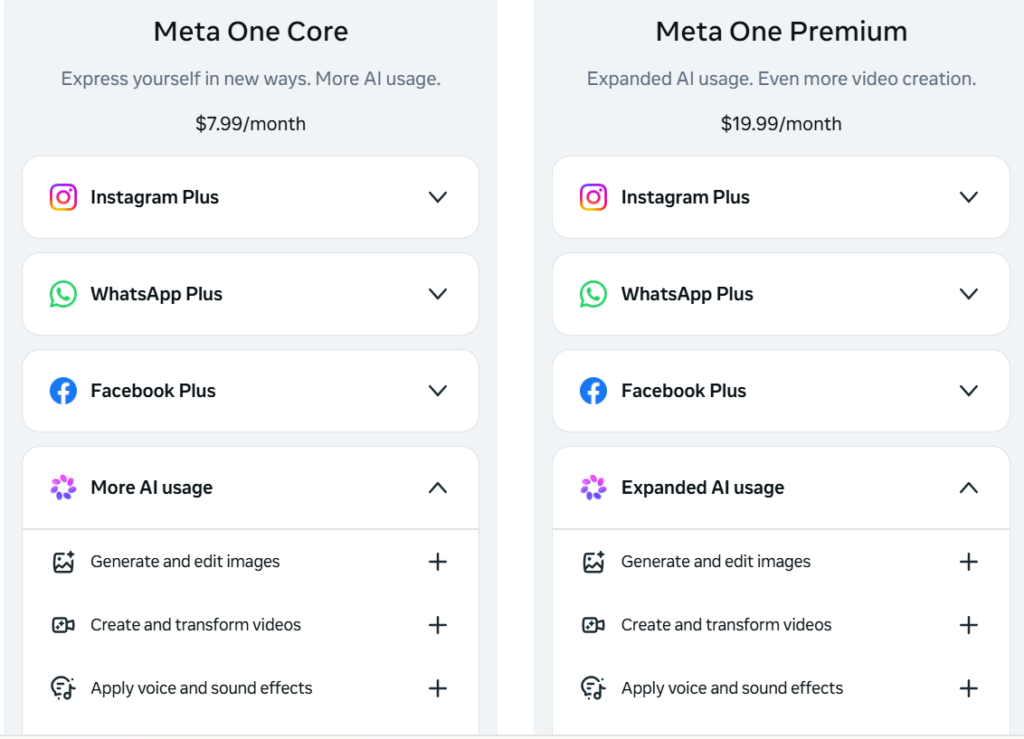
The individual bundles, Core and Premium, provide greater access to AI-powered image and video generation, along with creative features such as Instagram’s Restyle tools and voice effects. Creator and business subscriptions focus more directly on managing online presence, publishing content, understanding audiences, and communicating with customers.
The business packages introduce features such as advanced analytics, competitor insights, content scheduling, and expanded access to Meta Business Agent. The AI-powered agent can respond to customer messages on WhatsApp Business, while businesses retain the ability to take over conversations.
According to Meta’s announcement, subscription prices start at $2.99 monthly for individual app plans, $7.99 for individual bundles, and $14.99 for creators and business bundles in the US. Higher-tier business packages reach $499 monthly. Pricing and feature availability vary by market, account, and plan.
The important development is not simply the number of features available. Meta is shifting more of the work related to social media marketing into its own ecosystem. A business can create content, publish it, review performance, and respond to customers without relying on an entirely separate set of services for every task.
For smaller businesses and independent creators, this could reduce operational friction. For larger brands, the question is whether these tools offer enough value to justify another subscription alongside existing marketing technology.
Meta One fits into AI ad Infrastructure
AI ad infrastructure refers to the technology and systems that support advertising across its lifecycle. This includes creative production, audience analysis, campaign optimization, ad delivery, measurement, and customer interactions.
Meta has already been incorporating AI into advertising through products such as Advantage+ and its Andromeda ad-retrieval system. These systems operate closer to campaign delivery and optimization. Meta One operates at a different layer, focusing on the professional tools and workflows that surround a creator’s or business’s presence.
Together, these developments illustrate how AI advertising technology is becoming embedded across more stages of marketing.
Generative AI can help produce images and videos. Analytics tools can help businesses understand how audiences respond. Scheduling features can organize publishing. AI agents can handle routine customer conversations. Advertising systems can then use their own optimization capabilities to help deliver campaigns.
These functions are related but not interchangeable. Meta One’s subscription features should not be confused with automatic ad buying, guaranteed audience growth, or a promise of improved campaign returns.
The strategic opportunity for Meta lies in connecting these activities more closely. The more marketing work businesses perform within their platforms, the more useful those platforms may become to their daily operations.
Why creators matter to Meta’s advertising strategy
Creators have become important to brand marketing because they can bring personality, niche expertise, and established communities to commercial messages. Their content can make products relevant to audiences that conventional brand advertising may struggle to engage.
Meta One’s creator and business plans target some of the practical challenges behind that work. Enhanced profiles, follow invitations, scheduling tools, audience insights, and expanded AI capabilities can help creators manage their presence and maintain a publishing routine.
AI tools for creators can also make content production less resource-intensive. Image and video generation, editing assistance, and creative experimentation may help individuals produce more variations without having to build a large production team.
However, production efficiency is only one part of the equation. More content does not automatically mean more meaningful engagement. Creators still need a distinctive voice, an understanding of their audiences, and a reason for people to trust their recommendations.
This is particularly relevant for brands using creator partnerships. AI can assist with production and workflow management, but it cannot independently establish genuine audience relationships.
Ad Pulse previously examined the tensions surrounding synthetic personalities in The Rise and (Supposed) Fall of Meta AI Bot Influencers. Meta One presents a different proposition. Rather than centering on AI-generated personalities, it offers tools that help creators and businesses operate more effectively.
The distinction matters. Brands investing in creator marketing still need to evaluate authenticity, disclosure, audience quality, and the relationship between sponsored content and genuine recommendations.
From content creation to customer conversations
One of Meta One’s more consequential features for businesses is its expanded access to Meta Business Agent.
Customer engagement often requires businesses to respond quickly to product questions, service requests, and purchase enquiries. Smaller teams may struggle to provide consistent responses outside working hours. An AI agent can help manage routine conversations and direct customers towards relevant information.
Meta says its business agent can respond to customer messages on WhatsApp Business around the clock. Businesses can take over conversations when needed and configure the agent around relevant business information.
This creates a possible connection between marketing and commerce. A campaign may generate interest, a social profile may introduce the business, and a messaging conversation may help a customer make a decision.
Yet the quality of this experience depends on more than automation. Incorrect responses, unclear escalation procedures, and poorly managed customer data can undermine trust. Businesses need to understand what the agent can handle, what requires human intervention, and how customer information is managed.
The commercial value of AI marketing tools will ultimately depend on whether they help businesses serve customers better, not merely on whether they reduce manual tasks.
The cost of convenience
Meta One also introduces financial consideration for advertisers and creators. The subscription model offers additional capabilities, but businesses must decide whether the benefits justify the recurring cost.
A creator may find expanded AI generation and publishing tools useful. A small business may value scheduling, analytics, and customer support. A larger brand, however, may already pay for social media management, customer relationship management, analytics, and creative production software.
The relevant comparison is therefore not simply between a free Meta account and a paid subscription. It is between Meta One and the tools a business already uses.
There is also a broader platform dependency issue. As businesses move more activities into Meta’s ecosystem, they may become increasingly reliant on its features, pricing decisions, data access, and product changes.
Meta One does not eliminate the need for independent campaign measurement or cross-platform marketing. Advertisers should continue evaluating performance against business outcomes, rather than treating platform-provided insights as a complete picture of effectiveness.
AI ad infrastructure needs trust
Meta’s expansion of AI across marketing workflows also raises questions about transparency, authenticity, and brand safety.
AI-generated content can accelerate production, but it can also make misleading material easier to create and distribute. Automated customer interactions introduce separate risks when systems provide inaccurate information or fail to recognize sensitive requests.
These concerns connect directly with Ad Pulse’s earlier reporting on Meta’s Scam Economy and Advertiser Trust. More AI capabilities do not automatically translate into safer advertising environments.
Advertisers need clear processes for reviewing generated assets, checking claims, managing account access, and escalating customer complaints. They also need to understand how platform automation affects campaign decisions and whether performance reporting provides enough transparency to evaluate results.
The goal should not be to reject AI advertising infrastructure. It should be to establish the controls necessary to use it responsibly.
What Meta One means for advertisers
Meta One reflects Meta’s effort to make its platforms more useful to creators and businesses beyond their existing advertising functions. By combining creative tools, audience insights, publishing capabilities, and customer engagement features, the company is expanding the role its ecosystem can play in everyday marketing operations.
The subscription model also gives Meta another potential revenue stream beyond advertising. Its challenge is to convince users that premium tools deliver enough practical value to warrant ongoing payment.
For advertisers, the immediate priority is to distinguish useful capabilities from product hype. AI can reduce production bottlenecks, support routine interactions, and help organize marketing work. It cannot guarantee stronger creative ideas, trustworthy customer relationships, or profitable campaigns.
Cut to the chase
The next phase of AI ad infrastructure will be shaped by how effectively digital platform systems connect, how transparently they operate, and how well businesses retain control over their marketing decisions. Meta One is a step towards a more integrated platform experience.