The Customer Experience Advantage: How Brands Win More Loyal Customers
A potential customer finds the product they have been looking for, adds it to their shopping cart, and prepares to complete the purchase. However, an unexpected delivery charge appears at checkout. The payment page loads slowly, and customer support fails to respond when the buyer needs assistance. Frustrated, the customer abandons the purchase and buys the same product from a competitor.
The brand did not lose the customer because of poor product quality or high prices. It lost the sale because the buying experience fell short of expectations.
This is becoming more troublesome for businesses in recent times. Drawing customers to the company through advertising, discounts, and promotions is only half of the task. What happens after a customer clicks an advertisement, visits a website, makes a purchase, or seeks help can determine whether they stay with the brand or switch to another.
Consumers tend to remember not only what they acquired but also how it was acquired, if their needs were met by the brand, and how quickly the issues were resolved. This is why customer experience marketing is emerging as a powerful competitive differentiator.
Brands that strive to make every interaction with their customers easy, relevant, and trustworthy are likely to gain more opportunities to build long-term relationships with consumers.
What is customer experience marketing?
Customer experience marketing is a strategy that strives to enhance every aspect of a customer’s interaction with a particular brand in the course of the customer’s journey. This is achieved by employing a broader approach in which the actual experience at the stages of product selection, purchase, usage, and support becomes an essential part of marketing.
For instance, various elements, including personalized product recommendations, a well-organized website, responsive customer service, and a convenient return policy, can shape the customer experience.
Unlike the traditional approach to marketing that mainly communicates the reasons for being a customer of this brand, customer experience marketing shows why staying loyal to this brand makes sense for them.
The strategy involves understanding customer needs, collecting feedback, identifying friction points, and improving interactions across different touchpoints.
In the end, the goal is to establish an experience where the customer feels being asked for feedback rather than being treated as another sales opportunity.
Why is customer experience important in marketing?
Consumers have a plethora of options. Customers can evaluate prices, check reviews, compare products, and change their brands easily. As a result, even a tiny inconvenience could affect their buying decision.
However, the issue arises when businesses measure their success by their own performance rather than by customers’ experiences.
Medallia’s 2026 State of Customer Experience Report revealed that while 66% of customer experience practitioners believed experiences had improved over the previous year, only 17% of consumers agreed.
This discrepancy shows that companies may believe they are providing better experiences while in fact failing to meet consumers’ expectations.
An effective customer experience strategy can help bridge this gap by:
- Creating brand loyalty: Customers will be more inclined to return if their interactions are hassle-free and reliable.
- Increasing customer satisfaction: Quick replies and good problem-solving can leave a good impression.
- Encouraging repeat purchases: Customers who trust a certain brand will have fewer reasons to look for alternatives.
- Improving brand reputation: Satisfaction will lead to recommendations and positive online feedback.
- Helping with customer retention: Companies will strengthen their current customer relations rather than completely rely on gaining new customers.
Thus, customer experience is not only a customer service task. It is an important marketing tool that shapes customers’ attitude towards brands in the long run.
How does customer experience create a competitive advantage?
Achieving a competitive advantage is not always a result of the lowest price offered or having the latest product on the market. Instead, it can happen by providing a better purchasing experience than competitors do.
Here are five strategies that can help brands achieve this goal.
1. Create a seamless customer journey
Customers do not stick to a single channel when interacting with brands. They can learn about a product on social media, check its details on one website, get in touch via a messaging app, and finally make a purchase online or in a physical shop.
Nevertheless, a disjointed customer journey creates many difficulties.
For instance, customers might have to repeat the information each time they switch customer support channels, and they may find that the product advertised on the website is not in stock at the shop.
Brands must connect all the points together to provide a uniform experience. These efforts should include providing the same product information, implementing the most suitable payment methods, updating orders in real time, and giving customer support teams access to communication history.
A seamless journey eliminates unnecessary problems, which, in turn, makes customers feel more comfortable when making transactions.
2. Deliver personalized customer experiences
Customers now expect brands to understand their needs rather than send them the same marketing message. Personalization allows companies to tailor the experience based on customer behavior, purchase history, browsing behavior, and preferences.
For instance, an online clothing marketplace can provide a recommendation based on what purchases customers made previously, offer something suitable, and remind the customer of items in their shopping cart.
Nevertheless, proper personalization does not mean sending out more notifications or gathering as much information as possible.
The 2026 Salesforce State of Marketing research found that 92% of marketers in India said customers increasingly expect two-way conversations with brands. However, 71% of marketers struggled to respond promptly because they lacked the necessary customer context.
This shows that AI tools alone cannot deliver effective personalization. Brands also need connected customer data and the ability to respond to customers meaningfully.
As Nishant Kalra, Vice President – Sales, Salesforce South Asia, explains, the future of marketing depends on moving beyond one-way campaigns toward intelligent, two-way conversations that build stronger customer relationships.
3. Make customer support part of the brand experience
Customer service often represents the moment when customers decide whether to trust the brand.
Problems such as delayed deliveries, incorrect orders, failed payments, and refund issues can quickly turn a positive customer experience into a frustrating one.
It is necessary for brands to provide support through channels that customers are already using like live chat, email, phone, and messaging services.
AI chatbots can answer common questions, provide order updates, direct customers to answers, etc. However, customers should still be able to speak with a human representative for complicated problems.
The company has to address complaints and make customers feel that the brand takes their concerns into account.
4. Simplify the online shopping experience
In the realm of online shopping and e-commerce, convenience can influence customers’ decisions to either complete their purchase or leave their carts full.
There can be a host of issues affecting customers’ experience, from long checkout processes and surprise costs to slow-loading pages, unclear product information, and a lack of alternative payment methods.
E-commerce companies can offer an improved online shopping experience by:
- Creating mobile-friendly websites that are easy to navigate.
- Ensuring accurate product details, pictures, and reviews.
- Being transparent about pricing and delivery dates.
- Reducing checkout steps.
- Making returns, refunds, and exchanges easy.
- Updating customers on their delivery and order status.
It is essential for marketplaces to consider the post-purchase experience. Buyers deserve to know that their orders will arrive as promised and that all issues will be resolved in a timely manner.
An easy shopping process lowers purchase barriers and inspires customers to come back.
5. Build trust through consistency and transparency
Customers have to rely on brands to deliver what they expect. When something is mentioned in the advertisement, such as quick delivery, a customized offer, or a specific benefit of the product, customers expect to find something similar in real life.
Failure to communicate consistently to customers, hidden fees, deceptive promotions, as well as shady data practices reduce the level of the customer’s trust.
Brands need to be transparent at every level of the advertising campaign, product description and pricing, and customer service interaction.
Providing consistent service across websites, mobile applications, social media, and physical stores is equally important.
It is important that companies always meet their promises.
Examples of how brands are enhancing customer experience in 2026
Brands are increasingly using AI and personalization to make customer interactions more relevant, convenient, and responsive. Two recent examples demonstrate how these strategies are creating better customer experiences.
Macy’s: Personalizing online shopping with AI
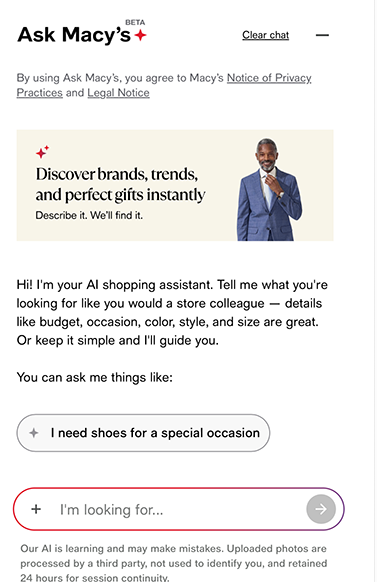
In 2026, Macy’s launched Ask Macy’s, an intelligent shopping assistant that is able to give tailored product suggestions, respond to shopping inquiries, and provide virtual fitting services. During the beta phase, users of the assistant accounted for about 4.75 times more generated revenue per visit compared to other customers.
Dr. Martens – AI usage for customer service improvement
Dr. Martens implemented AI technologies in 2026. AI has been used for customer service purposes to receive routine inquiries more efficiently. AI systems have been handling 50% of customer communication.

How can brands increase customer retention through customer experience?
Think about two shoppers placing their orders on the same e-commerce site. One receives his package at the scheduled time, receives regular updates on the order, and discovers that returning the order is simple. The other gets his package later than scheduled, has a hard time reaching the customer support team, and takes several days to receive a refund for his return.
Although both customers purchased the same product at the same price, their experiences could determine whether they choose to shop with the brand again.
Customer experience is the area where the brand plays a direct role in retaining customers.
Brands may create favorable conditions for a return purchase in several ways:
- Understand customer behavior: Check purchase regularity, activity on the browsing level, testimonials, and interactions with customer service to determine what customers really appreciate.
- Reward loyal clients: Provide useful loyalty points, access to exclusive content, and personalized perks to recognize long-term relationships.
- Tackle problems at the beginning: Reveal issues that arise repeatedly, like complaints, shipment delays, or payment difficulties, to avoid losing customers.
- Keep communication on point: Provide customers with practical product descriptions, reminders, and updates instead of inundating them with commercials.
- Gather and implement feedback: Encourage customers to share their experiences and demonstrate how their suggestions help improve products and services.
How do you measure customer experience?
A customer experience strategy must include measurable outcome targets because it is impossible to improve what one does not understand and track.
Thus, customer experience management involves gathering feedback, observing customer actions, and analyzing how interactions affect customer satisfaction and retention.
Some of the key performance indicators include:
- Net Promoter Score (NPS): shows likelihood of customers recommending a brand;
- Customer Satisfaction Score (CSAT): shows customers’ satisfaction level with a brand’s product/service/interactions;
- Customer Effort Score (CES): indicates how simple it was for a customer to perform the action or resolve the issue;
- Customer Retention Rate: indicates what percentage of customers continue to buy in a certain timeframe;
- Customer Churn Rate: shows what percentage of customers has stopped buying or using the service;
- Repeat Purchase Rate: indicates how often customers return to make a purchase.
Firms can also take advantage of customer experience management tools to gain insights and gather information through conversations, track stages in customer journeys, and identify areas of discomfort.
But it’s worth noting that measuring indicators only may do little for businesses. They would need to use the insights obtained to enhance the actual experience. A high satisfaction score does not mean much if customers continue to encounter the same issues.
The future of customer experience marketing
Technology is transforming how brands understand, engage, and build relationships with customers. Brand-new concepts such as AI, predictive analytics, automation, and customer data platforms are helping businesses deliver more relevant and personalized customer experiences across all channels.
As an example, AI can analyze customer behavior, leading to recommendations on products, the timing of service needs, and the automatic handling of routine customer interactions through customer data platforms.
Nonetheless, technology is meant to support the delivery of experience, not to act as an experience.
Brands must create a balance between automation and personal interaction, personalization and privacy, effectiveness, and empathy. Customers will appreciate automation in product use but will also demand a meaningful solution if something goes wrong.
The most successful brands will be those that apply technology to reduce friction and keep the customer’s perspective and needs at the forefront in every decision.
Cut to the chase
Customer experience marketing enables companies to earn customers’ trust and loyalty throughout the customer journey. By facilitating customer interactions, companies can retain customers and create a competitive advantage.
FAQ’s
Customer experience marketing focuses on improving every interaction a customer has with a brand, from product discovery and purchase to customer support and after-sales service.
A smooth, personalized, and reliable experience builds customer trust and encourages repeat purchases. Poor experiences, such as delayed deliveries or complicated returns, can push customers toward competitors.
Brands can improve customer experience by simplifying the buying journey, offering personalized recommendations, providing responsive customer support, collecting feedback, and maintaining consistent service across channels.
At a Glance
- Customer experience marketing helps brands build stronger customer relationships and stand out from competitors.
- A smooth customer journey reduces friction and makes purchasing easier.
- Personalization helps brands deliver more relevant and meaningful customer interactions.
- Reliable customer support and consistent service encourage customer satisfaction and retention.
- Measuring metrics such as CSAT, NPS, customer effort score, and retention rate helps brands identify areas for improvement.