

Affiliate Marketing Trends: How Publishers, Creators, and Brands Are Rebuilding Revenue Models
As creators, publishers, and brands look for better ways to monetize their content, the evolution of affiliate marketing from a performance channel into content-driven commerce has opened better venues for creators and brands to monetize their content.
Publisher-recommended purchases, creator-endorsed ratings via TikTok, and product reviews provided within email newsletters may not represent a traditional retail environment, but are still becoming popular areas for making buying decisions.
As the boundaries between content and commerce remain blurred, creators, publishers, and brands are discovering new pathways to convert influence into revenue. In the past, the affiliate economy relied on coupon sites and cashback platforms; now it encompasses a much broader ecosystem, with recommendations directly linked to purchases.
The affiliate economy is redefining the methods by which creators monetize themselves, how publishers accumulate revenue, and how brands assess the success of their marketing efforts.
Why is affiliate marketing again in the spotlight?
Affiliate marketing is on the rise due to the simple fact that all parties have aligned incentives. Brands pay for a result; creators and publishers get rewarded based on how well they perform. Consumers find new products through trusted sources instead of relying on traditional advertising.
U.S. affiliate marketing spending surpassed $10 billion in 2024, according to EMARKETER, reflecting growing demand for performance-based marketing channels. The key difference this time is who is now driving those increases: rather than just coupon websites, creators, publishers, newsletter publishers, and influence-driven communities are driving sales.
Overall, affiliate marketing is becoming the building block of connecting content to influence commerce.
The revenue models that got us here aren’t working anymore
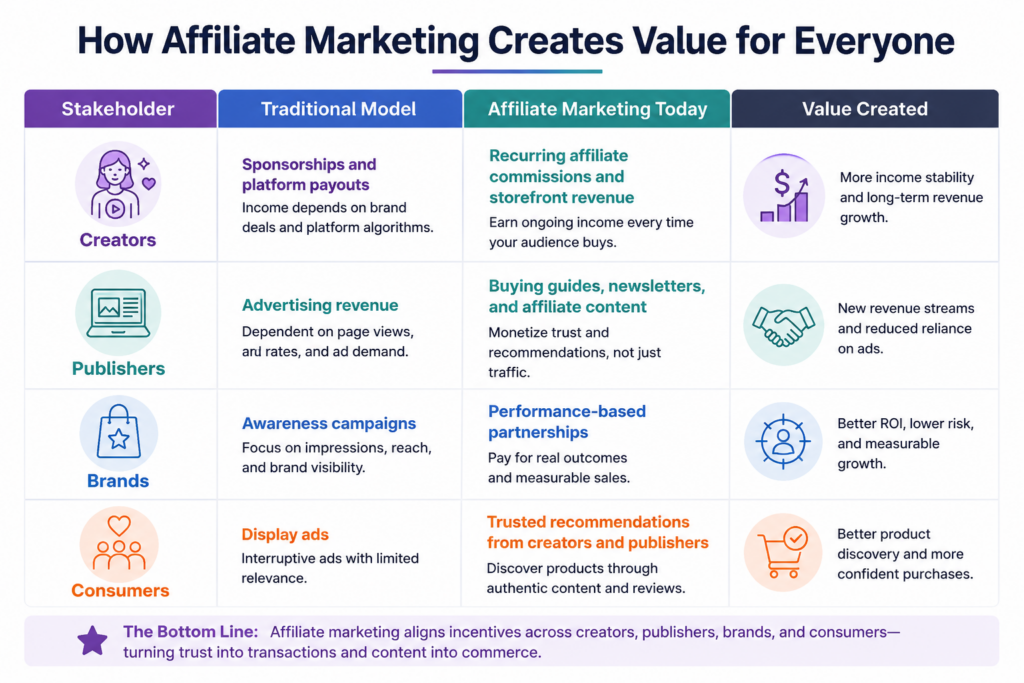
Over the past several years, publishers, content creators, and brands have operated under different business models. For example, publishers have been primarily dependent on advertising revenues.
Creators have relied on sponsorships and payouts from digital platforms. Brand marketers have directed large budgets towards awareness programs, with the belief that demonstrating a direct business impact would be quite difficult to prove.
Only recently have all three groups faced significant pressure to prove that they are achieving positive results. Publishers are seeing decreased amounts of referral traffic, shifts in search behavior, and increased competition from AI-generated answers. Creators are grappling with unpredictable algorithms and variable revenues from platforms. Marketers are feeling the increased pressure to show measurable returns on each campaign they run.
As a result, publishers, creators, and brands are required to prove they deliver measurable results. Overall, the revenue models based on assumptions they previously used are becoming increasingly difficult to justify, leading to a demand for new business models that deliver clear, measurable, and recognizable results.
The proof is already in the market
Affiliate marketing has already begun to be adopted throughout the industry, as the creation of creator storefronts allows influencers to create shopping locations based on their recommendations, and the development of social commerce platforms is helping to make it easier than ever to connect content directly to a purchase.
The impact of these trends is being seen clearly through major retail holidays such as Cyber Monday: according to Adobe Analytics, approximately 20% of all US ecommerce revenue was driven by influencers and affiliate marketers, highlighting the growing role creator recommendations play in shaping purchase decisions.
All of these trends point to a much larger trend where affiliate marketing is no longer ‘on the sidelines of digital commerce. Rather, it is steadily growing into the core infrastructure that will be used to connect content, experience, and revenue together.
Creators aren’t just influencing purchases-they are driving them
Creator-led commerce has become a key force for driving the evolution of affiliate marketing. More than simply acting as a media channel, creators have started forming commercial relationships.
Instead of just receiving a one-off sponsorship fee by an advertiser, many creators now share the revenue generated through affiliate links, stores and other creator commerce programs. Every recommendation a creator makes has the potential to lead to ongoing income.
This model provides value for all parties involved in a transaction. The creator receives recurring revenue from commissions; the brand receives measurable results from the campaign; and the audience receives recommendations from trusted and authentic sources.
The creator economy continues to expand rapidly. Goldman Sachs estimates that it could approach $500 billion by 2027, driven in part by creators building businesses beyond sponsorships.
Rather than relying only on a single source of income, creators are now diversifying their portfolio of income streams by adding revenue from subscriptions, products, memberships, digital products, and affiliate commissions. Affiliate revenue is emerging as a fundamental method for creators to monetize themselves.
When recommendations become retail
The shift is especially visible in categories like beauty and consumer products. More often than ever before, purchases today start with the Creator (aka an influencer) review or product demonstration or tutorial, instead of being initiated by a traditional search phrase (aka keyword search).
Medicube is a strong example. The K-beauty brand generated more than $102 million in TikTok Shop sales while partnering with over 34,000 creators, demonstrating how creator-led commerce can become a powerful revenue engine.
This lesson can be applied across all industries/brands/categories. Content is not only influencing consumer purchase decisions – now, in many cases, the content is acting as the Physical Storefront for the consumer.
Publishers are building new revenue models
Affiliate marketing is playing an increasingly important role for publishers as digital media economics evolve. Advertising revenues remain under pressure, while audiences discover content via a variety of channels. As a result, publishers are developing new business models around trust and recommendations. Product reviews, buying guides, newsletters, and curated recommendations create new revenue streams for publishers.
Instead of simply monetizing attention, publishers are increasingly monetizing purchase intent. For many media organizations, affiliate marketing has transitioned from a secondary source of income to a vital part of their long-term business strategy.
Brands want outcomes, not just impressions
Brands are under similar pressure as publishers to justify ROI. Therefore, performance-based deals are becoming far more attractive compared with simply being brand aware.
More and more often, creators and publishers who can drive buying behavior are beginning to be seen as growth partners, rather than just entities to place media. This change is also affecting how success is determined.
While reach and impressions will always have value, purchase influencing will soon be an equally valid measure of success. As brands increase their emphasis on accountability, they are beginning to look beyond visibility and focus on results.
Technology is removing the friction
Enhanced technology and improved infrastructure have rapidly advanced the affiliate economy. There are many modern creator monetization platforms that help track sales, evaluate performance, process payments automatically, and manage large scale partnerships.
What was once a complicated task of using affiliate networks and manual processes can now be done in just a couple of clicks. As content creation and commerce continue to converge, creator-driven commerce has a bright future ahead of growth.
The future belongs to performance-driven content
The most significant change isn’t in affiliate marketing.
It is in how value is assessed on the web.
Creators are looking for alternative methods for generating income, in addition to sponsorships. Publishers are seeking ways to offset the decline in their advertising revenue. Brands require ways to measure how they drive business outcomes.
Affiliate marketing lies at the center of all three of those requirements. With the continued convergence of content and commerce, the value of recommendations is rising. As they can now be measured as part of a direct transaction.
As the lines separating creators, publishers, retailers , and marketers become increasingly blurred. We are witnessing the formation of the affiliate economy, in which content now serves to generate both revenue and awareness.
For companies wishing to achieve long-term sustainable growth, this is a critical distinction.
Cut to the chase
Affiliate marketing is evolving from a marketing channel to a revenue engine. That links publishers, brands, and artists through quantifiable results. Businesses that can convert trust into transactions will be in the best position to grow as content and commerce continue to blend. Are you interested in learning more about publisher monetization, creative commerce, and the future of digital marketing? Keep up with Ad Pulse.
FAQ’s
Creator commerce, AI-powered shopping, social commerce, and creator storefronts are among the biggest affiliate marketing trends.
They help brands measure ROI through performance-based partnerships that drive actual sales.
They enable creators to earn recurring income through affiliate links, storefronts, and product recommendations.