
LinkedIn Premium Is Costing B2B Marketers More Than They Bargained For
LinkedIn has always wrapped itself as a professional’s paradise. A network where careers are built, deals are closed, and brands find their audiences. But in 2026, a mounting stack of changes is forcing marketers, professionals, and business owners to ask harder questions. Is LinkedIn Premium cost actually worth what you get back?
Is the platform quietly engineering a pay-to-play trap that leaves free users gasping for air?
The platform’s recent moves — slashing follow invitation credits for free users by 80 percent, gating AI writing enhancements behind a paywall, already tightening InMail restrictions, and watching organic reach crater by more than 50 percent — aren’t isolated product decisions.
Together, they signal a deliberate monetization strategy: one through subscriptions, and next through LinkedIn advertising. All while laying off hundreds of employees and posting 12 percent year-over-year revenue growth.
We are going to tell you the story of a platform that knows exactly how indispensable it has become to B2B marketing and professional networking and is now cashing in on that dependency.
Sudden collapse of ‘Follow Credit’, 250 became 50
Until recently, any LinkedIn user could send up to 250 invitation credits per month to invite connections to follow their company page. It was a reliable, accessible growth lever for brands of every size. That era is over.
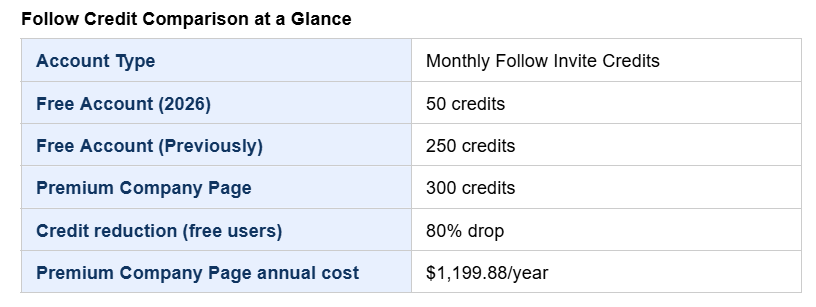
LinkedIn has reduced company invitation credits for free accounts from 250 down to just 50 per month — an 80 percent cut. Premium Company Page subscribers, meanwhile, receive up to 300 credits monthly. The math LinkedIn running is transparent to anyone paying attention.
Your company page now gets exactly 50 invitation credits per month to invite connections to follow your page. That’s it. Fifty. For context, many companies were previously sending hundreds or even thousands of invitations monthly.” — The X Concept, March 2026
For marketing managers at growing brands, the operational impact is immediate. Those 50 credits aren’t pooled — they’re shared across everyone on the team who manages the page. One enthusiastic team member can exhaust the month’s allocation before anyone else gets a look in. And LinkedIn’s offered solution? Upgrade with LinkedIn Premium, costs $119.99/month ($1,199.88 annually).
That translates to paying $1,200 per year for the ability to send an additional 250 invitations monthly — roughly $0.40 per invitation. For a small business or a lean marketing team already running on tight budgets, this is not a minor line item.
Organic reach is on its deathbed
Following the slashed follow-credit, another is dying in an organic reach environment that has become almost hostile to brand-level content. The numbers are stark.
According to data from platform analytics firm Ordinal, organic reach for company pages dropped by 60 percent to 66 percent between 2024 and 2026. Personal profiles, by contrast, now generate 561 percent more reach than company pages posting identical content.
Analysts describe the dip as a structural realignment engineered by LinkedIn’s newer AI-driven algorithm, known internally as 360Brew, which launched its ‘Authenticity Update’ in March 2026.
“Engagement has dropped by up to 72 percent, but LinkedIn is still a goldmine for B2B connections if you know how to use it.”
LinkedIn Marketing Mastery, 2025
For B2B marketers, this creates a vicious paradox. LinkedIn remains the single most effective platform for professional targeting and lead generation, with 87 percent of B2B marketers using it for campaigns.
The implicit message is clear: if you want your brand seen, pay for ads. If you want your page to grow, pay for the LinkedIn Premium.
LinkedIn Premium Cost in 2026: The price you pay
LinkedIn’s paid tier structure has expanded and repriced significantly.
Annual billing reduces costs by 16–33 percent across plans, but the base prices have been climbing. Sales Navigator Core increased from $99.99 to $119.99 in 2025 alone — a 20 percent jump in a single year.
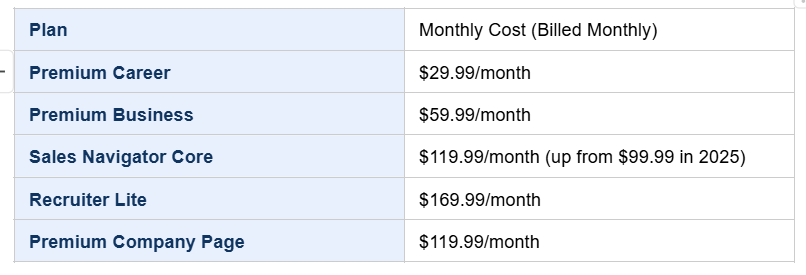
The InMail credit system underpins much of Premium’s value proposition for outbound marketing and sales. Free accounts receive zero InMail credits. Premium Career offers 5, Premium Business provides 15, and Sales Navigator Core gives 50 per month. The per-credit math is worth examining:
- Premium Career: $8 per InMail credit (5 credits at $39.99)
- Premium Business: $4.66 per InMail credit (15 credits at $69.99)
- Sales Navigator Core: $2.40 per InMail credit (50 credits at $119.99)
For context, industry data suggests InMail response rates run 4.6x higher than cold email, which helps justify the cost for high-volume sales teams. But for a typical marketing manager using LinkedIn for brand positioning rather than direct sales prospecting, those InMail credits may sit unused. And unused credits expire after 90 days, regardless of what you’ve paid.
Nine changes that are reshaping LinkedIn right now
Beyond the headline shifts in follow credits and premium pricing, a cluster of algorithm and product changes has been reshaping the platform over the past several months. Drawing on analysis from across the marketing industry, these are the changes hitting brands and marketers hardest in 2026:
- The 360Brew Algorithm Update — LinkedIn’s unified AI ranking engine now evaluates all content signals simultaneously, replacing separate disconnected models. It heavily penalises ‘corporate speak’, engagement pods, and external link spam.
- The Depth Score — Introduced in March 2026, this metric measures genuine human attention: scroll depth, time spent, saves, and comments over a 24–48-hour window. Posts can resurface days later if depth of engagement remains strong.
- Company Page Demotion — Company pages now receive approximately 5 percent of user feed allocation. Personal profiles dominate at 65 percent. The drop in brand-level organic reach between 2024 and 2026 stands at 60–66 percent.
- The Follow Credit Cut — Free accounts reduced from 250 to 50 monthly invitation credits. Premium Company Pages receive 300, at $1,199.88/year.
- Advanced Analytics Gating — Detailed company page analytics are now restricted to Premium subscribers, limiting free accounts’ ability to measure their own performance.
- Restricted InMail for Free Users — Free accounts receive zero InMail credits. All direct outreach to non-connections requires a paid plan.
- AI Features Paywalled — AI-assisted writing, profile enhancement, and job fit insights are reserved for Premium subscribers across plans.
- The ‘Authenticity Update’ (March 2026) — Officially killed engagement bait, legacy automation pods, and spammy external link behavior, penalizing accounts that relied on these tactics.
- Engagement Drop Across the Board — Median impressions per post fell 47 percent year-over-year. 70 percent of LinkedIn users in 2026 are categorized as ‘ghost scrollers’ who consume content without interaction.
The B2B Double Tax: Paying for Premium AND Paying for Ads
Here is where LinkedIn’s monetization strategy reveals its most aggressive face. The platform has long operated a dual revenue model — premium subscriptions and advertising. What has shifted in 2026 is that the compression of organic reach has effectively made advertising no longer optional for brands that want visibility.
In 2021, organic company content made up 7 percent of the average LinkedIn feed. By 2025, that figure had shrunk to just 2 percent. Ads and promoted content, meanwhile, now account for roughly 39 percent of the average feed. The architecture of the platform has been gradually restructured so that free organic distribution is scarce enough that paid amplification becomes necessary for basic reach.
Layoffs, AI, and the internal contradiction
In May 2026, LinkedIn announced it would cut approximately 875 employees — roughly 5 percent of its global workforce of 17,500. The cuts affected teams across Global Business Organization, marketing, engineering, and product. This came on the heels of a prior round of nearly 7,000 layoffs across 2024.
In the memo announcing the cuts, new CEO Daniel Shapero wrote that the company was “scaling back investments in some areas including marketing campaigns, vendor spending, customer events and underutilized office space.” The framing positioned the cuts as strategic reallocation toward AI and automation, not a company in distress.
And in revenue terms, that’s accurate. LinkedIn is growing. A 12 percent revenue increase in the most recent quarter is not the profile of a struggling business. But for the professionals who rely on the platform — and who are being asked to pay more for it — the juxtaposition is difficult to ignore. A platform posting record revenues is simultaneously cutting the human infrastructure that once supported its user and advertiser base, while charging more for AI-generated features that free tools already provide.
The broader tech context amplifies this: Layoffs. recorded more than 108,000 tech layoffs in 2026 as of mid-year, approaching the 124,000 counted across all of 2025. Many of the professionals most affected by this wave of redundancies are the same ones LinkedIn is asking to pay $29.99–$119.99/month to stand out in a job market.
A bleak calculus in a difficult economy
LinkedIn’s position in the professional world is, for the moment, unassailable. With 1.3 billion users and the most concentrated B2B decision-maker audience on any platform, it remains indispensable for networking, hiring, and marketing.
“The price tag is steep. If you only log in once a week to read industry news, the high monthly cost completely ruins your return on investment. The subscription only makes sense if you use it aggressively every single day.” — FullEnrich, April 2026
The platform is asking users to pay for features that compensate for the suppression it created. It is asking B2B brands to pay for subscriptions and advertising in a feed that the platform itself has restructured to reduce organic brand visibility. And it is doing all of this while cutting the workforce and posting record revenues.
LinkedIn knows that B2B professionals and marketers cannot afford to leave. That knowledge is the foundation of every pricing decision the platform has made in the past two years. Until a credible competitor emerges, LinkedIn will continue to take more than it could give.
Cut to the chase
The future, for most professionals paying the LinkedIn premium cost, looks less like an investment and more like a subscription. The platform has changed the rules of the game — and then started charging for the rulebook.