
The Coachella Fallout Exposed a Bigger Problem With Influencer Marketing
This year’s Coachella was supposed to be the creator economy’s greatest flex. Justin Bieber headlining. Sabrina Carpenter is making her festival debut. An estimated 375,000 attendees filing through the desert, and thousands of brand-sponsored creators are ready to capture every moment.
Instead, what played out on social media was a very different kind of content.
Last-minute cancellations, brands quietly pulling invitations days before the festival, and a messy public reckoning with the structural failure.
The Coachella chaos was not a PR blunder or a bad batch of contracts. It was a system failure. And it exposes challenges that the influencer’s marketing industry has been reluctant to admit.
When creator logistics fail in public
Bands scaled their creator programs faster than the infrastructure to run them.
The incidents were concrete and numerous. Creator Yazmin Marziali, with over 280,000 TikTok followers, learned her brand trip had been canceled via text — two days before her trip.
A brand allegedly told Creator Kelsey Kotzur that they were “at capacity.” UK-based creator Glocortex described months of vague communication from an agency before receiving a last-minute cancellation. They noted the whole arrangement had “felt so last-minute and lowkey too good to be true.”
Perhaps the most damning case involved Lucy and Lydia. These two long-standing influencers had originally pitched a fully developed Coachella concept to a brand they admired. Brand approved and expanded to include eight creators.
Weeks before the event, they received an email citing budget constraint. Then the brand attended Coachella anyway — with talent and content that closely mirrored the original pitch. No contract. No pitch fee. No recourse.
“It poses major questions about creator pitching. Until clearer standards are introduced, whether through contracts, pitch fees, or stricter usage agreements, situations like this risk becoming a regular feature in the influencer industry.” — Hello Partner
What made these incidents particularly corrosive was their visibility. Creators documented everything in real time. They do it on the same platforms where brand deals and audiences are happening. The reputational damage does not stay inside a Slack thread or email chains; it becomes content.
And in an industry built on audience trust, that is a uniquely expensive failure mode.
Too many middlemen, no single owner
Modern influencer marketing campaigns route through a maze of intermediaries. A brand creator program might touch a talent agency, a creator manager, an influencer platform, a brand consultant, an event partner, and a logistics vendor, before a single piece of content is shot. Are these middlemen also sharing accountability?
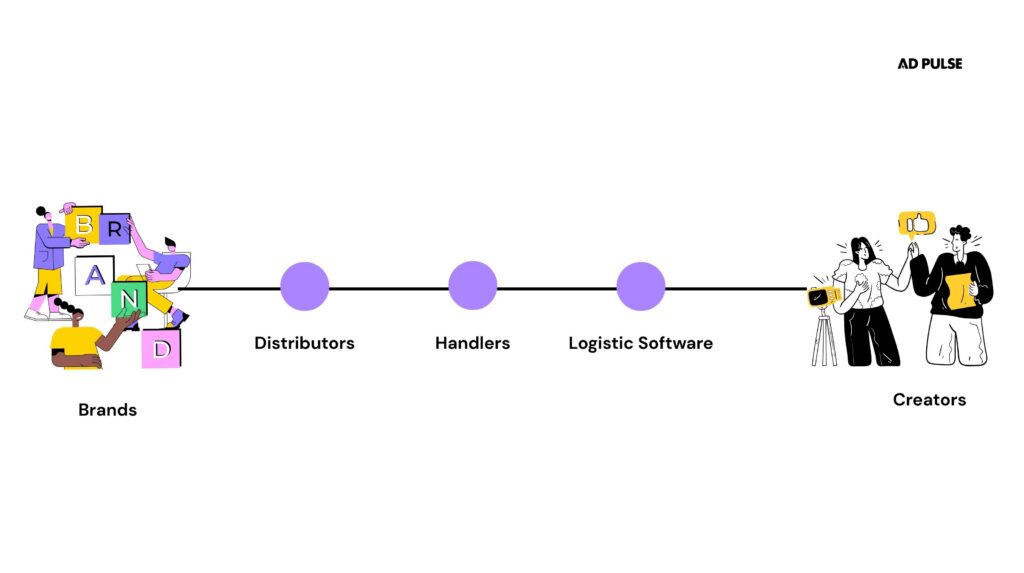
In terms of supply chains, fragmentation of networks can make things go wrong.
When a shipment fails, the distributor blames the logistics vendor. When a brand trip collapses, it is always a “budget constraint.” Language is always passive. Accountability is always elsewhere.
This fragmentation has a practical consequence beyond individual grievances. When a campaign spans multiple intermediaries, brand strategy gets diluted at every handoff. The brief that started with a nuanced creative direction often arrives at the creator as a vague instruction set, short on context and time. The result is generic content that serves not the brand, not the creator, and certainly not the audience.
Brands scaled creators faster than systems
This is the central failure. The influencer marketing industry reached 2.55 billion in market value in 2025, representing a compound annual growth rate of over 33 percent, according to the Influencer Marketing Hub Benchmark Report 2025.
US creator marketing spend alone is projected to hit more than one billion in 2026, more than doubling since 2022.
The real results were behind the growth. Around 91 percent of brands using influencer marketing reports that creator content drives more ROI than traditional digital advertising, per Aspire’s 2025 State of Influencer Marketing report. With numbers like that, the instinct was obvious: scale up, add more creators, cover more events, move faster.
But scaling a creator program is not like scaling a paid media buy.
Every new creator represents a human relationship, a legal agreement, a deliverable schedule, and a reputational dependency. The platforms and processes most brands use to manage that complexity were designed for five-creator rosters, not fifty. As the 2026 Influencer Marketing Hub Benchmark Report notes, the limiting factor for brands scaling nano- and micro-influencer programs is no longer finding creators — it is throughput.
Intake, vetting, briefing, compliance, usage rights, and asset management need to scale faster than creator volume. For most brands, they have not come close.
What Coachella exposed is what happens when the gap between the two curves; spending growth and operational maturity, gets wide enough. The budget gets committed before logistics are confirmed. Creators are onboarded before contracts are finalized.
Events get over-subscribed because no single person in the chain has a complete view of all the commitments already made. The result looks, from the outside, like negligence. From the inside, it is just a supply chain with no inventory management.
Burnout, fraud, and fake engagement are operational symptoms
The visible chaos at Coachella sits alongside a set of chronic failures that rarely make TikTok but are equally serious indicators of a system under strain.
Influencer burnout is now an acknowledged industry problem. It is driven by overbooking and the pressure to maintain constant output across multiple platforms for different brands. The issue is structural. Brands treat creators as interchangeable content units rather than creative partners. They tend to overload deliverable schedules, compress timelines, and under-brief. Creators absorb the operational slack that brands have not built into their own processes.
The creative quality suffers, engagement drops, and brands wonder why their influencer spend is underperforming, without recognizing the conditions.
Fake engagement compounds the problem from the other direction. According to HubSpot’s 2025 influencer marketing report, approximately 15–20 percent of accounts on major social platforms contain some level of inauthentic engagement.
The incentive structure is partly to blame. When brands optimize follower counts and impression numbers rather than genuine audience quality, they create a market for inflated metrics.
Platforms have upgraded their detection systems, but sophisticated bot networks evolve faster. A 2025 study from the Influencer Marketing Institute found that human auditors still catch 23 percent more fake engagement than algorithm-only approaches.
Perhaps most telling: despite all of this, a 2025 Influencer Marketing Hub study found that 78 percent of brands admitted they had no formal compliance process in place. Another 34 percent reported compliance violations in their own campaigns. The industry has been running on informal trust and hope at a scale that neither can support.
The next phase: Creator infrastructure
The brands that come out ahead will not be those that spend the most on creators. They will be those that build the operational backbone to manage creator relationships responsibly at scale. We should begin to call the creator infrastructure.
Creator CRM systems are becoming essential as brands move away from treating influencers like one-off vendors.
Long-term creator partnerships need:
- consistent communication workflows
- standardized contract templates
- centralized deliverable tracking across teams
AI-powered vetting tools are now being used to:
- verify audience authenticity
- detect fake engagement
- analyze creator quality beyond follower counts before brands commit budgets
Performance tracking is shifting toward measurable business outcomes such as:
- conversion rates
- attributable revenue
- customer acquisition cost (CAC)
- instead of vanity metrics like reach and impressions
The industry is gradually shifting toward creator ecosystems built on:
- ongoing partnerships
- shared creative direction
- mutual accountability
- curated creator rosters instead of transactional campaigns
Smaller creator networks also reduce:
- last-minute campaign disruptions
- logistical chaos
- cancellation risks
- oversaturated brand collaborations
Cut to the chase
Supply chains break when growth outpaces systems. This is one of the major challenges influencer marketing faces. That is exactly what happened to creator marketing, too. The Coachella fallout was a stress test that revealed precisely where the infrastructure is missing in contracts, in coordination, in compliance, and in accountability.