Why Programmatic Advertising Platforms Are Winning the Digital Budget Shift
There was a time when advertising felt simply beautiful.
Brands purchased TV advertising time during peak hours (Prime Time), paid for space in glossy magazines, reserved billboards months before they appeared on the street, and relied on their audience to see their message and remember it.
Now?
AI technology is able to decide who will receive each advertisement when they receive it, what color the CTA (Call-To-Action) button will be, and how much budget will be used to fund the campaign — all within milliseconds.
Programmatic Advertising—where Algorithms are beginning to replace traditional media buying decisions, where attention is acquired and sold as if it were stocks, and where traditional media is quietly losing billions of advertising dollars to other platforms.
The biggest headline(s): Digital channels are taking almost 40% of the Total Advertising Budget (~40%). Much of this transition to Digital is being propelled by Programmatic Systems.
Therefore, this is not simply an evolution in media planning. Advertising is being entirely re-wired.
So, what is programmatic advertising, after all?
At its essence, programmatic advertising is an automated exchange of digital advertising inventory that uses data and AI versus manual negotiation. To put it another way:
Traditional advertising
- Human negotiators secure placement.
- The time required to launch a campaign can be significant.
- Brands can only rely on estimates of the audience they’re reaching.
Programmatic display advertising
- Ads are completely automated.
- Real-time campaign optimization is fully realized.
- There is a high level of personalization to ensure the ad reaches the audience.
The moment someone opens a webpage, advertisers compete for that ad space in milliseconds. The winning ad appears almost instantly.
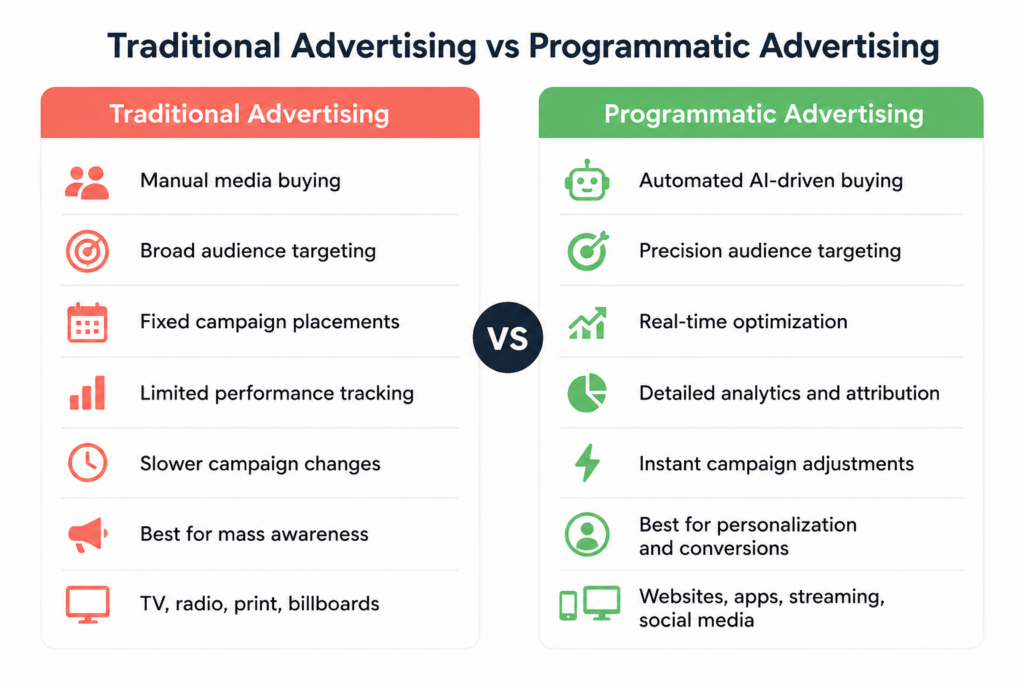
As a result of these benefits, brands are rapidly moving to a purchase-based system for their advertising campaigns through programmatic platforms. Some of the benefits that programmatic advertising offers are:
- Increased Targeting Capabilities
- Quicker Optimization
- Real-Time Analytics
- Lower Waste
In an advertising market where dollars are limited, efficiency is becoming the only thing that counts.
Traditional media isn’t disappearing — but its power is changing
Although traditional media continues to exist and has changed its effectiveness due to how consumers now consume media, the measures of those effects have also changed.
But the audience’s behavior has changed. Gen Z watches creators more than channels; streaming has fragmented viewership, and TikTok has compressed attention spans into seconds.
That is why the debate around programmatic advertising vs traditional media is growing stronger.
Traditional media still offers scale.
Digital offers precision.
As Ad Pulse points out,
“Traditional advertising focuses on reach, while programmatic focuses on results and precision.”
A billboard cannot measure engagement. A programmatic ad can track clicks, watch time, purchases, and campaign performance in real time.
That level of accountability is reshaping modern advertising.
The real reason brands are shifting advertising budgets to digital
Brands are steadily increasing their commitment to digital marketing and advertising. It’s a common misconception that technology is the sole driver of this change, but in fact, the driving force has been shifting consumer behavior.
Consumers today want their advertisements to be relevant, personalized, and timely. Brands are looking for advertising channels that allow them to reach a specific audience, adapt to spontaneous timing changes, and provide statistical data that proves results.
Hence, it makes sense that we are seeing an increase in brands’ budget commitment to digital marketing via programmatic advertising, using AI tools to target and analyze the performance of their campaigns.
Is traditional advertising dying?
Nope, it’s still changing.
TV commercials are changing into a data-driven model through streaming services, Connected TV, and individualized viewing experiences. Traditional media still has the power to shape culture, and digital gives brands precise targeting and measurable results
The brands that embrace both are the ones that will grow moving forward.
How young audiences are reshaping advertising
With Millennials and Gen Z altering how we pay attention on the web, they can skip, watch, and interact with their favorite brands no matter the screen, and they’ll demand that brands appear authentic, not intrusive.
That’s why the marketing trends in digital for 2026 will focus on User-Generated Content, AI-Powered Personalization, and Interactive Advertising Experiences.
What are the notable benefits of Omnichannel marketing strategies
The traditional linear buying process has been replaced by a more complex experience.
A buyer might learn about a brand on TikTok, search for further information on Google, and finally make a purchase via IG or via an app.
Because of this shift in consumer behavior, brands are developing and implementing omnichannel marketing strategies to deliver a unified customer journey across multiple platforms. Some recent examples:
A shopper discovers a skincare product on TikTok, researches it on Google, sees a Connected TV ad later, gets retargeted on Instagram, and finally buys it through the Sephora app.
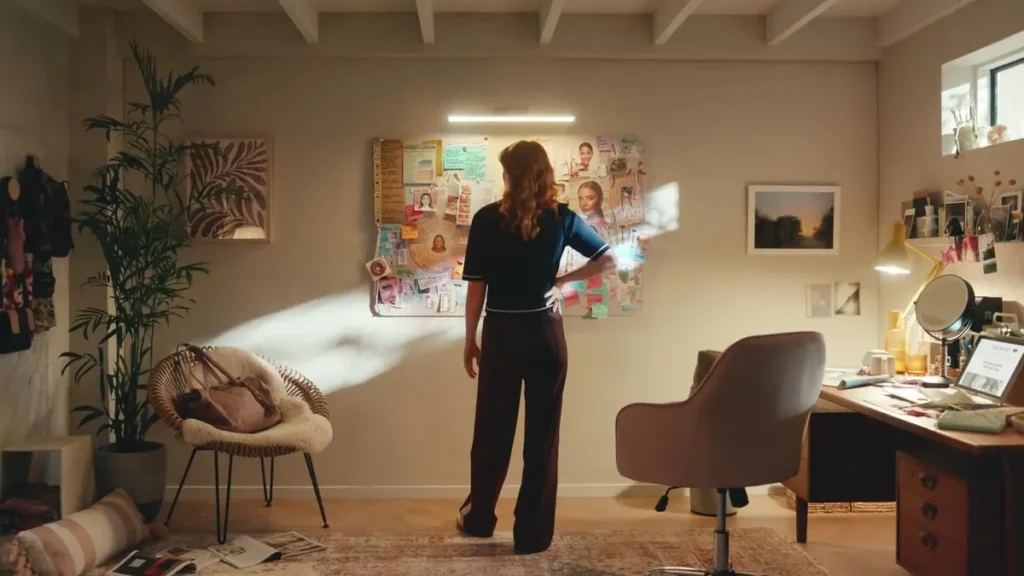
The customer views an advertisement created by Nike on various social media sites, tests out products via the Nike app, receives follow-up notifications on streaming service advertisements and YouTube advertisements, and ultimately completes the purchase through either Nike’s app or their in-store pickup option.
The future belongs to hybrid advertising
Advertising will not be an either/or scenario of traditional vs. digital; rather, brands will succeed by leveraging both traditional and digital, and by using an emotional storytelling approach coupled with programmatic precision, the power of artificial intelligence to guide advertising effectiveness, and the ability to create personalized advertisements in real time.
More importantly, by 2026, advertising will have evolved beyond visibility to include understanding what drives attention movement among audiences.
Cut to the chase
Even though traditional media isn’t going anywhere, programmatic advertising is revolutionizing the ways that brands attract attention, measure effectiveness, and allocate funds in the online world. Brands that can effectively combine storytelling with AI-based programming will ultimately own the future of marketing.
FAQ’s
Programmatic advertising is the automated buying and selling of digital ad space using AI, data, and real-time bidding instead of manual negotiations.
No. Traditional advertising is evolving through streaming platforms, Connected TV, and digital integrations, while brands increasingly combine it with programmatic strategies.
Brands are moving budgets to digital because programmatic advertising offers better targeting, real-time analytics, personalized campaigns, and measurable performance.