The Culture of Shopping: From Malls to TikTok Shop
The culture of spending weekends at malls, trying several fits, and buying like there will be no tomorrow is not exactly a thing of the past. It is simply not happening in the same way. Shopping trends in 2026 have evolved.
The shopping journey now starts much earlier and can happen almost anywhere.
A product can appear in a TikTok video, recommended by an AI bot, get validated through Reddit comments, be compared through Google, and finally purchased through a retailer’s app. Or the journey can go on anyway. The path is not linear.
That is the culture of shopping in 2026.
Retailers need to look beyond the traditional store-versus-online debate. Physical experiences are evolving and merging with digital behaviors. There is an emergence of phygital shopping, where online research, social discovery, physical experiences and digital transactions increasingly work together.
So, what are the major shopping trends in 2026? Let’s find out.
What to Expect from This Article
- 10 Shopping Trends shaping the way consumers discover and buy
- What Is Social Shopping? And why it matters to modern retail
- What Retailers Need to Know about changing shopper behavior
- What Retail Marketing Experts Can Do to turn these shifts into actionable strategies
10 shopping trends in 2026
Salsify describes the new culture of the shopping environment as an “always on” shopping era. Here, consumers can move from passive discovery to purchase across multiple channels. Its 2026 research also found that physical stores remain an important discovery channel, while shoppers continue to move between online and offline touchpoints.
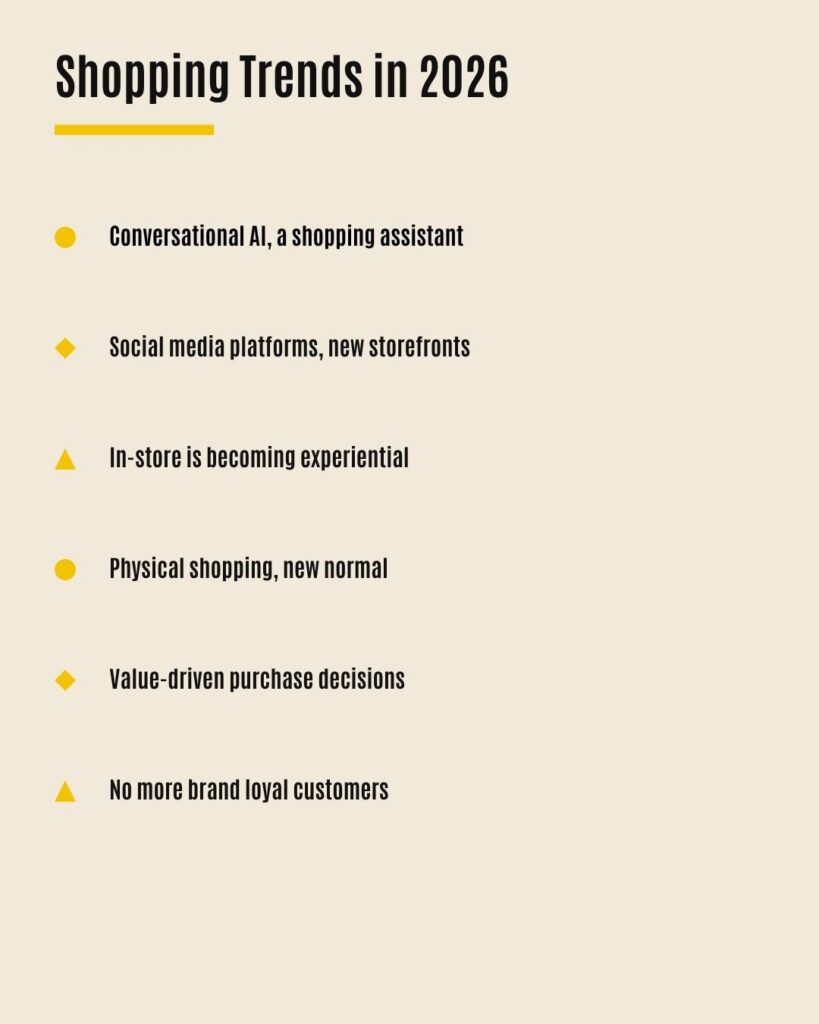
1. Conversational AI, a shopping assistant
Consumers are using generative AI to discover products, converse to compare and increasingly shape purchase decisions.
2. Social media platforms are new storefronts
Social platforms are merging entertainment, recommendations, community conversations and checkout into one shopping environment.
3. In-store is becoming experiential
Stores increasingly function as spaces for discovery, product testing, advice and experiences rather than simple checkout points.
4. Phygital shopping, new normal
Shoppers move between websites, apps, stores and social platforms without treating them as separate shopping journeys.
5. Value-driven purchase decisions
Price, promotions, product quality and perceived value are becoming increasingly important as consumers become more selective with spending.
6. Consumers are no more brand loyal
Shoppers are increasingly willing to switch brands when another product offers better prices, features or relevance.
7. Cross-channel product research
Consumers check multiple sources, reviews, social conversations and product pages before committing purchases.
8. Need of useful personalization
Shoppers increasingly expect recommendations tailored to their needs but still want transparency and control over personalization.
9. Product content is a conversion tool
Images, videos, reviews, comparisons, specifications and detailed descriptions increasingly determine whether shoppers feel ready to buy.
10. Social shopping
Creators, influencers, reviews, forums and user-generated content increasingly influence discovery, validation and purchase decisions.
What’s social shopping in 2026?
Social media is increasingly relevant across the purchase journey, while AI is changing how consumers search, evaluate and discover products. Salsify found that 64 percent of shoppers surveyed were using AI shopping tools to discover or research products. McKinsey’s 2026 consumer research points in the same direction. Among Gen Z respondents, 28 percent said they already use generative AI tools for shopping.
Social shopping is not simply putting a “buy now” button underneath a social media post. It is a combination of discovery, influence, validation, and purchasing inside social environments.
TikTok is a useful example. A shopper can watch a creator demonstrate a product, read comments from other users, see a product link, compare reactions and purchase without leaving the platform. The content is the advertisement, review, recommendation, and storefront at the same time.
That explains how TikTok is changing shopping. It reduces the distance between entertainment and commerce.
The traditional retail journey was often deliberate. Consumers decided to shop, visit a store or website, search for products, and purchase them. The newer journey can be accidental.
A consumer may not be shopping at all. They are watching a video. Then comes discovery. A recommendation creates curiosity. Comments provide validation. A creator provides a demonstration. A link provides access. The purchase can happen within minutes.
But there is an important catch.
The mall is not dead, yet
It would be easy to declare physical retail outdated. The data does not support that conclusion.
UPS found that 59 percent of surveyed consumers still preferred shopping in-store, while its research also showed that shoppers increasingly expect online and physical experiences to work together.
Salsify similarly found that physical retail stores were the leading method for discovering new products in its 2026 research, narrowly ahead of online marketplaces. It also found widespread webrooming and showrooming behavior.
The store, therefore, is changing its job.
A physical store can allow consumers to touch a product, try it, ask questions, compare options and experience the brand. The purchase may happen there. It may also happen later through an app.
Things retailers need to keep in mind
Retailers need to stop thinking about channels as separate departments.
- A website cannot have one product description while the store employee gives another.
- A social post cannot promote a product that is unavailable online.
- An AI assistant cannot recommend outdated inventory.
- A physical store cannot offer an experience the digital channel fails to support.
Consistency is the most sought ingredient in omnichannel marketing as a part of the shopping experience.
Salsify found that shoppers increasingly research across multiple channels before purchasing. For fashion, apparel, personal care and beauty, 54 percent of shoppers surveyed said they review two or three channels before buying.
Retailers also need to rethink personalization.
Consumers want relevance, but relevance is not the same as being followed around the internet by the same product recommendation. AI should help shoppers find what they need faster, not make the entire experience feel automated.
Trust becomes even more important as AI-generated content expands.
McKinsey found that AI systems increasingly pull information from third-party sources such as forums, reviews, blogs, and video platforms. It also found that brand-owned websites accounted for only 1 percent of sources cited by large language models in its analysis.
What can retail marketing experts do?
For marketers, the biggest change is moving from campaign thinking to journey thinking. A campaign can still create awareness. But shoppers now encounter brands through hundreds of fragmented moments.
A creator may introduce the product. A review may validate it. An AI search may compare it. A retailer’s marketplace may sell it. A physical store may complete the experience. Marketing needs to work across those moments.
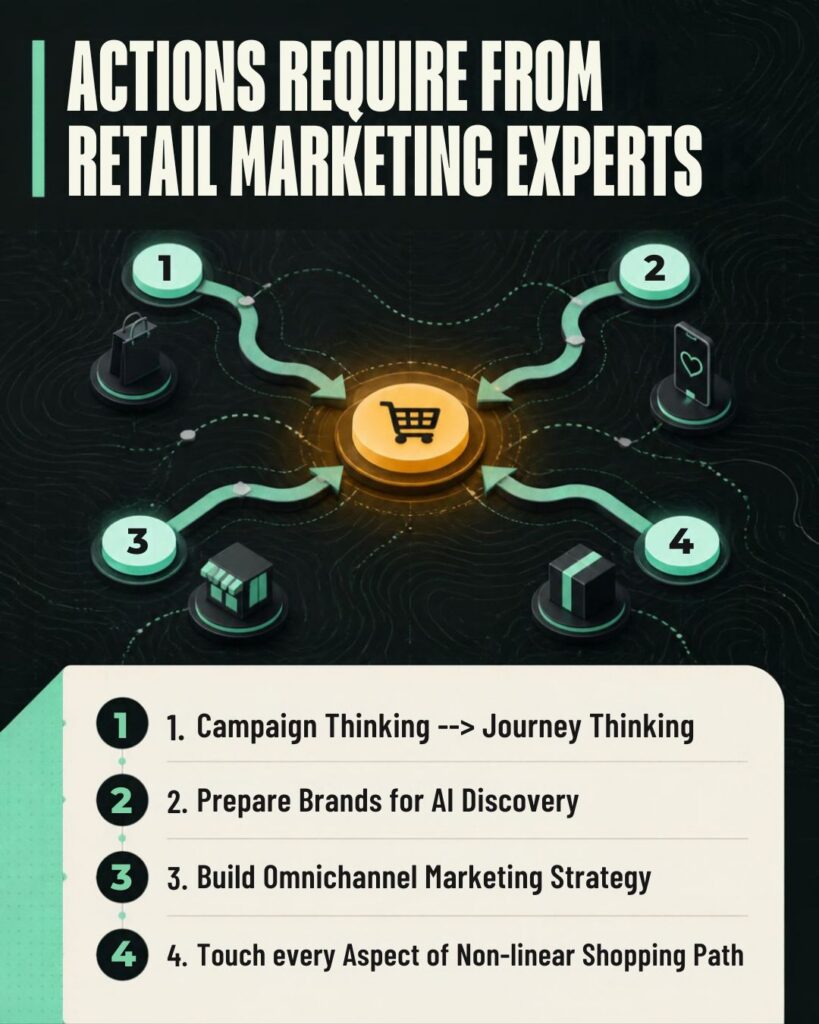
That means creating content that is useful beyond advertising. Product demonstrations, comparison content, creator reviews, FAQs, customer stories and community conversations can all become part of the purchase journey.
Marketers also need to prepare brands for AI discovery. Traditional search optimization is no longer the entire game. Brands need clear product information, consistent descriptions, credible third-party references, and content that AI systems can understand and retrieve.
McKinsey notes that brands may increasingly need to think about visibility inside large language models alongside traditional search. At the same time, marketers should resist the temptation to automate every consumer interaction. The more commerce becomes automated, the more valuable genuine human signals can become.
A real review. A useful creator demonstration. A knowledgeable store employee. A community recommendation. A customer interaction that solves a problem.
These are not old-fashioned assets. They are trust signals in a shopping environment increasingly crowded with synthetic content.
Cut to the chase
The culture of shopping has not disappeared. The mall has become one part of the journey. The website is another. TikTok is another. AI search is another. That is what makes how shopping is changing in 2026 a bigger question than whether consumers prefer online or offline shopping.