Comment Culture: Why the Conversation Is Becoming the Content
There was a time when the comment section existed simply to react to content. Today, it’s often the reason people stay.
Whether it’s TikTok, Instagram, YouTube, or LinkedIn, users increasingly scroll straight to the comments, not just to leave an opinion, but to understand what everyone else thinks. For many, the conversation has become just as valuable as the content itself.
That shift is changing how marketers think about engagement. Success is no longer determined solely by what happens in the feed, but by what happens beneath it.
The comment section is no longer where content ends; it’s where a second layer of content begins.
So how did the comment section become the most valuable asset on social media?
Welcome to the era of comment culture
Comment culture has extended beyond giving feedback but has also emerged as an entertainment medium.
An exemplary way is through TikTok. Users develop entire communities built around inside jokes and build upon those jokes through comment threads. Thus, creators use audience comments in new videos to continue the storyline.
Users commonly say that they “came for the comment.” This would have seemed like a ludicrous statement a decade ago!
Being a part of the audience is no longer simply watching but participating. There is thus a more collaborative form of content creation, with creators igniting the spark, while communities fuel the fire around it.
Why audiences trust comments more than content
As audiences become more skeptical of polished content, comments are becoming a trusted source of validation. Consumers understand that creators have sponsorships, use algorithms to drive reward engagement, and that brands naturally present their best side. Comments, by contrast, often feel more spontaneous and authentic.
As consumers rely more heavily on comments to gauge how others are reacting to an advertisement for a product or service, many are going directly to the comments to see what is being said.
Often, the comment section serves as a shortcut for consumers to form a good opinion of a product or service, verify the credibility of claims, and read real-time reviews before making their own decision.
The comment section is becoming the new community
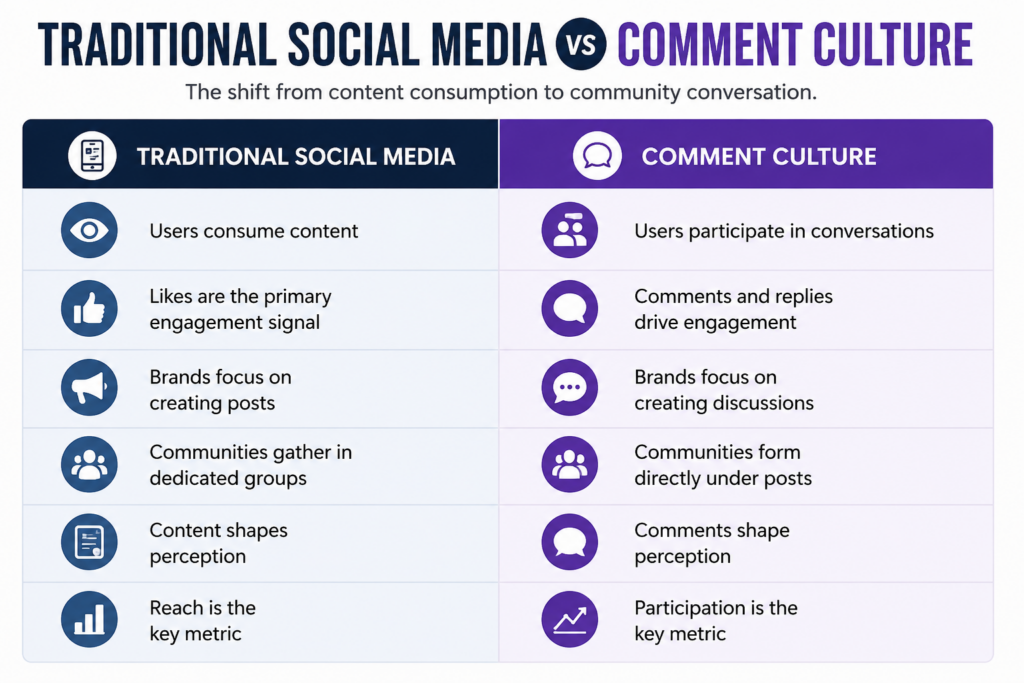
Traditionally, online communities would come together in specifically designed areas. These would include things like:
- Forums
- Groups on Facebook
- Communities on Reddit
- Servers on Discord
These areas are still around, but more and more, communities are coming together underneath a post.
For example, BookTok readers are discussing their book recommendations and debating book endings in the comments. Sports fans are using highlight videos to have live discussions. Fitness creators are using their videos to find and connect with people who can share tips in reply threads.
Communities that form under a post differ because they can be easily accessed by users.
Users do not need to go to another platform or an entirely separate group to join in on a conversation; as soon as they click on something, they begin to participate in it.
For brands, this means that building communities no longer has to happen in owned spaces. Building a community of fans can take place wherever audiences are having conversations.
The social media sector has long used “likes” or thumbs up as a method of tracking engagement. However, “likes” are passive forms of engagement.
In contrast, commenting on a post or replying to someone else’s comment requires active participation, thereby indicating a much greater commitment of time and energy than simply liking an item does.
Thus, many platforms are now placing greater emphasis on content that fosters discussion (i.e., invites comments).
A single comment can spawn multiple responses. One response leads to another, and so on. Conversations often continue after the initial post, and new users join because they find the discussion interesting.
From an engagement standpoint, comments can generate momentum for a post while a “like” simply indicates that a user agrees with a post.
Consequently, brands that focus solely on impressions and reactions may miss the bigger picture. Engagement on social media is increasingly driven by participation rather than observation.
Comments are becoming real-time market research
There is an unexpected result of this shift: the comments section has become an invaluable resource for consumer insights.
- Consumers express their frustrations through comments.
- Consumers communicate their unmet needs.
- Consumers compare products to competitors.
Consumers describe to one another why they’ve made or why they have not made a purchase as a result of their product.
Previously, companies used to spend money on focus groups in order to gather these same types of insights. Now many of these conversations are made public and voluntary.
For example, the surge of things such as the Stanley tumbler; while product awareness increased via influencer marketing, it is also as a result of consumers communicating with each other their ranges, experiences with these products, and providing recommendations on social media.
These comments give marketers insight into what customers actually want. For marketers, such information is hard to ignore.
The brands winning today aren’t just posting. They’re participating.
A few brands will continue to view comments as a means of communicating with customers for service. However, other companies are beginning to see comments as content.
Duolingo, Ryanair, Wendy’s and Scrub Daddy have become known for their active engagement with their audience in comment sections. The responses that brands provide in comment sections generate similar amounts of attention to the initial post.

Brands do not want to monopolize every conversation they can identify. Rather, they would like to provide an opportunity to participate within an existing conversation.
Brands that are aware of the culture of comments believe that community contribution is typically more genuine than an advertisement.
The smartest social teams do not merely create content. They assist in creating conversation around the content.
Measuring social media engagement in the comment era
As the importance of comment sections continues to rise, traditional metrics are becoming less effective on their own as a means to measure outreach effectiveness.
Traditional metrics
While one million views represent outreach
Views do not represent connections.
Marketers must look beyond vanity metrics, to measure the effectiveness of their current social media and community engagement efforts.
Some of the most valuable questions to ask your content are:
- How many meaningful conversations did my post generate?
- Are users replying to one another?
- Are users returning to participate again?
- Is the community growing organically?
These indicators of long-term brand health are more useful than traditional social media impression metrics. The future of engagement measurement will put less value on audience size, and more value on audience participation.
The future of social media lives below the post
The biggest social media trends are often discussed in terms of algorithms, AI tools, and platform updates. But one of the most important shifts happening right now is behavioral.
People increasingly view social platforms as places to discuss rather than simply consume. The feed may still capture attention.
But the comments are where attention lingers, opinions of form, and communities take shape. For brands, creators, and marketers, that distinction matters.
Because the next generation of social success won’t be determined solely by who creates the best content.
It will be determined by who creates the most compelling conversations.
And increasingly, those conversations begin where marketers once paid the least attention.
Cut to the chase
Marketers continue to invest an enormous amount of money to gain consumers’ attention; however, audiences now seem to get the most value from the comments below. Consumers consider what is being said in the comments, whether it’s advice on products, funny videos that got tons of views, or commenting on the heated arguments occurring, much more entertaining than the main content of each post.
FAQ’s
Comment culture is the trend of audiences spending more time engaging with conversations in comment sections than simply consuming the content itself.
People read comments to get authentic opinions, verify information, and see how others are reacting before forming their own views.
Comments reveal customer sentiment, spark engagement, and provide valuable insights that can help brands improve their marketing strategies.