
AI Productivity in Marketing: Are Teams Really Saving Time or Just Doing More Work?
The promise of AI productivity in marketing was simple: eliminate repetitive tasks, streamline workflows, and give marketers more time for creativity and strategy. Instead, many teams are discovering an unexpected reality — work is happening faster than ever, yet it feels more exhausting than ever.
There are faster turnaround times for campaigns; content production is happening in bulk; and reports that typically took 2 to 3 days to create are now available right away.
AI has undoubtedly increased marketers’ productivity; however, many marketing teams are quietly asking themselves the same question: If AI is saving them so much time, why do people still feel so overwhelmed?
Let’s deep-dive into the growing tension between efficiency and exhaustion—and explore the rise of the AI productivity paradox.
The productivity boom marketers wanted
Marketers have been excited about AI for good reasons. Marketing teams spend a ton of time doing repetitive tasks (e.g., writing ads, analyzing reports, building presentations, repurposing content).
But today, there are many productivity tools for marketers using AI that can perform these processes in minutes. Marketers are using AI to:
- Generate campaign ideas
- Write email copy
- Create social media posts
- Build SEO outlines
- Analyze performance data
- Personalize messaging
AI has really changed what modern marketing operations look like. A single marketer can now generate the output of an entire team previously.
However, faster workflows have also created new expectations.
The AI productivity paradox
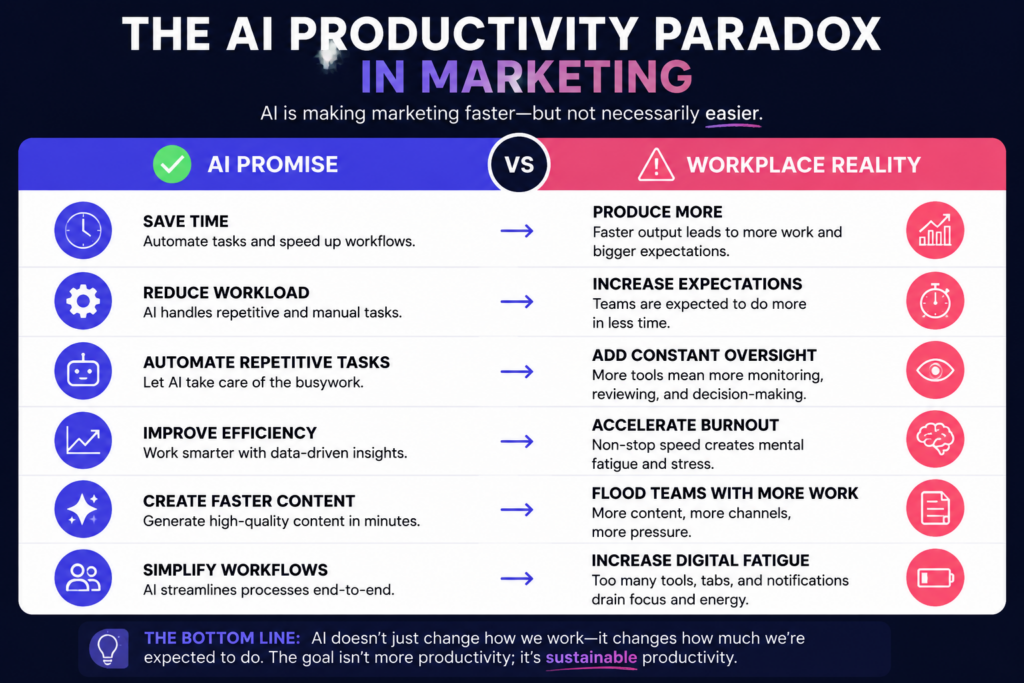
The greatest myth concerning Artificial Intelligence is that producing speedier results equates to producing fewer results. The reality is that when you execute work more quickly, you are also likely to be adding more work.
So where once your campaign took a week to execute, now senior management expects it to be delivered in two days. If AI can produce ten versions of content quickly, companies develop a demand for fifty. Employees experience this increase in productivity as an increase in their workload; employees do not benefit from new levels of productivity, but instead have created a higher productivity benchmark.
This is what makes the impact of AI on marketing productivity so complex. You may become more efficient on a technical level, but there is no relief for many employees. Instead of experiencing a reduction in time, they experience increased demand.
As a result, there is more pressure, shorter deadlines, and continuous optimization.
The AI productivity reality check
The use of AI technologies has greatly increased the speed of marketing teams globally; based on the findings of the recent industry report (2026), 87% of marketers currently use generative AI in at least one of their day-to-day processes, and on average, marketers will benefit from a reduction in the amount of time spent on AI tools by approximately 6.1 hours per week compared to pre-AI usage.
However, the most recent findings from the Industry Report (2026) state marketing professionals reported the highest levels of mental exhaustion related to using too many AI systems, with 26% of marketers reporting a level of brain fry due to AI-generated manufacturing of results; researchers attribute this to continuously providing oversight for AI systems while assuming that you will have to make multiple decisions to produce product launch results with AI produced content at an accelerated pace.
More output, more stress
The clearest example of change that can affect how brands communicate is through content creation.
Because of AI, brands can create blogs, emails, social media posts, and advertising campaigns at an unthinkable level of volume. There is more on the content calendar because of how much faster AI is able to create content.
At the same time, more content does not necessarily mean higher-quality content.
Much of the content generated by AI today is repetitive because teams use similar prompts, trending topics, and formatting; this is especially evident in product marketing, where the speed of output can sometimes replace thoughtful storytelling or positioning strategies.
Consumers are noticing the lack of difference, and marketers are feeling tired from the constant churn of content creation.
Is AI adding more stress?
Absolutely true for many of today’s professionals.
Prior to the advent of AI, the majority of limitations stemmed from time or resource constraints. Today, however, the primary limitation is your ability to focus. As a result, when marketers are tasked with evaluating potential campaign options, creative variations, personalization, evaluating and analyzing any data/analytics resulting from campaigns A and B being run simultaneously by an AI system, etc., so on and so forth, mental fatigue can create a ‘decision paralysis’ for marketers.
The question is no longer whether we can create something, but which version we should go with.
As such, there has been an increase in discussion/concern about the impact of AI on burnout in the workplace (i.e., AI-induced digital fatigue). While many agencies use AI technologies to improve their workflow processes, the use of such tools eliminates the natural breaks between tasks, which can alleviate work-related stress/discomfort/strain caused by extensive use of digital applications.
Marketers are experiencing the overwhelming effects of a nonstop workflow driven by excessive technology use in the workplace.
The real role of AI
While there may be some fears about how AI could impact marketing teams, they are not adverse to marketing teams. Many organizations today have found value in AI as a necessary component in their overall marketing strategy.
Instead of using AI to supplant people’s creativity within the organization, the healthiest organizations use AI to remove repetitive obstacles from hardworking creative professionals.
In the most effective team, AI enables marketers to:
- Automate manual tasks
- Reduce the time needed for research
- Produce simple reports
- Create content drafts in advance
- Improve process efficiency.
The goal of AI should not be endless productivity, but smarter and more sustainable work. When used effectively, AI can handle repetitive tasks, giving marketers more time for strategy, creativity, and storytelling.
The future of AI productivity
Future marketing belongs not to those who use the most AI tools, but to those who employ AI responsibly, so as not to overwhelm employees or audiences.
Organizations are already beginning to realize that generating infinite amounts of content is not a sustainable solution. Audience members have become increasingly picky. Generic messages generated by AI will be easier to disregard than before.
The only thing that can help brands distinguish themselves is their ability to balance automated work with original work.
Simply being productive is no longer an impressive feat.
Everyone is productive these days.
The only way organizations can gain an edge is to know how to create something that still has a human character in a world so full of Automated creations.
Cut to the chase
AI was supposed to save marketers time, but for many teams, it has simply increased the pace and pressure of work. The real challenge now is not adopting AI faster — it is learning how to use it without burning people out. Read the full story on Ad Pulse to explore the growing AI productivity paradox shaping modern marketing teams.
FAQ’s
Yes, AI helps marketers automate repetitive tasks like content creation, reporting, research, and data analysis, allowing teams to work faster and more efficiently.
While AI increases speed and output, it also raises expectations, shortens deadlines, and creates nonstop workflows, leading to digital fatigue and workplace stress.
The AI productivity paradox refers to the idea that while AI saves time and improves efficiency, it can also increase workloads and pressure by encouraging companies to demand more output from teams.