
AI Influencers Go Global: Can Brands Balance Creativity and Brand Safety?
Imagine executing a fashion campaign starting at midnight, changing the model’s clothes before breakfast, adapting visuals for several countries by lunchtime, and publishing new content later in the day. No casting calls, studio bookings, or last-minute scheduling hassles.
Now imagine discovering that the influencer featured in the campaign doesn’t exist.
For marketers, this highlights both the opportunities and challenges of using AI-generated characters to promote products. Synthetic personalities open up new creative possibilities, but they also force brands to question where creativity ends and deception begins.
In 2026, the debate around AI influencer marketing is no longer just about creating convincing digital faces. It is about trust and the responsibility of businesses that use synthetic personalities to influence purchasing decisions. Let’s take a closer look.
AI influencers are changing the rules of marketing`
Traditional influencer marketing depends on a recognizable connection between creators, audiences, and the products they endorse. A creator’s personality, expertise, lifestyle, or direct experience with a product is often what makes their recommendations attractive to followers.
Synthetic influencers change that relationship by introducing digitally created personalities that may not have real-life experiences behind their recommendations.
These digitally created personalities can have a consistent appearance, voice, backstory, and personality aligned with a brand. Some are generated using artificial intelligence, while others combine computer-generated imagery (CGI), animation, and human creative direction.
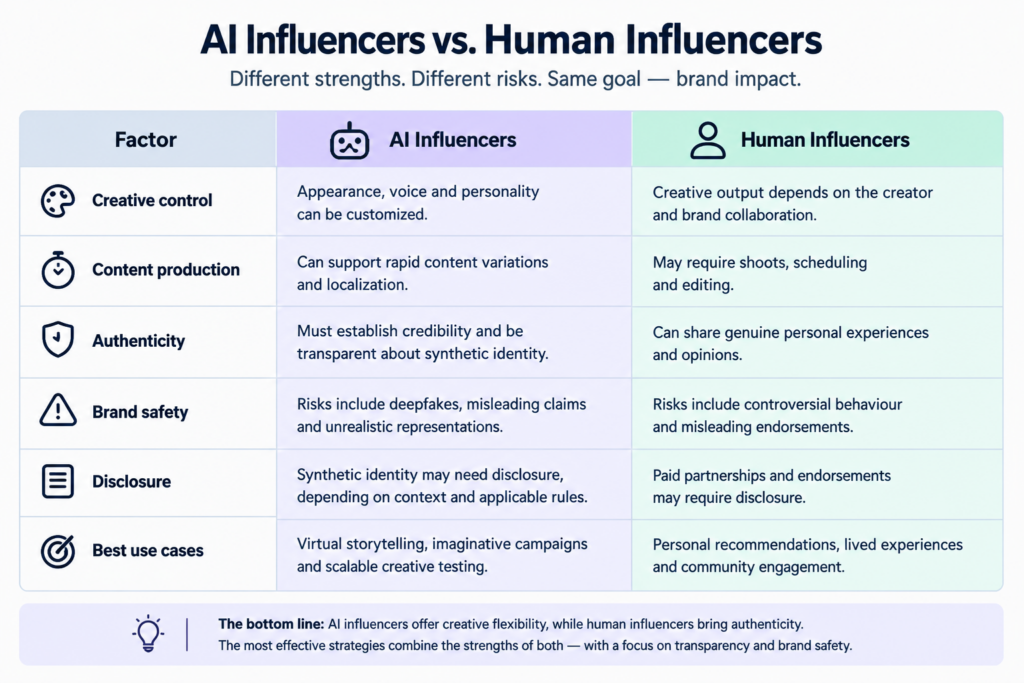
This offers clear benefits for businesses because synthetic influencers do not require travel, physical shoots, or coordination around a human creator’s schedule. Their appearance can also be adapted for different markets, niches, and campaigns.
Fashion, beauty, entertainment, and gaming are natural areas for experimentation. A digital character can highlight a collection, appear in a virtual environment, or participate in a creative concept that would be expensive or difficult to execute through traditional production.
However, creative control comes with risks. The more realistic a synthetic character looks, the easier it may be for audiences to mistake it for a real consumer. While this realism can attract attention, it can also mislead people about the nature of endorsement.
That is where AI influencer marketing moves from a creative decision to a brand-safety challenge.
The trust problem: Consumers are becoming more selective
Efficiency is arguably the strongest point in favor of using synthetic influencers, whereas careless use can lower the level of consumer trust.
A Gartner survey Of 1,006 US consumers found that 35% now rely on influencers less for shopping information and recommendations because of AI. The same research found that 65% believe brands produce too much AI-generated marketing content, while 57% say such content has made them less trusting of brand messaging overall.
These findings do not mean that consumers reject all virtual influencers. Instead, they suggest that audiences are becoming more cautious about content that feels artificial, repetitive, or misleading.
Gartner senior principal analyst Emily Weiss explains the appropriate response: “The answer is not to avoid AI. The answer is to use it thoughtfully.”
The distinction is important for brand marketers. A fictional character promoting a clothing collection can be an effective creative approach. However, a synthetic person pretending to be a customer and sharing an experience with a particular skincare product presents a different problem.
The issue is not that the influencer is artificial. It is that audiences may be misled about the experience, identity, or credibility behind the recommendation.
Why AI influencers become a brand safety risk
Brand safety involves protecting advertising from appearing alongside harmful or inappropriate content. Influencer brand safety extends this responsibility to evaluating a creator’s behavior, audience, claims, and credibility. The introduction of synthetic influencers makes these checks more complex.
1. Unreal experiences framed as real reviews: An AI-created persona can appear in an unboxing video or talk about the goods’ benefits and early successes. However, a fictional character could not yet use a skincare product, stay in a hotel, or test the pill.
When a brand shows some fabricated personal experience as authentic, storytelling verges on deception.
2. Unachievable illustration and damaging stereotype: Influencers that are created by artificial intelligence can create restricted beauty standards and unreal body ratios. A figure designed for a certain market can contain cultural or visual references that do not correspond to another category.
Companies require the approval of human professionals concerning representation, context, and cultural importance and are not always able to make a final check of the technical level of images.
3. Deep fake images and impersonating identity: Synthetic media can be similar to celebrities, ordinary people, or creative individuals and function without proper permission. The advertising campaign, which seems innocent, can bring reputational consequences if it uses a person’s image without consent.
4. Unrestrained statements and inconsiderate endorsing: The person created by artificial intelligence may seem knowledgeable; however, this does not mean that its statements are valid. All fields of goods require care when providing information regarding the advantages of products.
How brands are already testing synthetic influencers
Brands are exploring the potential of AI influence as part of their creative strategy to lower costs and to push products.
A recent Guardian report highlighted experiments involving Maket, Once, and fashion brand Ashle, while noting concerns about AI-generated content being mistaken for real people.
Indian brands are also exploring virtual influencers using existing marketing budgets.
The takeaway: brands should test synthetic personalities carefully, measure audience reactions, and establish clear transparency rules before scaling their campaigns.
Creativity vs disclosure: Does every AI influencer need a label?
It is not required that each advertisement that employs AI use a label. Nevertheless, the audience should be aware of the impact of synthetic content on their choice.
The IAB’s AI Transparency and Disclosure Framework is designed to provide consumers with productive information while not overloading them with unnecessary labels.
Caroline Giegerich, IAB vice president of AI, highlights the principle: “Trust is everything between a brand and its customers, and being honest about AI is part of earning it.” Source: IAB.
In case of virtual influencers, in cases where they look real, recommend goods, or make fictional events appear real brands must keep in mind transparency. The marketers must pay attention to the disclosure laws in every target market since there are going to be obligations regarding AI transparency according to the EU AI Act starting from August 2nd, 2026.
5 Ways to Use AI Influencers Responsibly
- Give the persona a clear identity: Make it clear when an influencer is virtual or AI-generated, particularly when its realistic appearance could lead audiences to believe it is a real person.
- Distinguish reality from fiction: A virtual character can tell a story, demonstrate product features, or participate in an imaginative campaign. However, do not invent personal experiences or suggest that the character independently tested a product.
- Address brand-safety risks: Identify and prevent risks involving deepfakes, unrealistic representations, harmful stereotypes, and misleading claims.
- Keep humans accountable: Assign a real team to approve claims, scripts, visuals, likeness rights, and final campaign materials. AI-generated advertising should never become an excuse for a lack of accountability.
- Establish cultural and category-specific safeguards: Review translations, local sensitivities, body representation, and product claims. Apply additional scrutiny to categories where misleading promotion could cause harm.
- Measure trust alongside performance: Track engagement, conversions, and creative efficiency, while monitoring audience sentiment, disclosure comprehension, complaints, and negative reactions. A campaign that produces inexpensive content but damages credibility is not necessarily successful.
These practices help make AI influencer brand safety part of the creative process rather than a last-minute compliance exercise.
The future of virtual influencer marketing
The evolution of synthetic influencers will open up new avenues for brands when creating and producing their content. They will be able to tell interactive stories, run multilingual campaigns, create virtual experience environments, and produce creative ideas that would otherwise be impossible to achieve using traditional techniques.
However, the scale itself is not enough to secure a competitive edge. If every brand can create an instance of a hyper realistic character, the need for authenticity and clarity will be even bigger among clients.
To be successful in synthetic influencer marketing, brands will need to create the best characters rather than the most realistic ones.
The division between safety and creativity cannot be defined by the mere usage of AI, but by the moment when the illusion of creation stops being truthful. Brands can break the limits of creativity if they do not blur the limits of trust.
Cut to the chase
AI influencers can help to run campaigns faster, reduce production costs and expand the creative options—but an erroneous synthetic influencer can harm people’s faith in a certain product. The main obstacle for companies is that it is not constructing ai influencer but rather striking a balance between creativity, transparency, and safety of the brand.
FAQ’s
AI influencer marketing uses digitally created personalities to promote products, services and brands across social media and other digital platforms.
Yes, when audiences could mistake a synthetic personality for a real person or be misled about its identity, experience or endorsement. Brands should follow applicable disclosure requirements in each market.
Brands can use AI influencers responsibly by being transparent about synthetic identities, verifying product claims, obtaining permission for likenesses, reviewing cultural sensitivities and maintaining human oversight.
At a Glance
- AI influencers offer creative flexibility: Brands can develop scalable, adaptable campaigns across markets and platforms.
- Consumer trust matters: Misleading synthetic content can damage brand credibility and influence purchasing decisions.
- Brand safety goes beyond content: Deepfakes, unrealistic representations, unauthorized likenesses and false endorsements all pose risks.
- Transparency is essential: Brands should disclose synthetic identities when needed and comply with relevant advertising regulations.
- Human oversight remains critical: Verify claims, monitor audience reactions and measure trust alongside engagement and conversions.