

AI Search Optimization: How Brands Can Win Visibility in ChatGPT and AI Search
Consumers are increasingly relying on AI assistants like ChatGPT, Perplexity, Gemini, and Claude to research products, compare services, and discover brands. That shift is creating a new marketing challenge: brands are no longer optimizing only search engines; they are optimizing AI recommendations.
Gartner predicts that by 2026, the volume of traditional search engines will drop by 25% as more people look to AI chatbots and virtual agents for assistance. Brands are being forced by this change to reconsider their digital marketing tactics outside of SEO.
The focus is moving from ranking 1 on Google to becoming one of the trusted sources of AI systems references when generating answers. This evolution has given rise to AI search optimization, also known as Generative Engine Optimization (GEO), a strategy designed to improve brand visibility inside AI-powered search experiences.
To see why it’s becoming essential, let’s explore how AI search differs from traditional search.
Why AI search is changing digital discovery
Someone is looking for accounting software. Instead of opening Google and clicking on ten links, they ask ChatGPT:
“What is the best accounting software for small businesses?”
Within seconds, AI recommends a handful of brands. If your business isn’t one of them, you may never get the opportunity to compete. This is the new reality of digital marketing.
Typically, in the case of traditional search engines, the search patterns are defined with a certain predictability:
Search → Browse through results → Visit websites → Compare → Buy
With AI search, however, this whole process suddenly becomes much shorter. Users no longer have to go through various pages of the search results because they get well-structured responses containing advice, comparisons, and explanations in one answer.
Adobe Analytics reported a 1,200% increase in traffic from generative AI sources to U.S. retail websites during the 2024 holiday season, highlighting rapidly growing AI-assisted shopping behavior.
From the perspective of marketers, this presents a whole new challenge. The war is no longer about getting clicks but about becoming part of AI’s answer.
AI SEO vs Traditional SEO
Although both aim to improve their discoverability, they work differently.
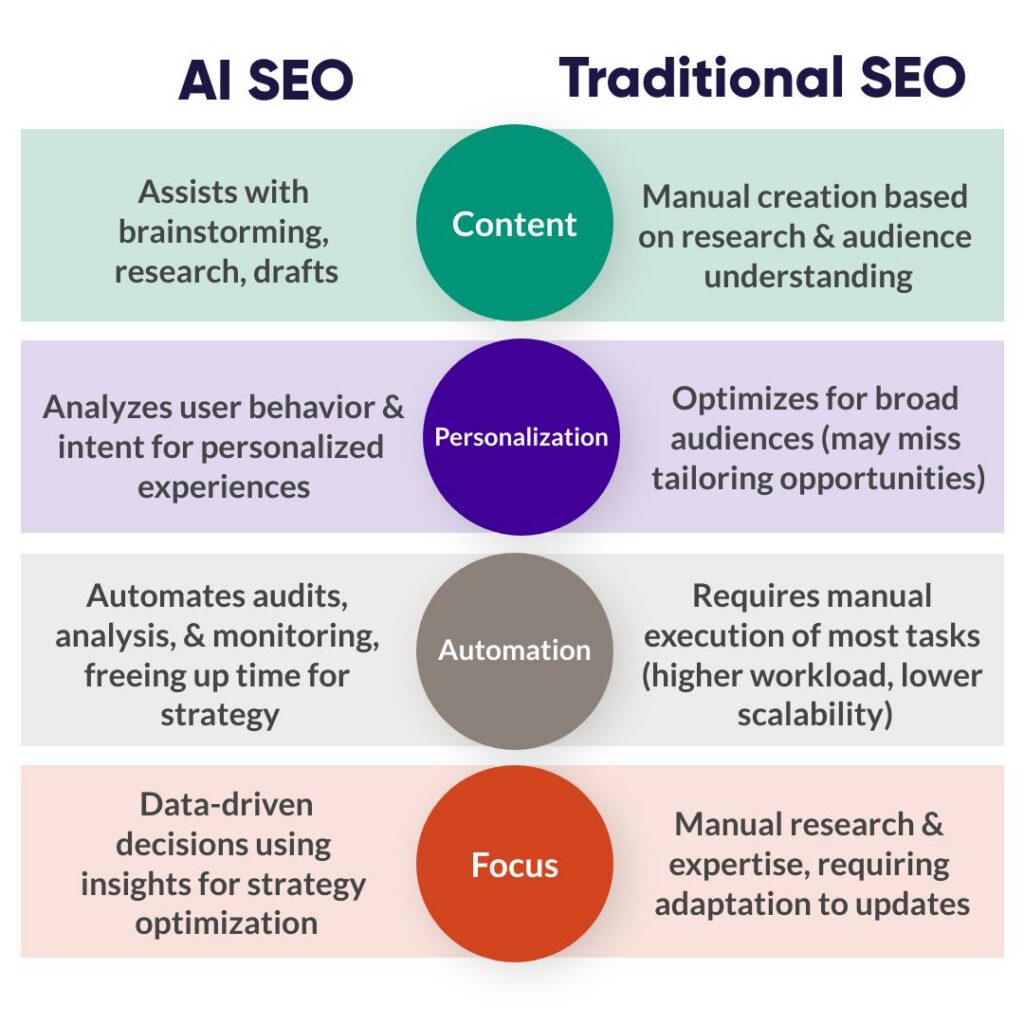
Conventional SEO is still crucial. Google Search is still a major source of traffic. AI search optimization, however, is starting to supplement SEO rather than take its place.
These days, brands must be visible in both contexts.
What is AI search optimization?
The aim of optimizing the search using artificial intelligence is to make sure that the materials produced by you can be understood, verified, and referred to easily by large language models (large language models) when they provide answers.
In contrast to conventional search engines that rank sites, AI models combine information from several sources before they respond.
This means that effective optimization is not solely dependent on density of keywords but rather on:
- Quality of the content
- Expertise on the subject
- Clarity of the explanation
- Consistency of the brand information
The reputation of your brand and its credibility on the internet.
Why brands are investing in GEO optimization
Several trends are accelerating the adoption of GEO, starting with the growing role of AI in product discovery and research.
Consumers are now using AI assistants to find:
- Product suggestions
- Software comparisons
- Medical advice
- Finance and investment information
- Travel arrangements and planning
- Firms research
These conversations take place before entering a website. This trend gives more value to AI recommendation visibility.
Zero-click experiences are on the rise:
There are cases where users get answers without clicking on anything. This means that while there may be less overall traffic towards a website, it is much more important to get featured in AI-generated responses. If people don’t land on the SERPs, actual ranking is becoming irrelevant.
Importance of trust is increasing over rankings:
Information that is consistent across several trustworthy sources is given priority by large language models.
Brands that have:
Authoritative publications, client reviews, and organized documentation are mentioned by the expert content industry. Are typically more likely to be cited.
Brands AI search visibility optimization tools
New services are appearing to assist brands in monitoring and enhancing their presence as AI search expands. Among the top tools are:
Insert a table…
These platforms are very useful to marketers as they offer insights on:
- if their brand appears in the AI recommendations
- who the competitors are and how much visibility they have
- the reference sources of competitors
- how effective the prompts are
- the share of voice of the brand
The growth of AI search emphasizes the fact that measurement is becoming just as important as the process of optimization.
How to optimize content for AI models
To optimize your content for AI models, you should aim to provide material that is simple to follow, dependable, and genuinely useful. The key is to provide answers for users, to structure your material using titles and subtitles, and to cover related subjects in a unique manner.
You should also provide original facts or ideas, back up any claims you make with reliable evidence, and keep your brand image consistent throughout your content. In addition, you need to ensure that you practice strong technical SEO, which involves using structured data, having high-speed websites, and using a clear structure in your website content.
AI marketing strategy is becoming more cross-channel
AI visibility needs the teamwork of all different parts of your business. Some areas that need to be included in the collaboration in AI visibility include:
- Search engine optimization
- Content marketing
- Public relations
- Product marketing
- Customer service
- Social media
- Documentation for developers
Therefore, all of these factors contribute to AI’s perception of you.
Common mistakes brands are making
Several organizations are making critical mistakes while trying to optimize the use of AI. Some of the common mistakes are:
Using GEO as keyword stuffing: AI prefers the best quality, relevant information, and authority is important, rather than overusing keywords.
Publishing raw AI content: AI content must have been processed to be meaningful, but human expertise always adds credibility to it.
Disregarding your brand reputation: The company’s overall reputation will affect how AI systems view the brand’s performance.
Focusing only on Google would not suffice: Nowadays, it is vital for marketers to operate not only with search engines but with AI assistants too.
The future of AI search optimization
Searching is no longer merely a stream of blue hyperlinks, but is now becoming a dialogue. With the advancement of AI assistants, the marketing specialists must prepare to entice the AI recommendations rather than rely just on search engine rankings.
Companies investing in trustworthy content, building a reliable digital brand reputation, and cultivating cross-channel credibility will be able to take advantage of opportunities offered by the newest technologies. Being successful in the new searching epoch means more than showing at the top of search results—it means being mentioned by AI among its sources.
Cut to the chase
Customers now consult AI assistants like ChatGPT, Perplexity, and Gemini for recommendations instead of merely looking on Google. Marketers need to switch from optimizing solely for search results to optimizing AI visibility as AI increasingly determines which companies to mention. This essay examines the reasons for the growing importance of AI search optimization (GEO), how it varies from conventional SEO, and the tactics brands may employ to become AI’s preferred option.
FAQ’s
AI search optimization (GEO) helps improve a brand’s visibility in AI-generated answers.
SEO targets search rankings, while GEO focuses on being recommended by AI platforms.
Create high-quality content, build authority, and maintain consistent brand information across the web.