
Marketing Attribution: Why Last-Click No Longer Works
A customer watches your CEO’s LinkedIn post, hears your brand mentioned on a podcast, asks ChatGPT for recommendations, reads reviews, visits your website three times, and finally clicks a Google Search ad before making a purchase.
Your dashboard gives 100% credit to Google Ad.
This is where last-click attribution fails. In the age of AI-powered and multi-channel customer journeys, the last interaction rarely tells the full story. Yet many organizations continue to optimize budgets based on a metric that ignores most of the buying process.
As the use of AI assistants, no-click search experience, retail media, influencer material, and privacy regulations change every aspect of the digital consumer journey, marketing specialists soon realize that past methods of attribution are getting outdated.
Brands that stick to this methodology are going to lose some of the most important touchpoints in the buying process and spend their marketing budgets on the wrong tools. Let’s explore
Why last click attribution no longer reflects reality
For years, customer journeys were relatively linear for users to search on Google, click on an ad, visit a website, and complete a purchase. Today, buyers discover brands through LinkedIn, creator content, AI assistants, reviews, newsletters, and comparison sites before finally converting. The last click may close the sale, but it rarely tells the full story.
So, although the last click seems like the reason for making a purchase, the actual purchase decision was influenced during all these previous steps.
AI is making customer journeys even harder to track
AI is essentially disrupting the way people find products.
Rather than having to open a bunch of tabs, people are now asking AI questions about:
- Which CRM tool is the best for start-ups?
- Which is the best cybersecurity software for under $100?
- What are the top project management tools?
The AI will search for everything and summarize the results efficiently before the user goes on to make a decision. However, this also creates a new challenge in terms of visibility.
A lot of important interactions happen before someone gets to the company’s website. Normal marketing attribution only works if the interactions are happening online.
Zero-click search is shrinking traditional attribution
The search is evolving in many ways.
With the advent of Google’s AI Overview, AI responses, snippets, and instant results, many questions are answered without visiting a site anymore.
Even when your content influences a buying decision, users may never visit your website.
According to Andy Crossen, Chief Product Officer, Partnerize ,”As AI-powered recommendations and zero-click discovery become more common, traditional attribution models built around clicks and website visits begin to break down.”
It leads to the false assumption that the SEO works worse just because there is a lack of clicks even when the brand presence and customer impact is on the rise. The effect of zero-click searches applies not only to search engines but to many other applications.
Privacy regulations have broken the old attribution model
The attribution process has become more complex due to concerns over privacy issues.
The days of third-party cookies have come to an end. Consumers are rejecting tracking more frequently. Mobile privacy regulations are imposing new limits on cross-platform measurement. Data collection practices are now requiring more stringent consent and transparency.
Consequently, marketers receive fewer data signals related to customer behaviors as compared to five years ago. Many businesses are working with fragmented data instead of complete sets of customer information.
Multi-touch attribution offers better context
Attribution modeling in marketing leads us to understand that credit cannot be assigned to just one touchpoint but is to be divided amongst various touchpoints along the way.
Some of the most popular models of attribution available today are as follows:
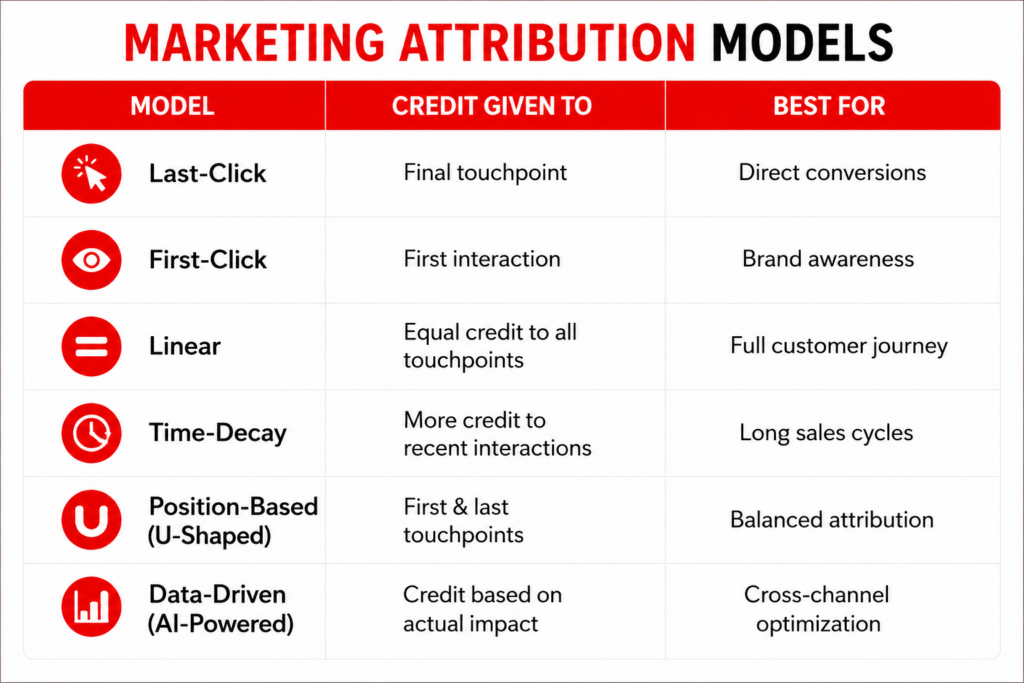
None of the models are free from drawbacks, but overall, multi-touch attribution provides a lot of advantages.
AI is transforming attribution modeling
The new age of AI entering marketing analytics is way beyond dealing with clicks percentages.
New AI systems analyze millions of signals derived from human behavior in order to determine what we cannot see.
While we normally ask the question,
“What ad got the last click?”
AI asks:
- “Which sequence of actions leads to the purchase?”
- “Which channel helps speed people’s purchase?”
- “How much time would the campaign pay off during the lifetime of customers?”
- “Which contact points help in making repeat purchase?”
Machine learning continuously updates attribution models as customer behavior changes. This allows marketers to move from static reporting toward predictive decision-making. Instead of simply explaining what happened, AI helps forecast what is likely to work next.
The rise of customer journey attribution
Nowadays, customers engage with brands on different platforms before they buy something. They may learn about a product from social networks, check reviews, talk to an AI assistant, get emails, and then go to the website to complete the purchase. Customer journey attribution attempts to show how all the mentioned interactions influence the process rather than giving credit for the last click.
Having this broader view allows marketers to conduct better analysis and discover what matters most to customers so that they can invest their budgets correctly. By studying the customer journey, marketers will find out about the platforms and channels which lead to increased awareness, engagement, and conversions.
Marketing teams need new success metrics
As more and more complications are introduced into customer journeys, measuring the success of marketing by only focusing on clicks and conversions is not adequate. Metrics such as customer acquisition cost, customer lifetime value, pipeline contribution, assisted conversions, and retention would paint a better picture of the contribution of marketing to business development.
Rather than asking where the final click came from, marketers should be asking the more important question of which activities drove the customer’s decision. This is the right approach for teams to be able to manage budgets better.
Why marketing mix modeling (MMM) is making a comeback
As the regulations regarding privacy will continue to evolve, making it complicated to track users on an individual level, Marketing Mix Modelling will become more vital in the marketing. Unlike measuring individual clicks, Marketing Mix Modelling makes use of aggregated data and establishes how various channels work together to drive the business.
For example, Consumer health company Suntory Wellness employed marketing mix modelling (MMM) analysis to discover that two of the main channels for the highest ROI in this company’s long-term advertising campaigns were YouTube and Search. Similarly, the gaming company Nexon used this MMM technique to assess the relationships between these different advertising channels and understand how they affect one another. In this way, Suntory Wellness and Nexon are applying this advanced marketing analytics technique, which helps companies go beyond traditional approaches of assessing advertising effectiveness through last-click attribution.
Building a future-ready attribution strategy
In the future, marketing attribution will depend less on precise tracking, but on smart evaluation. Here are five things that companies should focus on:
- Combine Multiple Models: Use first-click, multi-touch, MMM, and data-driven attribution for a more complete view of performance.
- Invest in First-Party Data: As third-party cookies disappear, first-party data is key to accurate and privacy-friendly measurement.
- Measure Influence, Not Just Clicks: Track the impact of content, creators, branded search, and AI—not just conversions.
- Use AI to Connect Data: AI brings together signals from multiple channels for smarter attribution and budget decisions.
- Accept Imperfection: No model is perfect. Combine multiple approaches to make better marketing decisions.
Leaders in modern marketing understand that digital measurement involves some degree of ambiguity. To minimize blind spots and make better investment judgments, they integrate data from several sources rather than striving for perfect attribution.
The new role of marketing attribution
Attribution isn’t just about reporting anymore. It’s also about being able to make informed decisions about budget allocation.
According to Amy Lanzi, CEO, Digitas North America, “If you do this right and you create a marketing system, you will be able to live beyond the two years path, because you’re creating a growth engine.”
The impact of AI, privacy changes, and other factors on consumer behavior has made it essential for marketers to rethink their approach to attribution.
By being able to adapt to new circumstances, marketers will create more robust marketing strategies that allow them to see the entire customer journey instead of focusing solely on the last touchpoint.
Those who are still stuck in optimizing according to last-click attribution will be able to see their focus shift from closing deals to making sure that demand is created in the first place by making the necessary investments in metrics that matter.
Cut to the chase
The entire marketing narrative is no longer conveyed by the last click. To assess actual marketing impact and make better investment decisions, organizations must adopt more intelligent attribution models such as AI, zero-click search, and privacy-first experiences to transform consumer journeys.
FAQ’s
Because it ignores the many touchpoints that influence a purchase before the final click.
Multi-touch attribution and Marketing Mix Modeling (MMM) provide a more complete view.
AI connects customer interactions across channels to measure true marketing impact.