

Search Everywhere Optimization: Why SEO Beyond Google is the New Visibility Game
For years, digital visibility meant one thing—ranking high on Google Search. But that definition is gradually disappearing. Today’s findings are generated across numerous platforms powered by artificial intelligence, social media, and user groups.
People use different ways to find what they are searching for, including not only searching; instead, but they also scroll and scroll; ask; check out videos and interact with people.
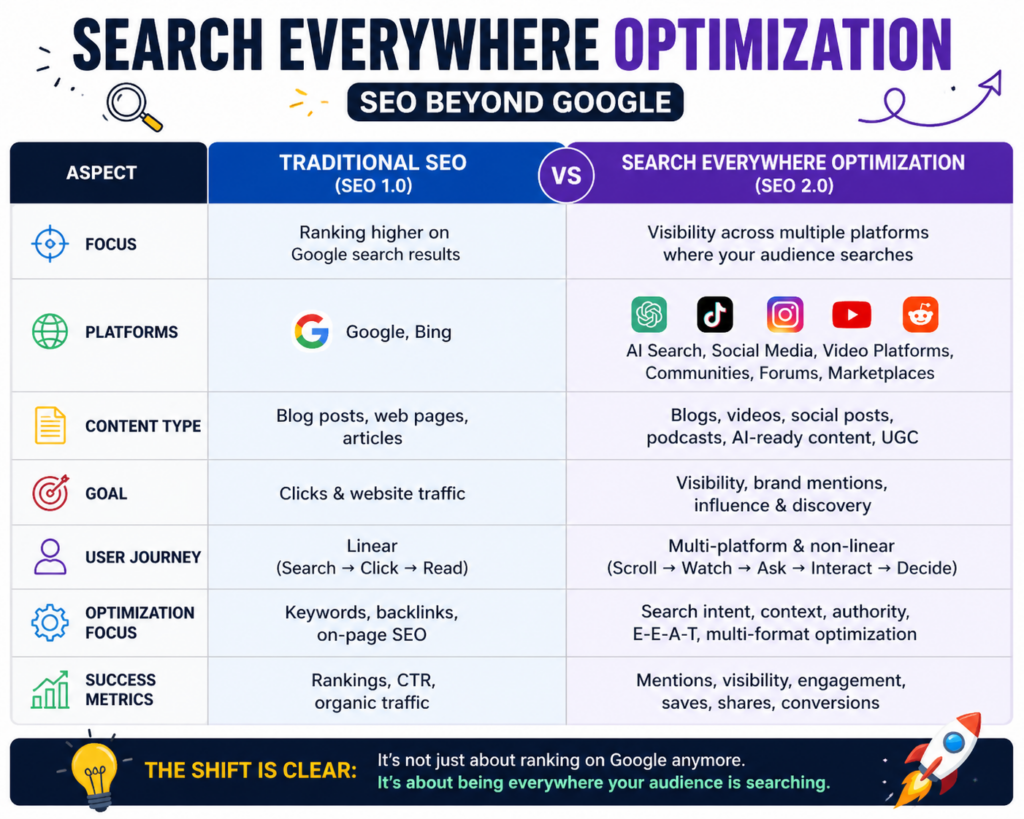
This shift has given rise to an innovative approach: Search Everywhere Optimization (SEO 2.0). It’s not just about ranking on one platform—it’s about showing up wherever your audience is actively searching, scrolling, or engaging.
In this new landscape, visibility isn’t earned in one place—it’s built across many. And that’s exactly what we’re about to unpack.
What is search everywhere optimization (SEO)?
Search Everywhere Optimization (SEO) refers to how you make sure your content, brand, or authority shows up when a user searches for it somewhere:
- AI search engines/ chatbots
- Social networks
- Marketplaces
- Smart assistants
- Traditional search channels
This doesn’t replace SEO; it expands it.
In today’s digital landscape, your audience’s journey is not a funnel but rather a web of paths to find what they want.
Why ‘SEO beyond Google’ is no longer optional
Let’s face it; Google is still important, but it’s no longer the only gatekeeper. While it still dominates, studies show it accounts for roughly 73% of search activity, leaving a significant share distributed across platforms, apps, and AI-driven tools.
The way people consume information has changed because of AI-equipped search tools like Perplexity AI and Microsoft CoPilot. Instead of clicking on links to see information, people now expect a direct answer.
The way users from Generation Z use platforms such as TikTok, as illustrated by the following example, can help search engines. If someone wants a restaurant recommendation, they will search for one on TikTok. If they want skincare advice, they will go look for it on Instagram Reels.
This change in behaviors means:
- Less website clicks
- More zero-clicks on searches
- More brand mentions are crucial to authority.
So, if you are not seen by users across all these platforms and are not being mentioned, you are invisible on many more sites than you think.
AI search optimization: The new frontier
AI searches do not evaluate which pages are best suited, rather they determine which answers should be presented. This shift is accelerating, with nearly 50% of consumers now using AI-powered tools like ChatGPT for information and decision-making, instead of relying solely on traditional search engines.
You create relevance in four ways:
1: Authority: Are you seen as a trusted source?
2: Clarity: Is your content clear for the AI?
3: Structure: Is the format or style you wrote your piece set up so that AI can read your material?
4: Consistency: Does your brand name appear the same across all sites?
With AI search, it is more important to be found than to be the most visible (page 1).
How to rank in AI search engine (Gimmick or strategy)
When ranking in an AI-driven environment, you should use a different strategy. Below is what actually works:
1. Write for humans, structure for machines:
Create content that is meant for people (i.e., human-readable) but organize it in such a way that it is easy for machines (i.e., AI) to pull out your information.
Think
- Headings
- FAQ’s
- Bullet lists
- Definitions
2. Build topical authority (Not just keywords):
Establish yourself as a topical authority rather than simply targeting isolated keywords. For example, if you’re writing on how to market using AI, you should include content about:
- Use cases
- Tools
- Obstacles
- Trends
When you use whole subjects (as opposed to targeting simple keywords) to create content, there is an increased probability that AI models will cite you.
3. Be quotable:
AI admires content that can be easily extracted. Quotable, sharp, and intelligent lines will increase your chance of being cited by someone else.
4. Earn brand mentions across the web:
AI algorithms use many references as part of their model. The greater the number of times your brand appears on the internet (in blogs, forums, and media), the more credibility your brand has.
5. Optimize for conversational queries:
People no longer type in the same way as a computer. Instead, they say:
What is the best AI SEO tool?
How do I get a high ranking in AI search?
Your content should reflect how people talk today.
SEO steps beyond Google indexing
If your approach to SEO goes no further than indexing, you aren’t getting the full picture. This is what modern optimization looks like:
1: Create a content strategy based on the platform:
What works on Google will not work on TikTok. Force your memory to conjure the following formats for social content:
- TikTok (Short, engaging visual storytelling)
- YouTube (In-depth tutorials on how to do something)
- Instagram (Visual first place for discovery)
- AI tools (Informational, structured documents)
2: Produce multi-format content:
You cannot just draft articles for blogs. Using just one idea, create multiple forms of content such as:
- Articles
- Videos
- Carousels
- Short clips
- Podcasts
3: Optimize in-platform search:
All platforms have their own algorithms.
- Use keywords in your captions on Instagram and TikTok.
- Optimize your titles and thumbnails for videos on YouTube.
- Also, focus on your platform engagement signals.
4: Utilize community platforms:
Community platforms such as Reddit and Quora frequently appear in AI-generated search results. Being a part of these communities creates visibility in additional places.
5: Track “visibility” instead of just rankings
The measurement of success is changing:
- Mentions in AI responses,
- Brand recall, and
- Engagement metrics across platforms.
SEO is neither a numbers game nor a presence game.
Best LLM SEO optimization tools to explore
The landscape of LLM SEO tools is rapidly changing, with new types of technologies emerging to help brands figure out how to properly optimize content for AI-based search engines. Some of these new tools include AI visibility tracking that reports each time a brand is referenced in an answer generated by ChatGPT, a content optimization tool that formats content in a more user-friendly way for language model readers, and the use of semantic SEO tools to build topic clusters rather than targeting standalone keywords.
Services like Surfer SEO and Clearscope are already being modified to reflect this new trend, where context and depth are valued more than simply the number of times a keyword appears in a piece of content. However, regardless of the maturity of these types of platforms, they will never replace having an effective strategy that aligns content with actual user intent and visibility across multiple platforms.
The biggest mindset shift: from ranking to relevance
Traditional SEO was primarily focused on the question:
- “How do I rank higher?”
Now, with Search Everywhere Optimization, the focus is on the question:
- “How do I show up everywhere my audience is looking?”
This is a subtle yet significant shift in the digital world. Where AI creates condensed versions of your content, social media platforms facilitate your users’ ability to find you, and users trust content creators more than websites.
As such, your organization is no longer competing to rank among others; rather, your organization is competing for attention across the various platforms in which you operate.
The future of search is distributed
As of today, search has changed from being a destination to simply being a behavior.
With AI usage and multi-platform discovery accelerating in 2025–2026, users are increasingly splitting their attention across AI assistants, social platforms, and community-driven spaces rather than relying on a single search engine.
From 2026 onward, the brands that will be successful are those that not only have conquered Google but also have mastered the art of showing up consistently at all the places their target consumers are already searching for them.
Cut to the chase
Using solely keywords and backlinks for your digital marketing strategy is so “last year”. Search Everywhere Optimization is not just a trend; it is a natural evolution of how people discover search and make decisions. So, the real question is? Is your brand built to rank—or built to be found everywhere?
FAQ’s
Search Everywhere Optimization is a strategy that focuses on making your brand visible across multiple platforms—AI search, social media, and traditional search engines—rather than just ranking on Google.
AI Search Optimization focuses on getting your content cited in AI-generated answers, prioritizing clarity, authority, and structured information instead of just keyword rankings.
Because users now search across platforms like social media, AI tools, and communities, relying only on Google means missing a large part of your audience and discovery journey.