
Why Human Verification Is Emerging as the Internet’s New Trust Layer
The internet was designed around speed and accessibility. Creating an account, publishing content, or connecting with someone across the world takes only seconds. For decades, platforms largely assumed that the person on the other side of the screen was real. That assumption is beginning to break down.
AI-generated influencers attract millions of followers. Deepfake videos are becoming increasingly convincing. Synthetic identities can interact with brands, open accounts, and build credibility over time. According to DeepIDV’s Fraudulent Identification Benchmark Report 2026, deepfake attacks have increased by more than 2,100% since 2022.
As AI-generated identities become harder to distinguish from genuine users, organizations are shifting their focus from verifying credentials to verifying people. Human verification, once viewed primarily as a cybersecurity measure, it is increasingly becoming a foundational layer of digital trust.
For brands, advertisers, platforms, and consumers alike, the challenge is no longer simply preventing fraud. It is preserving confidence in an online ecosystem where authentic and synthetic interactions increasingly look the same.
Trust used to be assumed. Now it has to be proven
Much of the internet has historically operated on implicit trust. Customer reviews were assumed to come from genuine buyers. Social media profiles represented real people. Videos, images, and testimonials were generally accepted as authentic unless there was reason to believe otherwise.
Generative AI has fundamentally changed that equation.
Today, realistic images, videos, voices, and written content can be created at unprecedented speed and scale. AI-generated influencers collaborate with major brands, synthetic customer reviews influence purchasing decisions, and automated accounts participate in conversations that once belonged almost exclusively to humans.
The result is a growing trust gap.
Consumers are becoming increasingly cautious about what they see online, often questioning whether the content, creator, or account behind an interaction is authentic before choosing to engage. Authenticity is no longer a desirable quality—it is becoming a competitive differentiator.
For organizations, this represents a broader shift in how trust is established. Instead of assuming authenticity, businesses increasingly need mechanisms that can demonstrate it.
Why marketers should care
Although human verification is often discussed within the context of cybersecurity, its implications extend well beyond protecting accounts and preventing fraud. It is rapidly becoming a marketing challenge.
Modern marketing depends on accurate audience intelligence. Campaign performance, attribution models, personalization strategies, and customer insights all rely on the assumption that engagement comes from real people.
That assumption is becoming increasingly difficult to defend.
Bot-driven interactions can artificially inflate campaign metrics. Synthetic accounts distort audience segmentation. AI-generated traffic can create misleading performance reports, making it harder for marketers to distinguish genuine customer interest from automated activity.
The rise of AI-generated creators introduces another layer of complexity. Virtual influencers such as Lil Miquela have already partnered with global brands, demonstrating that AI personas can generate substantial engagement. As these digital personalities become more sophisticated, brands will increasingly need to determine not only how much engagement they receive, but also who, or what, is generating it.
This shift has significant implications for measurement. Reach, impressions, click-through rates, and engagement lose value if organizations cannot confidently verify that the audiences behind those metrics are human.
In an environment where data increasingly drives every marketing decision, audience authenticity may soon become as valuable as audience size.
The hidden business costs of fake identities
Synthetic identity fraud represents one of the fastest-growing threats facing the digital economy.
Unlike traditional identity theft, which relies on stealing an existing person’s credentials, synthetic identity fraud combines legitimate and fabricated information to create entirely new digital identities. These identities can establish credit histories, build social media profiles, interact with businesses, and remain undetected for extended periods.
For organizations, the consequences extend well beyond financial fraud.
Fake identities contaminate customer databases, reduce the quality of first-party data, distort audience insights, and undermine the accuracy of analytics used for strategic decision-making. Marketing teams may unknowingly optimize campaigns around engagement generated by automated systems rather than genuine customers, leading to misplaced budgets and flawed business conclusions.
As AI continues to improve the realism of synthetic identities, distinguishing authentic users from sophisticated digital personas will become increasingly difficult.
Without reliable methods of verifying human presence, organizations risk making critical business decisions based on data that is fundamentally unreliable.
CAPTCHA had a good run. AI changed the game
For more than two decades, CAPTCHA served as the internet’s default method for distinguishing humans from automated systems. Whether identifying traffic lights, selecting crosswalks, or deciphering distorted text, users demonstrated their humanity by completing tasks that computers struggled to solve.
That model is reaching its limits. Advances in computer vision and generative AI have dramatically improved machines’ ability to solve image- and text-based challenges. What was once an effective barrier against automated bots is increasingly being overcome by AI systems capable of completing these tests with remarkable accuracy.
The challenge has evolved.
Organizations are no longer trying to stop simple scripts from accessing websites. They are defending against sophisticated AI agents capable of mimicking human behaviour, generating realistic conversations, and interacting with digital services at scale.
As discussions around CAPTCHA bypass techniques continue across developer communities, many organizations are reassessing whether traditional puzzle-based verification remains effective.
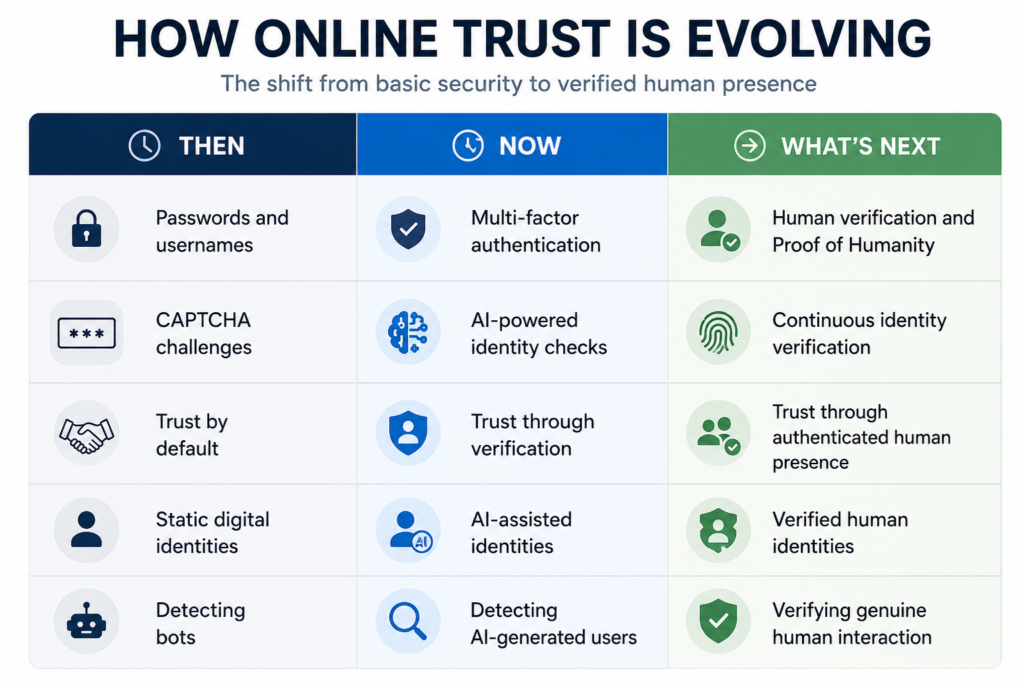
The objective is no longer to determine whether someone can solve a visual challenge. It is to establish whether a genuine human is actively present during a digital interaction.
That shift is driving interest in newer verification approaches that rely on behavioural analysis, biometric signals, liveness detection, and continuous authentication rather than one-time tests.
Identity is becoming the internet’s new trust layer
As cyber threats have evolved, identity has emerged as one of the most valuable assets to protect.
Organizations once focused primarily on securing networks, applications, and devices. Increasingly, however, attackers are targeting identities instead. If a malicious actor can convincingly impersonate a legitimate user, many traditional security controls become significantly less effective.
This shift is reflected in Entrust’s 2026 Identity Security Trends Outlook, which argues that identity now sits at the centre of Zero Trust security strategies. Rather than assuming any user is trustworthy, organizations are moving toward continuous verification throughout every digital interaction.
The implications extend beyond cybersecurity.
Every login, transaction, customer interaction, and online purchase depends on confidence that the individual behind the action is genuine. As digital relationships increasingly replace physical ones, identity itself is becoming a foundational layer of trust across the internet.
Human verification strengthens that foundation by helping organizations confirm not only that credentials are valid, but also that the individual presenting them is real, unique, and actively present.
In an AI-driven internet, proving identity is becoming just as important as protecting it.
As David Prieto, Head of Identity, Data & AI Security at Telefónica Tech, noted during MWC 2026, “There is no trustworthy AI without a trustworthy identity.” The statement captures a growing reality: in an AI-driven internet, trust increasingly begins with proving who—or what—is behind every interaction.
Deepfake detection is becoming a business necessity
Deepfakes have gone from being an interesting way to entertain people online to potentially damaging liabilities for businesses. Companies are now reviewing their methods for verifying the credibility of content online. As fake executive messages, cloned voices, and changed endorsements have challenged them to do so.
Organizations face two issues regarding deepfakes: detecting fake material and maintaining trust in the authenticity of legitimate material. When a consumer begins to doubt whether anything they view is authentic, confidence in digital communication diminishes significantly.
As soon as consumers begin to doubt the authenticity of any media. Digital communication loses trust. This is why deepfake detection technology is already helping organizations build layers of assurance. About their digital identities, even before another organization creates its digital identity.
Organizations that can authenticate documents effectively in this manner will have a significant market advantage. Because doubts about their products will be easier to instill than beliefs about any of their competitor’s goods.
Human verification is becoming a competitive advantage
The organizations that invest in human verification are not simply reducing fraud—they are strengthening trust across the customer journey.
For marketers, verified audiences lead to cleaner customer data, more reliable attribution, and greater confidence in campaign performance.
Publishers and platforms have to focus on verifying authentic users improves the quality of engagement while reducing the influence of bot networks and synthetic accounts.
For consumers, it creates greater assurance that the people, reviews, and conversations they encounter online are genuine.
Trust is becoming measurable.
The urgency is clear. Speaking about World’s human verification initiative in 2026, OpenAI CEO Sam Altman remarked, “We are also heading to a world now where there’s going to be more stuff generated by AI than by humans.” If that prediction becomes reality, systems that can verify genuine human participation may become essential infrastructure for the internet.
Just as verification badges once helped distinguish authentic brands, public figures, and creators from imposters, the next generation of digital trust may focus on confirming that an account represents a real human rather than an AI-generated identity.
That evolution has implications far beyond cybersecurity. As AI-generated content becomes increasingly commonplace, authenticity itself may become a competitive differentiator.
Organizations that can demonstrate the integrity of their digital ecosystems are likely to build stronger customer relationships, improve the quality of their data, and create more trustworthy online experiences.
In an increasingly synthetic internet, proving that people are real may become just as valuable as proving that products are genuine.
The future of online identity won’t be visible
In the past, identity validation occurred mostly unnoticed. That is now shifting.
Digital trust is becoming more noticeable to consumers, and government bodies are enforcing higher standards of verification. Companies are creating stronger investments in verification technologies. As a result, companies are seeing human verification progress from purely a security mechanism to being a critical element of the digital economy.
In the past, verification badges allowed users to identify real celebrities, creators, and brands from their impostors. However, soon we may have yet another new verification system that goes even further to establish that an individual is who they say they are.
Due to the growing number of AI-generated digital assets, establishing whether an account represents a real person could offer a means by which to verify authenticity in the digital age. For brands, creators, and platforms, human verification may become less about establishing security. Then it may become a competitive advantage for those verified as human.
The company that will be successful will not necessarily be based on having the most technologically advanced AI. They could simply be the businesses that are trusted above others.
Cut to the chase
The next era of the internet will not be defined solely by smarter AI. It will be defined by how effectively we preserve trust in a digital world increasingly populated by machines.
As deepfakes, synthetic identities, and AI-generated content become harder to distinguish from reality. Human verification is emerging as a critical foundation for online identity, digital commerce, and brand trust. In the years ahead, proving your humanity may become one of the internet’s most valuable credentials.
FAQ’s
Human verification confirms that an online user is a real person, not a bot, deepfake, or AI-generated identity.
Modern CAPTCHA alternatives use AI, biometrics, and behavioral analysis to verify human users more accurately and improve security.
As AI-generated content grows, human verification will help protect digital identity, reduce fraud, and build trust in online interactions.