The New Creator Economy Rule: Stop Chasing Followers, Start Driving Revenue
For a long time, the influencer marketing industry was obsessed with one thing: follower count. Brands partnered with creators boasting millions of followers, celebrating virality, and measuring success through likes, shares, and impressions. However, 2026 marks a significant shift in priorities. The question marketing leaders are now asking is: “How much revenue did this creator actually generate?”
Many brands have discovered that campaigns targeting millions of people often resulted in poor sales, while niche influencers with a small but engaged audience were able to sell better. Vanity metrics may look impressive in campaign reports, but they don’t always translate into sales, customer retention, or long-term business growth.
In an earlier Ad Pulse article, we stated that “authenticity in itself has become a performance metric,” and today this statement is more relevant than ever. Authenticity alone is no longer enough—it must translate into measurable business outcomes. As marketing budgets come under greater scrutiny, brands are moving away from vanity metrics and toward performance-driven creator partnerships.
Let’s deep dive into how the creator economy is evolving from a follower-first to a revenue-first model and what it implies for brands in 2026.
Reach doesn’t pay the bills, revenue does
The creator economy has entered its next phase. It’s no longer about “Who has the biggest audience?”—it’s about “Who can drive measurable business results?”
This change sums up the evolution in marketing, as the Influencer Marketing Hub 2026 Benchmark Report highlights that brands are increasingly prioritizing lower-funnel metrics such as conversions, attributable revenue, and sales as influencer marketing matures into a performance-driven channel.
When marketing budgets are getting tighter, creator partnerships are being treated the same way as paid media – all campaigns have to prove their efficiency.
In the words of Neal Mohan, CEO of YouTube, “Our creators are reinventing entertainment and building the media companies of the future.”
The marketing funnel has a new entry point
Few consumers initiate their purchasing process by turning to a search engine. Instead, they start with a creator in whom they place their trust.
Whether it be a skincare review on TikTok, a product demonstration on YouTube, or a recommendation from an expert on LinkedIn, creators are influencing consumers long before they visit a company’s website.
The customer journey looks something like this:
Creator Recommendation → Community Discussion → Product Review → Purchase → User-Generated Content
Consumers are increasingly looking for reliable views rather than things initially. Because of this, creators become the beginning of the purchasing process rather than merely another touchpoint.
As a result, the comments section of a post has replaced traditional product evaluation methods, and creator communities are the first source of validation for purchase decisions.
In essence, brands must realize that creators are changing the way consumers decide to make a purchase, moving beyond just creating awareness.
Creator commerce is replacing sponsored content
The most significant shift is that creators are generating more content. It’s that they are selling many more products. With the advent of platforms such as TikTok Shop, YouTube Shopping, and Amazon Creator Storefronts. There is now much less time required from discovery to purchase. Now, consumers can often watch something on TikTok and make a purchase immediately.
This has brought about the creator commerce trend, in which creators are seen as independent retail points of sale rather than an advertising medium.
According to eMarketer’s 2026 social commerce report, creator-led shopping, TikTok Shop, and built-in checkout experiences are accelerating social commerce growth, with more than half (51%) of U.S. social buyers expected to shop on TikTok in 2026. The report highlights how creators and younger consumers are turning product discovery directly into purchases
Rather than paying for digital adverts, brands have started to engage creators instead.
Why brands are replacing one big influencer with 100 small creators
The move away from follower counts is also impacting how brands establish creator partnerships. Rather than spending a large sum of money on a few influencers with huge followings. Brands today are building continuous creator networks comprised of niche influencers with highly engaged audiences.
This new method lowers the risk, provides a constant flow of original content, and makes sure that multiple audience groups are reached at the same time. More importantly, it results in measurable business effects.
A good example is Unilever, which claimed in 2026 that it would significantly increase its creator partnerships while switching from traditional advertising. The company is creating campaigns for the creator world aimed at maximizing engagement and commerce across many online platforms.
AI is making creator marketing more accountable
AI is also transforming brands’ creator selection processes.
In the past, brands chose creators based on their popularity. Nowadays, brands use AI-driven platforms to assess audience types, purchase intentions, conversion rates, brand loyalty, overlapping audiences, and even fake followers.
These tools also help companies forecast the success of their advertising campaigns before investing. With this technology, marketers can forecast the success of a campaign before spending money on it.
Vogue Business (2026) states that “brands are no longer pursuing ad-hoc influencer deals but entering into long-term relationships whereby influencers partake in strategy development, product development, and brand storytelling.”
This quote demonstrates that creators are inclined to be seen as business partners rather than mere marketing vehicles.
As a result, companies are making more profitable investments in influencer marketing.
Stop measuring engagement, start measuring business impact
The creator economy has introduced a new scorecard for success.
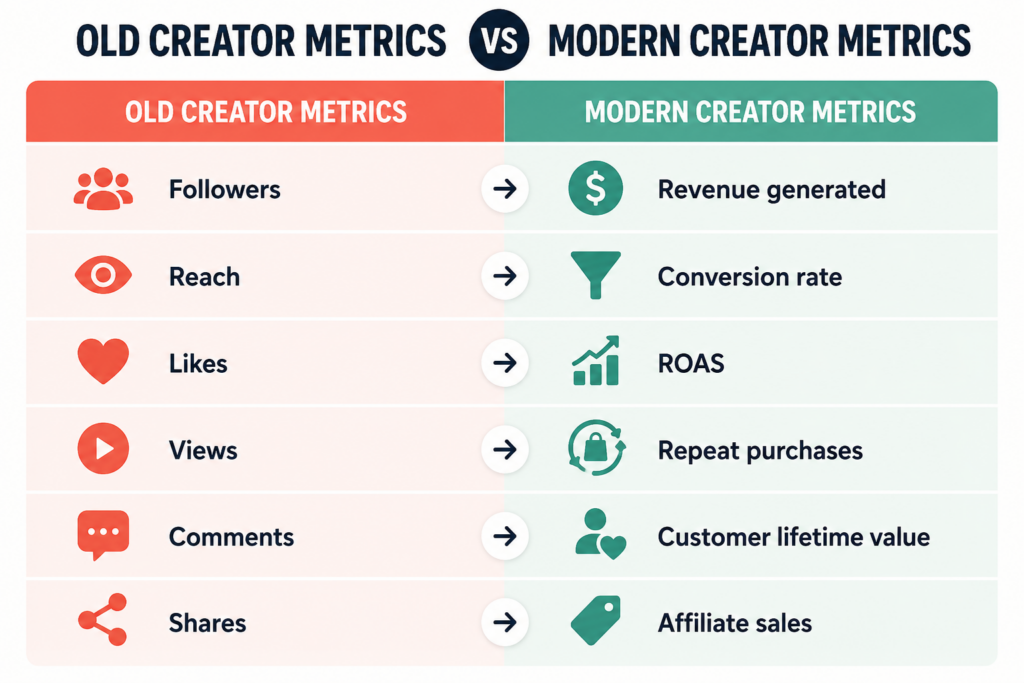
These parameters give a far better understanding of the return on investment (ROI) in influencer marketing. Rather than asking how many people saw a campaign, brands are asking how many customers the campaign brought in and helped retain and turn into repeat customers.
Creators themselves are turning into entrepreneurs. Most of them already run affiliate shops, make their own products, sell subscriptions, and create communities that guarantee continuous income. Thus, this trend shows that creators can not only act as marketing partners but also become independent businesses that brands can grow with.
Performance is becoming a new currency
The economy of creators is not predicated merely on visibility but rather on quantifiable value. Creatives who educate their public, create trust and influence purchases, become valuable partners for business. Rather than a mere project, it drives long-term growth.
This shift transforms influencer marketing and affects the way influencers are compensated. Allowing them to receive a mix of fixed payment and affiliate commissions, along with sales incentives.
The lesson for marketers is obvious: the more efficient creator collaborations are those that marry creativity with profitability.
Cut to the chase
The creator economy is at a point where business impact is being prioritized over audience size. Brands have started to look beyond follower counts and engagement metrics.
And have shifted to measuring success by revenue, conversions, and customer loyalty. In 2026, the top creators will be those making a real impact on business rather than just gaining attention.
FAQ’s
Brands are prioritizing measurable business outcomes like sales, conversions, and customer retention over vanity metrics such as follower count and likes.
Creator-led growth is a strategy where creators act as long-term business partners, driving awareness, engagement, conversions, and customer loyalty.
Brands can improve ROI by partnering with niche creators, tracking conversion-focused KPIs, using AI for creator selection, and building long-term collaborations.