

Rainbow Washing Doesn’t Work Anymore. Here’s Why
Every June, the corporate rainbow returns. Logos change color. Limited-edition Pride collections appear. Brands flood social feeds with messages of inclusion. For years, visibility alone was often enough to earn goodwill.
Not anymore.
Today’s consumers can investigate a company’s values as quickly as they can view its latest campaign. Employee reviews, political donations, ESG disclosures, corporate policies, and social media receipts are all a few clicks away. As a result, Pride marketing is facing a new reality: symbolic support no longer carries the weight it once did.
The question is no longer whether a brand shows up for Pride Month. It’s whether that support exists on July 1.
This shift is accelerating the decline of rainbow washing: the practice of using LGBTQ+ imagery and messaging without meaningful action behind it, and forcing brands to prove that inclusion is more than a seasonal marketing strategy.
Rainbow washing, simplifed
The concept of rainbow washing is relatively clear: a business will include LGBTQ symbols, messages, or Pride-themed advertisements in its promotional materials to enhance its image; however, it does not actually show any real concern for LGBTQ+ individuals through policy, investment, advocacy, or long-term commitment.
Common examples of this are:
- Brands change their logos to rainbow colors for the month of Pride but don’t have many LGBTQ+ employees.
- Produce Pride-related products, but don’t donate any of the proceeds from those sales to LGBTQ+ organizations.
- Promote inclusivity in their advertisements, but actually fund groups that suppress LGBTQ+ rights.
- Feature LGBTQ consumers in their advertisement campaigns only during the month of June.
The term rainbow washing is often used in conjunction with the terms woke washing, purpose washing and performative activism, as all of these terms point to different examples of the same issue: most people are more willing to say something than they are willing to actually do something.
As communications expert Cathy Renna stated, “superficial gestures can reduce Pride to a “cash register performative kind of action” rather than meaningful support.
Why consumers aren’t buying it anymore
A decade ago, public support for LGBTQ+ communities could differentiate a brand. Today, visibility is expected. What differentiates brands now is whether they can back that visibility with action. Consumers have information at their fingertips, including:
- Corporate donations to LGBTQ+ causes
- Employee reviews
- ESG disclosures
- Supply chain information
- Investigative journalism
Every Pride campaign now comes with an audit trail. The purpose of brands has never been so closely scrutinized as it is today.
Reports published in the International Journal of Advertising recently reviewed over 128,000 consumer conversations about rainbow-washing and have reported increasing skepticism towards brands whose messaging appears to lack alignment with their actions. This research highlighted the increasing disconnect between symbolic advocacy and genuine commitment.
Social media has amplified this scrutiny.
Every Pride campaign now comes with questions like:
- Does the company support LGBTQ+ employees throughout the year?
- Do they make charitable donations to LGBTQ+ organizations?
- Do they have inclusive policies globally?
- What happens after June 30?
If brands cannot effectively answer these questions, consumers are increasingly perceiving that Pride campaigns are superficial and purely used for marketing rather than genuine social commitments.
The moment Pride became a credibility test
Recent years have shown an unfortunate discovery for marketers and companies around the world. The backlash surrounding brands such as Target and Bud Light revealed a difficult truth for marketers: consumers increasingly expect consistency, not convenience.
When companies appear to be providing conditional support (or no longer support brands when criticized), they lose trust with consumers rapidly.
This has created a challenging dilemma for brands:
- If they support Pride only at times that are convenient, the public may think that they are being opportunistic.
- If they fail to support Pride due to receiving criticism, this could result in the public believing that they do not have sincere intentions.
In either case, the brand will suffer from a lack of trust.
The key takeaway for marketers should not be to shy away from social topics.
Consumers want to see consistency in values- or morals-based marketing: consumers are growing wary of brands that behave altruistically only when it is commercially advantageous and then withdraw once pressure to continue doing so arises.
Sarah Kate Ellis, the president and CEO of GLAAD, has noted that consumers are looking for brands that demonstrate consistent support for LGBTQ+ communities, not just seasonal campaigns. Authenticity, she argues, comes from aligning public messaging with sustained action and values.
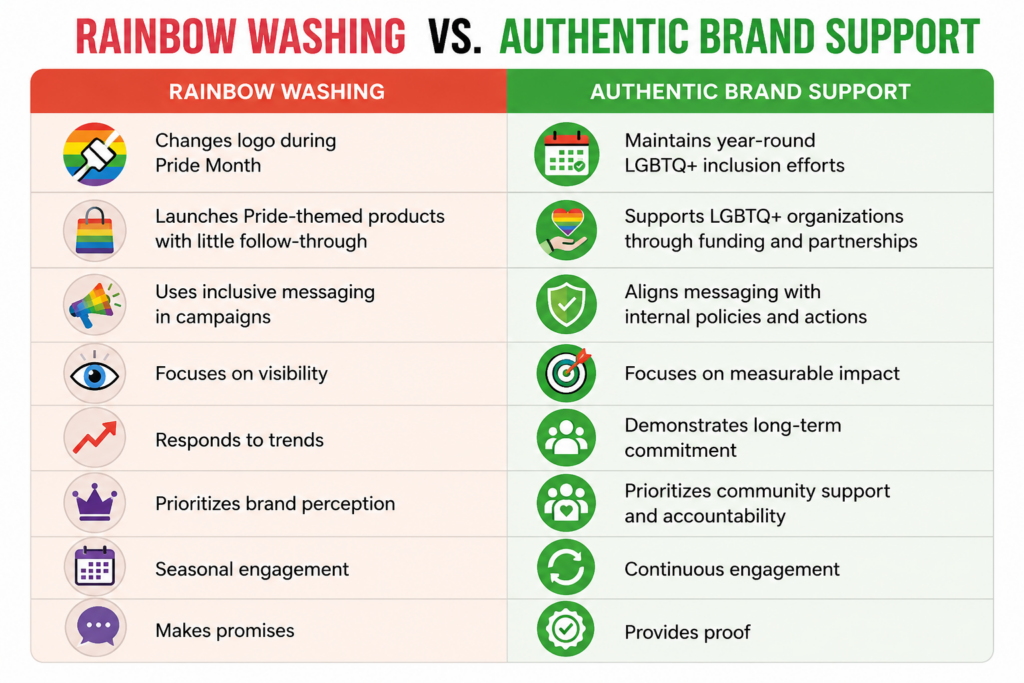
Visibility vs commitment
The distinction of brand activism and rainbow washing is determined by the manner of operating.
Rainbow washing says, “Look at what we believe.” Brand activism illustrates: “Here’s how we will support this movement.”
Authenticity can be exhibited through practices such as inclusive hiring practices, employee benefits, community engagement, and year-round representation activities.
According to research from GLAAD and Ipsos, most consumers support brands that represent an LGBTQ+ inclusive message. However, they are much less likely nowadays to have faith in brands that do not back up their messages through actions.
Statements are no longer sufficient for today’s consumers. They are expecting marketers to provide quantifiable action to support their claims.
What authentic support actually looks like
Some brands have responded to growing scrutiny by connecting Pride marketing to year-round initiatives rather than treating it as a seasonal campaign. Their approach demonstrates how visibility becomes more credible when it is backed by sustained action.
Levi’s: Levi’s has continued investing in Pride initiatives even as some brands have scaled back their public involvement. The significance isn’t the campaign itself, it’s the consistency.
Long-term support carries more credibility than seasonal participation because it signals that inclusion is part of the brand’s identity rather than a temporary marketing theme.

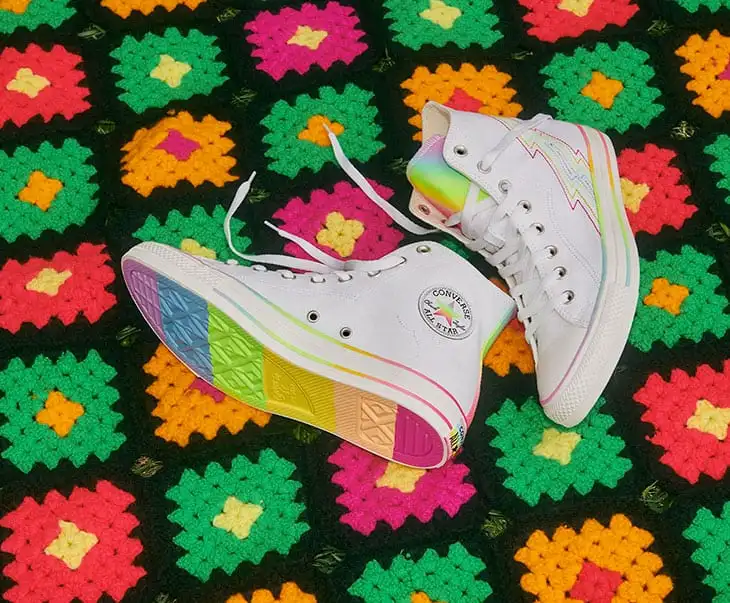
Converse: By pairing their Pride campaign with cash donations to various organizations and partners that support LGBTQ+ youth, Converse has shown that investing in communities is just as important as creating visible images of advocacy.
Purpose-driven marketing: Why year-round inclusion matters
Purpose-driven brands don’t limit inclusion efforts to a single month on the calendar. For example, organizations such as Dove, LEGO, and Microsoft have made inclusion as part of their overall business strategy and product design process as well as a part of their accessibility projects.
The campaigns they run have an impact because they’re created with commitments already present within the whole organization. Marketing is believable to the extent that it resembles the operational, hiring, investment, and community engagement practices used by the company during a given year.
This is how consumers can identify that a brand is credible.
How Gen Z is driving the change with their authenticity filter
Gen Z has grown up in an era of unprecedented transparency. That means they are incredibly good at spotting contradictions between how a company markets itself and how it behaves.
Gen Z consumers are used to investigating products before endorsing them because they were raised in a digital-first world. Transparency and accountability are becoming more crucial components of brand trust since they may swiftly contrast business activities with marketing claims.
When this generation considers a company’s participation in Pride, they want to know if the company’s actual actions are consistent with its claims. For Generation Z, representation is certainly a crucial factor; however, authenticity is even more critical.
Future of inclusion requires more than symbols
The future of LGBTQ+ marketing will have more of an emphasis on action vs. visibility. Trust-building brands will put their emphasis on the year-round representation of the LGBTQ+ community through a strong focus on internal accountability, transparent reporting, and meaningful partnerships within the LGBTQ+ community. Brands can no longer treat inclusion as an image-building exercise. They must back their commitments with measurable actions and tangible results.
This changing trend is related to the overall consumer expectation; many consumers are now more informed about brands than ever and are demanding more knowledge about how brands are living their values. They want brands to be accountable and take measurable actions, not just have a message.
Consumers no longer judge brands solely during Pride Month. They evaluate brands consistently based on the actions they take throughout the year.In this economy, accountability is the new currency for trust.
Cut to the chase
Brands cannot be compared to their competitors in the same way as they used to be. Consumers want to see brands established through sustained commitment and action, not just by their brand identification for visibility purposes. Authenticity has changed from being a campaign to an ongoing obligation for brands in today’s marketplace.
FAQ’s
Rainbow washing is when brands use Pride-themed marketing without supporting LGBTQ+ communities through meaningful actions.
Consumers now expect brands to back their messages with real commitments and measurable impact.
Brands can avoid rainbow washing by supporting LGBTQ+ inclusion year-round through policies, actions, and transparency.