

Ad Effectiveness Could Be the Missing Link in Brand Sustainability
Creative campaigns and assets are not rising in ad effectiveness in proportion to what brands have expected. Every day, a consumer or potential customer views more than four thousand ads, but do they remember each one of them?
One small brand can test 100–1000 ads in a month, and that number continues to grow depending on the size of the brand. Nonetheless, for a company like Pepsi, a single campaign could result in more than two thousand creatives.
Advertising at scale isn’t about originality. It’s about survivability in an algorithm. All of these numbers, scenarios, and stats raise a significant question mark over sustainability.
Why does emission not become an issue? Why don’t agencies try to reuse, repurpose, and reduce current ad production numbers? Aside from this, can thousands of ads guarantee ad effectiveness, brand memory, or clarity? The only solution seems to be investing in long-term assets that can offer longevity to brands.
In this article, we will explore the missing link for brand sustainability at a time when ads are being made to serve algorithms rather than consumer psychology.
Decarbonization of Media, an inception
Ad Net Zero and IAPI came together through this research to offer an analysis of how both media factors and creative characteristics shape the sustained effectiveness of advertising.
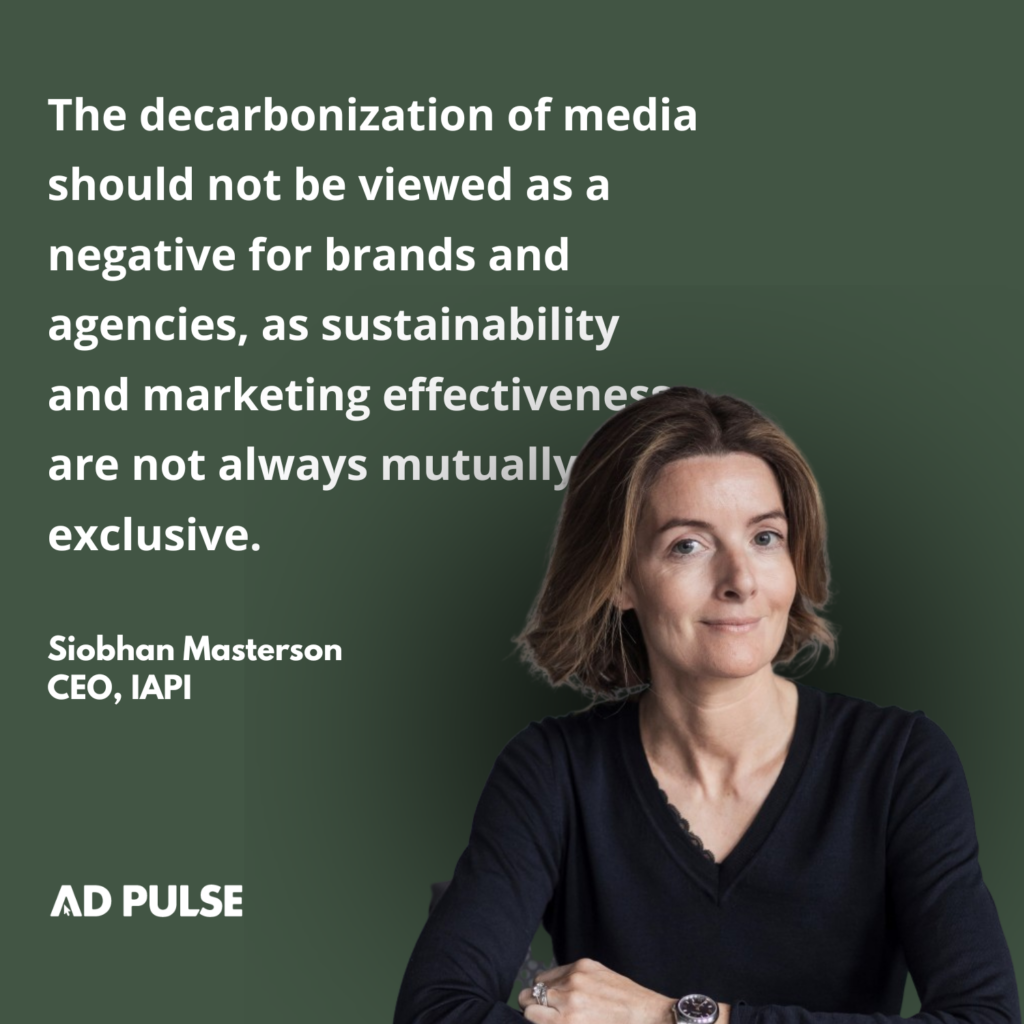
“We know that the weight and media mix chosen for a campaign can make a substantial difference to its carbon footprint, and that advertisers need to be well-informed to plan their marketing with its environmental impact in mind. This report provides exactly that, moving us from ambition to implementation and helping ensure that advertising is part of the solution.”
Siobhan Masterson, CEO of IAPI, describes the purpose of the study.
The decarbonization of media should not be viewed as a negative for brands and agencies, as sustainability and marketing effectiveness are not always mutually exclusive. There are opportunities to explore the enduring effectiveness of high-quality advertising and the concept of wear-out in TV advertising, while also bridging the gap with locally relevant data that was previously unavailable.
According to GRAM (Global Alliance for Responsible Media), industry-wide data indicates that there is an overproduction of assets, some of which are never even used.
Jill McGrath, CEO of TAM Ireland, made an underlying note for marketers and business leaders: “Stop thinking in campaigns and start thinking in assets. Build creative that lasts.”
Ad effectiveness is high in older assets
For example, System1 analyzed over 50,000 ads, comparing effectiveness scores for ads tested shortly after launch with those tested years later. The results showed no significant decline in effectiveness. Some ads even improved over time, especially those featuring recurring characters or strong brand assets.
In our previous conversation with System1’s VP of Marketing, Vanessa Chin, she said, “When I think of trust, I think of building relationships with consumers and being recognizable.”

System1’s research consistently shows that novelty can become a liability when it comes to the expense of recognition. One of the clearest signals is that, when it comes to Super Bowl ads, 21% of viewers can’t recall the brand.
However, the wear-out phase remains a poignant part of any asset lifecycle. ‘Wear-out’ is a central concept, suggesting that advertisements lose their effectiveness the more times people see them.
Kantar’s ad tracking over two decades indicates that true wear-out is rare. However, digital ads tend to receive higher ‘fed up’ scores and show increased dips in enjoyment over time.
So, what can agencies and brands do to solve the wear-out phase and sustain the assets for all good?
1. Stop blaming wear-out. Start fixing weak creative.
The idea that ads naturally lose effectiveness over time is overstated. Wear-out is not inevitable; it is often the result of poor assets being overexposed.
High media weight does not automatically damage performance. A strong creative asset holds up, even under repeated exposure. If an ad stops working, the problem isn’t how often it’s seen; it’s what’s being shown.
2. Emotion works, but only when it’s structured
Emotional storytelling is essential for long-term effectiveness, but it doesn’t operate in isolation.
Without clarity and structure, emotion falls flat. If audiences cannot process the message quickly, they won’t retain it. Campaign age alone is not a reliable indicator of declining performance—poor execution is.
3. Simplicity is effective
The data leans heavily in one direction:
simpler, more fluent creative consistently outperforms complex executions.
- It captures attention faster
- It improves memory encoding
- It drives stronger long-term behavioral outcomes
Complexity, on the other hand, slows comprehension, and in a fragmented attention economy, that cost is significant.
4. Test early, not after the damage is done
If brands want assets that last, they need to identify them early.
Testing creative upfront ensures that only effective and resilient assets are scaled. This reduces waste, cuts down unnecessary production, and shifts the focus from volume to longevity.
5. Match creative assets to its role
Not every ad needs to do everything and trying to make it do so often lead to inefficiency.
Use fluent, easy-to-process creative to build long-term mental availability and brand associations. Use more cognitively demanding creative when deeper engagement or action is required. This clarity of role allows assets to perform better over time.
6. Attention is the starting point for everything
Without attention, there is no memory. Without memory, there is no effectiveness.
High engagement is not optional — it is the baseline requirement. Emotion can amplify impact, but only when paired with clarity and structure.
Cut to the chase
Sustained ad effectiveness is not proportional to what is being produced. It is no longer about producing more ads or chasing constant novelty. Bringing sustainability while maintaining credibility, memorability, and longevity. Agencies must invest in creative assets that last longer, perform better, and reduce the need for excessive production, addressing both effectiveness and sustainability in the process.