
Future of Marketing Jobs: What Will Marketers Actually Do By 2030?
AI isn’t coming for marketing jobs; instead, it’s coming for the way marketers work. Sounds alarming, but it’s already happening.
After all, AI can design ad campaigns, perform analysis, tailor messages, manage ad placements, and handle a variety of monotonous tasks. In that sense, the question of 2030 will not be whether AI has changed marketing jobs, but which skills are necessary to keep marketers relevant.
Disruption is already underway. Gartner reports that 65% of Chief Marketing Officers (CMOs) believe that AI will change their role in the next 2 years. At the same time, only 32% of CMO respondents feel that major adjustments to their skill sets will be necessary.
That gap between how quickly the job is changing and how slowly people are preparing for it may become one of the biggest career risks in marketing.
In this article, we will highlight the marketing skills that will be important by 2030, including AI literacy, data analytics, creativity, strategic thinking, and human judgment, and suggest what marketers can do to ensure their continued high demand.
Yes, you heard it right, marketing jobs are not disappearing, they are rewritten
If you want to grasp the future of marketing careers, you need to stop thinking of artificial intelligence (AI) as a means of replacing entire jobs. It is more likely that AI will replace specific tasks performed in jobs than jobs altogether.
Copywriting will not cease to exist, but the production of repetitive content may be automated. Media buying will not disappear; however, campaign optimization will increasingly be done by machines. Analytics will remain vital, but marketers will spend less time creating reports and more time analyzing the meaning behind numbers.
According to research by Gartner, AI-driven automation will grow from 16% of marketing work in 2026 to 36% in 2028.
This means that marketing professionals in 2030 will spend far less time on producing marketing campaigns and much more time managing marketing processes.
As Gartner analyst Kristina LaRocca-Cerrone explained: “The CMOs who win won’t just manage AI. They will integrate it into how marketing leads the enterprise.”
That is the main hint for career development.
A successful marketer will not necessarily be the one who knows the most AI tools. It will be the person who knows when to use AI and when not to, and what impact AI can have on the production process to improve the business.
Let’s talk about the 7 marketing skills that will define a career by 2030
1. The importance of AI literacy: In order for marketers to be successful by 2030, they will have to master the use of AI tools, automation, prompting, and personalization, as well as learn how to apply AI ethically. Becoming AI-literate will therefore be at the core of the marketing skill set.
2. The growing importance of data analytics: Marketers will have to translate data into decisions. The ability to measure customer behavior, leverage customer insights, measure ROI, and use predictive analytics will distinguish strategic marketers from ordinary media producers.
3. The importance of strategic thinking: AI tools may be capable of performing tasks, but marketers still need to choose what to do and how. The ability to define strategies, positioning, audience understanding, and decision-making will go a long way in the marketing field.
4. Creativity is going to be more important: As AI technology enables everyone to produce endless amounts of content, being creative becomes a valuable skill. Well-thought-out ideas, storytelling capacity, cultural knowledge, and originality will prevail over the speed of content production.
5. The significance of Human judgments: Although AI can generate recommendations, marketers have to evaluate results and make complex decisions. Communication skills, empathy, and adaptability.
6. AI search will open up new possibilities: When customers start using AI for search, marketers must become educated in GEO, LLM optimization, and AI search visibility to ensure their companies can be found and recommended.
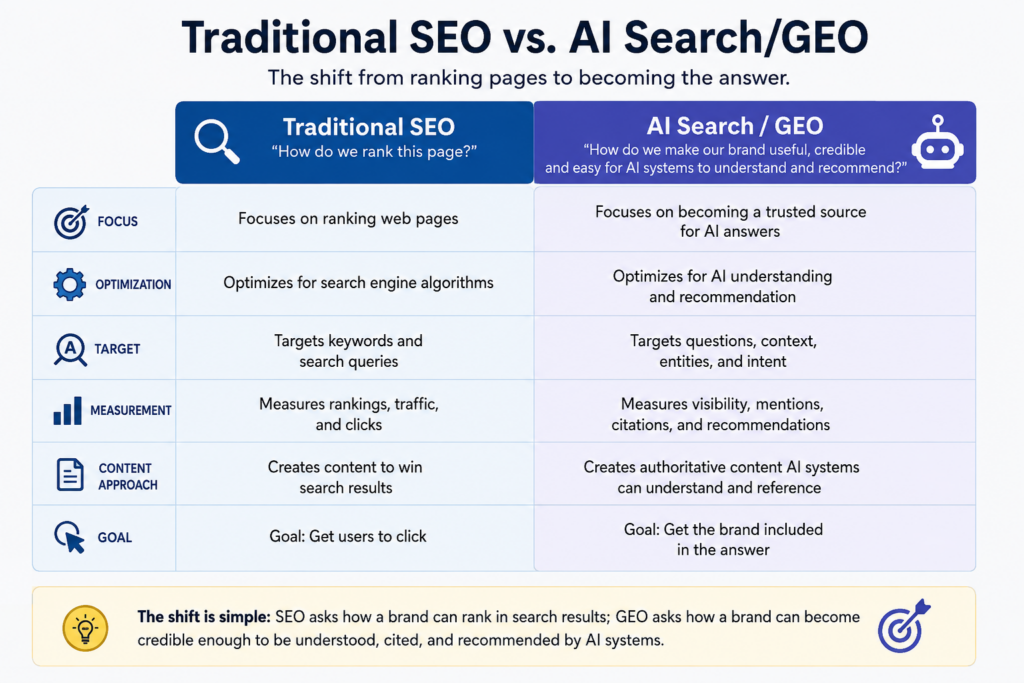
7. Business skills will speed up career paths: Future marketers will have to learn about revenue, customer lifetime value, profitability, and ROI. Being able to relate marketing campaigns to business growth will become an important advantage in their careers.
What about digital marketing skills?
Digital marketing capabilities will remain relevant in 2030, but their role will evolve over time.
Search engine optimization, paid media, email marketing, social media, content marketing, and marketing automation are likely here to stay.
Rather, they will continue to be more automated and interconnected.
The job of a marketer will change from managing channels to managing systems.
Here is an example:
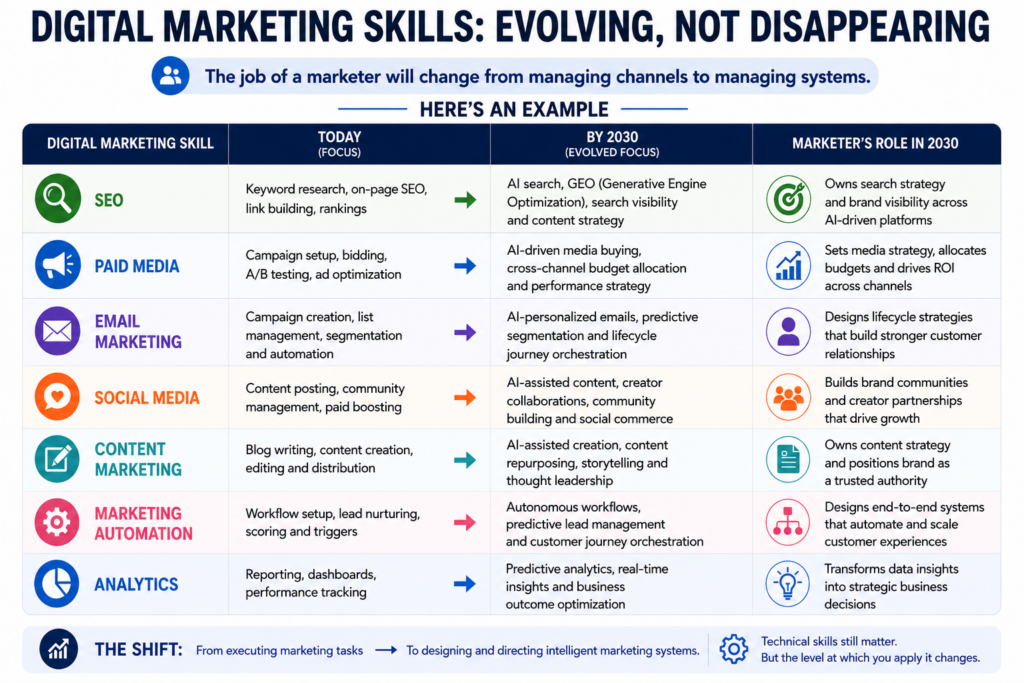
Technical skills still matter.
But the level at which you apply it changes.
What marketing jobs are most likely to stay valuable?
There are no marketing jobs that can be described as “AI-proof”.
However, some positions might be less affected than others due to a mix of different skills that cannot be replaced by AI.
Probably the following functions may withstand the tests of automation:
- Marketing strategists: as they utilize their knowledge of consumer behavior when making business decisions;
- Brand managers: as the assessment of brand values, cultural context, and reputation cannot be automated;
- Growth marketers: as they rely on experimentation, analytics, and business acumen;
- Customer experience strategists: as the comprehension of human behavior is still hard to automate;
- Creative directors: as the original creative design requires judgment and understanding of the context;
- Marketing analytics heads: as businesses still need a human in charge to turn the data into a decision.
Thus, the most reliable career advice is not to look for an “AI-proof” job position but rather to build a skillset that makes you more valuable than an AI.
What skills do marketers need in the future?
To ensure their future relevance, marketers should not focus on a single skill but should pursue a skill-stack approach.
The marketing skills that will be prioritized in the year 2030 could be summarized as follows;
AI + data + strategy + creativity + psychology of the customer + business savvy
It can be imagined as a pyramid.
- The foundation enables marketers to master the fundamentals of marketing.
- The next level gives knowledge of digital execution and analytics.
- The third level teaches AI fluency.
- The highest level is where marketers learn to apply their strategy, creativity, intuition, and leadership.
- The higher the level of a marketer, the more difficult it will be to render their work redundant.
So, will AI replace marketing jobs?
The marketing profession will encounter some changes in certain job descriptions that will become less important, with some entry-level occupations being completely transformed. Nevertheless, this does not imply that the profession will become non-existent.
In fact, the evidence from 2026 points to a more nuanced future. According to Gartner’s 2026 research, 98% of CMOs are already piloting or using AI for activities such as content creation, workflow automation, and optimization. Yet adoption does not automatically mean transformation.
The BCG 2026 report found that 96% of CMOs report significant end-to-end AI transformation, but only 32% qualify as AI transformation leaders. Meanwhile, 42% are still using GenAI mainly as an assistant for individual tasks. The message is clear: AI adoption is accelerating, but turning that adoption into meaningful organizational change remains the real challenge.
This creates opportunities for many companies. However, they need to find people capable of carrying out these transformations in marketing departments.
These professionals will be real marketers who know how to utilize technology, data, creativity, and possess business skills.
The real future of marketing careers
Choosing between human intelligence and AI could be the biggest blunder that marketers commit up to the year 2030.
- The most effective approach, though, is to combine the two.
- AI will reduce production costs.
- Data will enable faster decision-making.
- Automation will make execution scalable.
However, the ultimate verdict on what is worth doing will be delivered by human intelligence.
That’s why the fate of marketing jobs is not that of humans versus machines. It’s the issue of whether marketers know machines or not.
The marketer who is using AI to work faster is good.
The marketer who embraces AI in production, interprets the data, questions the output, understands the customers, comes up with creative concepts, and relates it all to revenue will be much more difficult to substitute.
At a Glance
- AI will transform marketing jobs, not eliminate them.
- AI literacy and data analytics will become essential skills.
- Creativity, strategy and human judgment will remain critical.
- Digital marketing skills will evolve from execution to system management.
- The most valuable marketers will combine AI, data, creativity and business expertise.
Cut to the chase
The evolution of careers in marketing doesn’t hinge on choosing between humans and AI, but on mastering a methodology for working with both effectively. By 2030, marketing professionals who can blend AI fluency, creativity, data analysis, strategic thinking, and human understanding will prosper. The aim isn’t to become immune to AI technology trends; it is to become empowered by it.
FAQ’s
Yes. SEO, paid media, content, social media, email, and automation will remain important but become more AI-driven.
AI literacy, data analytics, strategic thinking, creativity, AI search optimization, and human judgment will be highly valuable.
AI will automate many tasks, but marketers will still be needed to set strategy, make decisions, guide AI, and drive business outcomes.