
The Constant in Marketing Fundamentals: How AIDA is Evolving in the Age of AI
More than 125 years have passed since Elias St. Elmo Lewis sat down and mapped the path the human mind takes to a purchase decision. Advertising technology has shifted from letterpress to large language models. Consumer attention has fractured across a thousand screens.
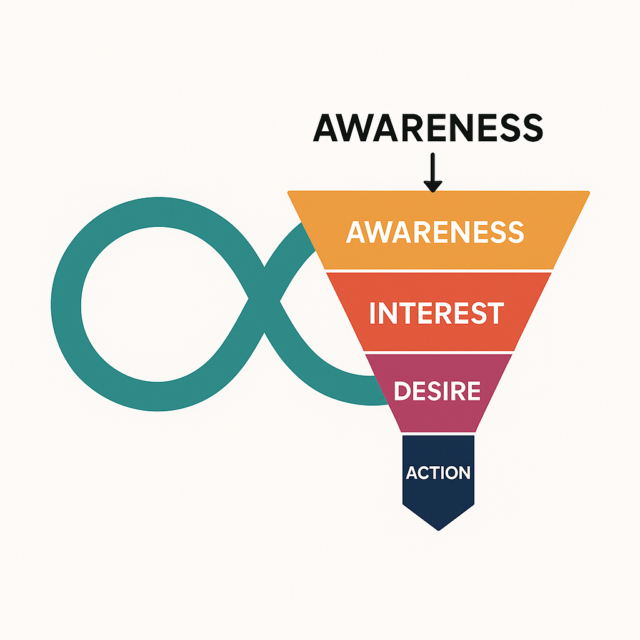
Yet Lewis’s four-step blueprint—Attention, Interest, Desire, Action—remains foundational in marketing education and campaign planning.
AIDA became an architecture, a map of human psychology: it illustrates how people notice things, engage with them, want them, and act on that want. While the technological environment surrounding marketing continues to evolve, the underlying psychological processes remain constant.
Henceforth, it becomes significant to understand the shifts in marketing fundamentals.
Let’s dive deep inside to explore how AI, social media, and the economics of the attention economy have significantly altered how each stage of AIDA operates.
AIDA turned into marketing orthodoxy
In 1898, Lewis wrote that the mission of an advertisement was threefold:
- Attract a reader so they start to read.
- Interest them enough to continue.
- Convince them to believe.
Lewis never called it AIDA. The acronym appeared in 1921, coined by C.P. Russell in Printers’ Ink, and applied Lewis’s ideas as a copywriting rubric.
The association with the sales funnel came later. Bond Salesmanship in 1924 was the first to map AIDA to a buyer’s journey. By the time Philip Kotler included it in Marketing Management—for 50 years and many editions—AIDA had become standard practice.
“The model was developed in 1898 by St. Elmo Lewis in an attempt to explain how personal selling works, laying out a sequence that describes the process a salesperson must lead a potential customer through in order to achieve a sale.”
Oxford
For most of the 20th century, AIDA’s four stages fit neatly because the media was mostly linear. TV ads ran sequentially; print ads had fixed space, and radio spots played in full. Consumers moved through the model as intended.
Now, the new elements have taken center stage.
Attention meets the algorithm
Two forces have made the most significant alteration to the linear AIDA assumption: social media and AI. Together, they have made the funnel less a straight line and more a loppy path.
Attention has become the scarcest resource in the modern economy. A Microsoft study found that the average human attention span dropped 25 percent between 2000 and 2013, from 12 seconds to 8 seconds.
In 2025, Gen Z spent an average of just 6.5 seconds per social media post. By 2026, longitudinal research from MIT Media Lab and Stanford tracked the average down to 7.6 seconds — a 36.7 percent erosion since 2000.
Platform design has amplified this. Infinite scroll, autoplay, and algorithmic feeds have contributed to a 39 percent decrease in deep reading habits between 2014 and 2024. In 2022, social media users were switching apps every 47 seconds. The average attention for a digital ad, which stood at 5 seconds in 2015, is estimated at 3 seconds in 2025.
For marketers, the “A” in AIDA—Attention—must be captured in under three seconds to start the model.
Collapse of the middle funnel
The middle stages of AIDA—Interest and Desire—were where brands built relationships with long-form content, demos, and editorials. Social media has drastically compressed this space.
When a consumer discovers a brand through a Reels video or a TikTok sound, they may skip Interest and land directly in Desire — or skip Desire and go straight to Action via a swipe-up purchase. The funnel collapses. Impulse becomes a funnel stage in its own right.
Social commerce has intensified this trend. Over 50 percent of Gen Z bought products through social platforms in 2024. What once took days or weeks—moving from discovery to purchase—can now happen in a single 30-second video. The middle funnel has compressed, especially for some categories and audiences.
For B2B and considered purchases, the middle funnel has grown longer. Longer cycles, group decision-making, and greater scrutiny mean Interest and Desire now require sustained, multi-touch nurturing over months.
AI, the new funnel engineer
Artificial intelligence has supercharged AIDA, and it has been exposed as always approximating. The integration of AI across every section, including emails, campaigns, CTV ads, and retail programmatic, has made AI a funnel engineer.
Where Lewis’s model assumed a generic audience moving uniformly through stages, AI enables stage-specific personalization at scale. Machine learning can identify where each individual sits in the funnel and serve them creatives, offers, and CTAs in real time.
Companies that deployed AI-driven personalization within AIDA-structured campaigns have reported up to a 20 percent increase in ROI and meaningfully reduced customer acquisition costs. A tech brand that aligned email content with each recipient’s funnel stage saw a 40 percent increase in click-through rates. These are not hypothetical gains.
AI also reshapes the Attention stage. AI-generated subject lines, thumbnail optimization, and predictive scoring help identify which email hooks work best. Now, the first three seconds of content can be engineered rather than guessed.
Dr. Emily Carter, a marketing researcher, framed it this way: “Integrating AI with traditional models like AIDA maximizes reach while keeping foundational principles intact.”
Expansion of marketing fundamentals
The marketing industry has responded to these changes by suggesting additions and modifications to the classic model, often extending AIDA to address new realities.
The AIDA model has been expanded by some scholars to include a fifth stage, Satisfaction, in recognition of research showing that the customer’s journey continues beyond purchase and that post-purchase experiences affect future engagement with brands (Kotler & Keller, 2016).
Additionally, further extensions such as Search, Share, and Love/Hate have been proposed, reflecting evidence that social discovery and peer-driven amplification represent pivotal stages between initial awareness and eventual action (Wind & Kotler, 2021; Court et al., 2009).
The strongest challenge to AIDA’s linear approach comes from the so-called Multimodal Funnel.
Now, consumers encounter brands through AI-mediated search, voice, social feeds, and traditional digital channels—often all at once. It’s difficult to track or assume a sequential path through stages.
ChatGPT has captured 4.33 percent of the global search market share. Voice shopping is projected to reach $40 billion in the US and UK alone. AI Overviews in Google search are causing 15–64 percent declines in organic traffic, depending on industry. The channel environment has fragmented so fundamentally that the funnel itself must be thought of as a multi-entry path.
The constant remains
None of this breaks AIDA. It puts pressure on the model, stretches it, and pushes marketers to use it with more skill. Yet the core logic remains, because it’s rooted in how people think.
People still have to notice something before they engage with it. Engagement still has to produce some form of desire or intent before action follows. No algorithm changes the sequence in the human brain; it only changes the speed, context, and medium used.
What changes are there in the time allowed for each stage, the channels used, and the data supporting each? The model itself is constant; everything else varies.
Cut to the chase
In post-AI marketing, AIDA is less a four-step checklist and more a diagnostic framework. When a campaign underperforms, the first question is still: where in the funnel did we lose them?
Was it the scroll past, an Attention failure? A high CTR but low conversion, an Interest-to-Desire breakdown?
AIDA endures because it’s built on how people buy it. It has survived the printing press, TV, internet, mobile, social media, and now generative AI.