

The Divide in AI Consumer Personas: Brands Must Work on Contextual AI Deployment
Brands and agencies are setting up a comfortable equation in boardrooms and marketing pitches. It is:
AI makes customer service faster, faster service means better experiences, and better experiences build loyalty.
However, consumer trust in AI is not a monolith, and treating it as one is a strategic error. What rarely gets examined is who exactly experiences those benefits, and who quietly absorbs the cost of getting left out.
AI consumer persona assumptions are often more fiction than reality, and that has become a pivotal challenge for brands. Ignoring the fact that not every young person or consumer uses, prefers, or trusts AI, brands are letting their systems work on numbers rather than reality.
In this article, we will analyze and explore AI consumer personas based on several reports and data.
The 4 distinct AI Consumer Personas by Klaviyo
Klaviyo’s AI Customer Service Playbook, built on a survey of over 8,000 global consumers, sketches four personas.
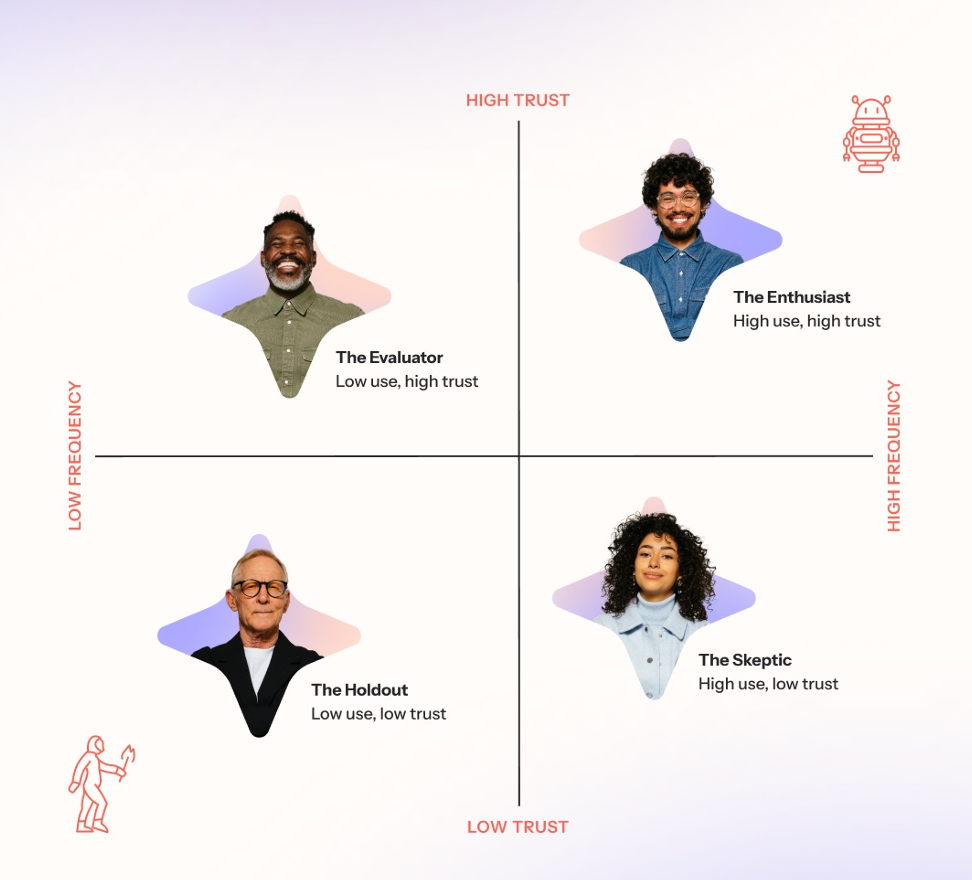
The report maps consumer AI behavior across two axes: frequency of use and level of trust. What a marketer or brand strategist should look at is how these personas interact with brands through a fundamentally different lens.
These distinctive personas highlight a compelling data point.
- AI Enthusiast
The AI Enthusiast sits at high use, high trust. AI is already woven into their daily routine, and they expect brands to match that level of comfort — with speed, accuracy, and personalization that doesn’t feel generic. They are 63 percent male, skew younger, and nearly a third earn above $100,000 annually.
- AI Evaluator
The AI Evaluator operates at low frequency but reasonably high trust. They use AI intentionally and selectively, not habitually. When they encounter it in a brand context, they want it to educate and assist — not push. This group is 54 percent female, 40 percent Gen X, and predominantly earns under $75,000.
- AI Skeptic
The AI Skeptic is the persona most brands are likely underestimating. They use AI frequently — at least monthly — but they do not trust it. They are literate about technology, which is precisely why they remain unconvinced by it. 61 percent are women, 39 percent are Gen X, and 45 percent somewhat distrust AI for providing satisfactory customer service. They are not avoiding AI. They are watching it critically.
- AI Holdout
Then there is the AI Holdout. Low use, low trust, and largely unpersuaded that AI belongs in their shopping journey. 90 percent do not use AI for product discovery. 70 percent completely distrust AI-powered customer service. And 82 percent say they never expect to have an “aha” moment with the technology. This persona is 60 percent women, 45 percent Gen X, and 80 percent earn under $75,000.
The demographics don’t add up
Three of the four AI buyer personas skew female and lower income. The one that doesn’t is the one that brands are optimizing their customer experience around.
This reflects a structural divide that has been built since generative AI entered mainstream use. According to Federal Reserve Bank of New York survey data, 50 percent of men report having used generative AI tools, compared to 37 percent of women.
A 2025 Pew Research study found that women are twice as likely to be concerned, rather than excited, about the use of AI in daily life compared to men.
That concern is, at least partly, a response to experience. Women have had documented encounters with AI systems that reflect bias — in hiring tools, in content moderation, in how AI-generated imagery has been weaponized. The wariness of the Klaviyo data surfaces in the Skeptic and Holdout personas has context.
The Income Layer
The income dimension of this divide adds a layer that the industry tends to underaddress. Post-AI consumer behavior is being tracked primarily through the lens of adoption and engagement, metrics that naturally favor higher-income consumers with more access to devices, data, and time to experiment with new tools.
But lower-income consumers represent a significant share of the B2C customer base across most categories, particularly in ecommerce, retail, and essential goods. The Klaviyo data shows that Holdouts — among the most income-constrained of the four personas — have a 90 percent rate of not using AI for product discovery, a 70 percent rate of completely distrusting AI for customer service, and a 1percent rate of believing AI has improved the support they receive from brands.
The risk of designing for the converted
The structural problem is that AI customer service tooling is being evaluated against the satisfaction of consumers who already trust the technology. Resolution speed, deflection rates, and engagement scores look healthy when measured against AI Enthusiasts — a group that actively prefers AI interaction. The friction that Skeptics and Holdouts experience doesn’t register in those metrics until it shows up in retention data, by which point the damage is harder to trace.
According to the SurveyMonkey report, more than half of consumers have negative feelings about companies using AI as part of the customer experience.
This is how a trust gap becomes a revenue gap. Not through visible churn events, but through the slow, quiet disengagement of consumers who never felt the AI experience was built with them in mind. The Skeptic stops reading brand emails. The Holdout routes their next purchase to a competitor that still offers a human on the line.
The quiet cannibalization
What is happening across many brands right now is a form of silent trade. AI customer service is delivering measurable short-term gains — faster resolution, lower staffing costs, 24/7 availability — while quietly eroding the trust of the customers least likely to flag it directly.
The mistake is not using AI for customer service. The mistake is using a single AI playbook for a customer base that is split across four fundamentally different relationships with technology.
What marketers should do here
The practical implication of the four-persona framework is not that brands should stop using AI. It is that brands need to stop deploying AI uniformly and start deploying it contextually.
- For Enthusiasts, go deep — personalize aggressively, optimize for speed, lean into proactive AI touchpoints.
- For Evaluators, use AI to inform and educate, not to push. Make the logic behind recommendations visible.
- For Skeptics, prioritize brand voice consistency over automation — if your AI customer agent doesn’t sound like your brand, it sounds like a liability.
- For Holdouts, make sure there is always a human option, clearly visible, without friction.
Brands that adopt a one-size-fits-all AI customer service strategy are not just making a tactical error. They are effectively telling a significant share of their customer base — predominantly women, predominantly in middle- and lower-income brackets — that the experience was not designed for them.
Cut to the chase
Distinctive AI consumer personas present a critical factor to brands. The best AI experiences start with customer comfort, not capability. For most brands, that means starting with the customers who trust AI the least.