AI Burnout in Marketing, 1 in 4 Marketers Feel the AI Brain Fry
Workplace burnout has seen several phases in the last five years. In the pandemic, it was Quiet Quitting. Later on, it was a productivity paranoia. Proximity bias emerged when remote employees felt overlooked within organizations. Today, AI burnout is creeping into organizations, and the marketing department has felt the heat.
AI burnout is one of the newest workplace discussions in 2026, as every single screen has been taken over by AI chatbots and agents. Across all departments, we are diving deep into marketing, as creative professionals are experiencing more than just burnout.
Nonetheless, marketing, as a profession, is identified as one of the most exposed to AI because marketing professionals increasingly manage AI tools for content generation and data feeding.
Let’s explore the AI burnout in marketing.
AI overload among marketing professionals
AI overload in marketing has led to AI fatigue. Earlier, there were briefings, meetings, and brainstorming sessions that yielded ideas and deliverables. Nowadays, briefings, brainstorming, and ideation incorporate AI.
One has to feed the project briefing (also framed using AI) to their AI to get ideas, and later create content based on the approved ideas by sending prompts. This may sound fast and productive for executives. Nevertheless, humans are not out of the loop while performing these tasks with AI.
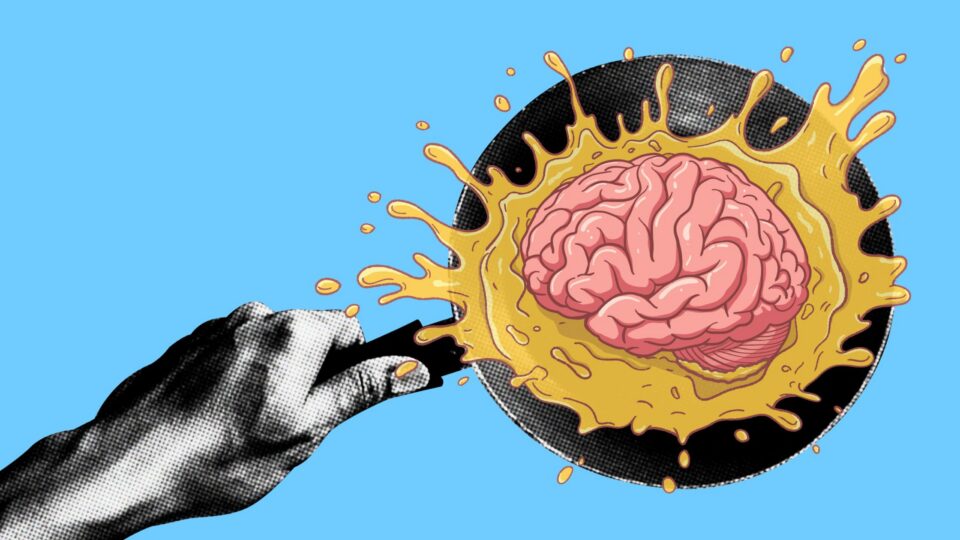
Professionals have to check the prompts several times before achieving the desired results. Quality checkpoints are increasing. More prompts, more results, more checkpoints. Witnessing this, Boston Consulting Group researchers have coined a new term, ‘AI brain fry.’
What is AI brain fry?
Mental fatigue from excessive use of AI, or from overlooking AI tools beyond one’s cognitive ability, is AI brain fry. BCG researchers conducted a series of interviews with 1488 employees and found that AI burnout was becoming a small-scale epidemic.
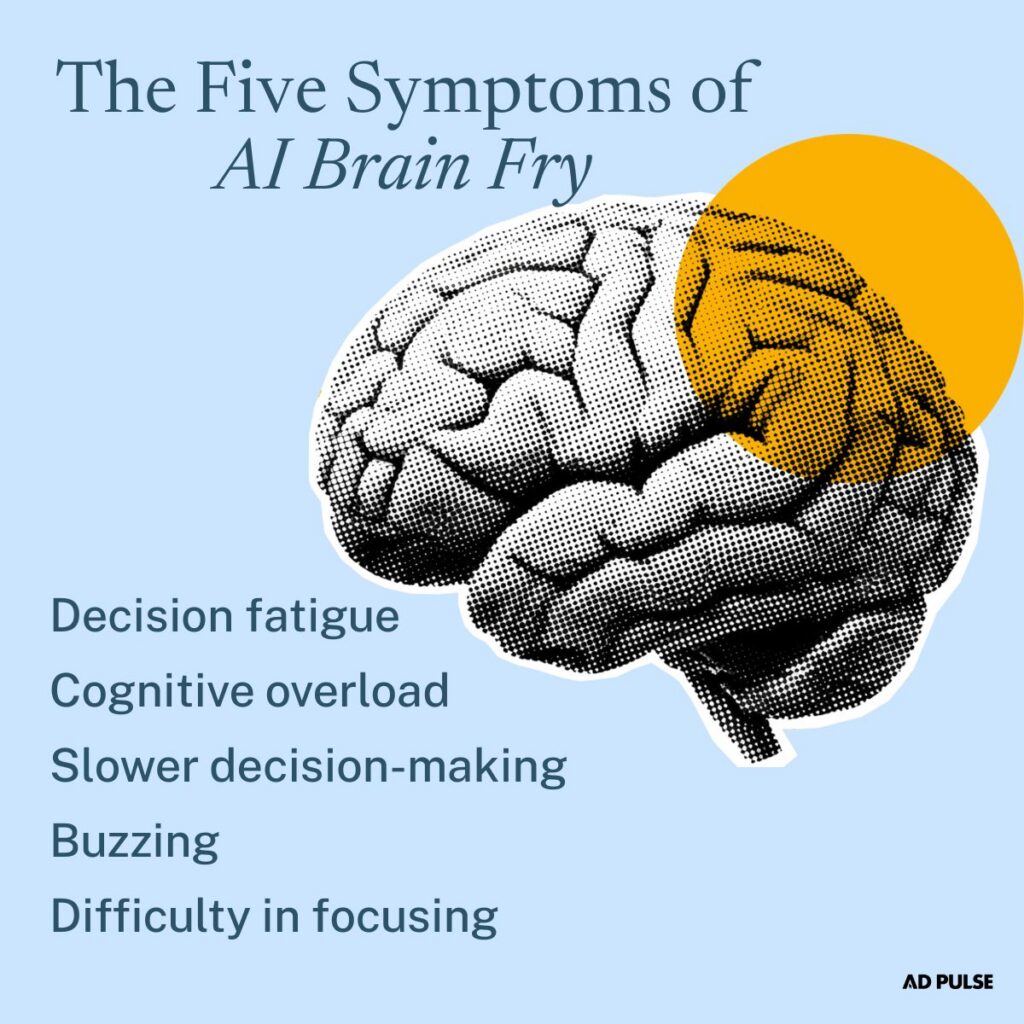
The AI brain fry leads to 5 major dysfunctional experiences:
- Decision fatigue
- Cognitive overload
- Slower decision-making
- Buzzing
- Difficulty in focusing
Outlook of AI burnout on marketing employees
The first sign is decision fatigue. Marketing was already a profession built around decisions: Which idea works? Which audience should we target? Which creative should go live? Now, AI adds another layer. Marketers have to decide which tool to use, which prompts to write, which output to trust, and which version deserves another round of refinement. BCG found that workers experiencing AI brain fry were more likely to experience decision fatigue.
Then comes cognitive overload. A marketer can move from ChatGPT to an image generator, from an analytics platform to an AI media tool, and then back to a campaign dashboard within the same hour. The problem is no longer the amount of work alone. It is the number of systems demanding attention simultaneously. BCG found that high levels of AI oversight were associated with greater mental effort and information overload.
The third symptom is slower decision-making. This sounds counterintuitive. If AI is supposed to make work faster, why would decisions become slower? Because speed at the output stage does not necessarily mean speed at the judgment stage. AI can produce ten campaign ideas in seconds. A marketer still has to evaluate all ten, check whether they fit the brand, remove hallucinations, assess originality, and decide which one is actually worth pursuing.
Then there is the rather strange “buzzing” feeling reported by participants. Researchers describe workers experiencing a mental fog or a sense of their minds buzzing after intensive back-and-forth with AI. It is almost like a digital version of a mental hangover. One participant described working through ideas with AI and eventually being unable to comprehend whether the work even made sense.
And finally, there is difficulty focusing. This could be particularly damaging for creative marketing. Good creative work needs periods of uninterrupted thinking. But AI-heavy workflows encourage constant switching between prompts, outputs, revisions, and tools. The marketer is technically producing more, while mentally staying in ten different places.
Moreover, AI burnout differs from traditional workplace burnouts.
AI brain fry is not traditional burnout
Traditional workplace burnout is generally associated with prolonged workplace stress, emotional exhaustion, and a declining sense of effectiveness. AI brain fry is more specific. It is what happens when the process of working with AI itself becomes cognitively demanding.
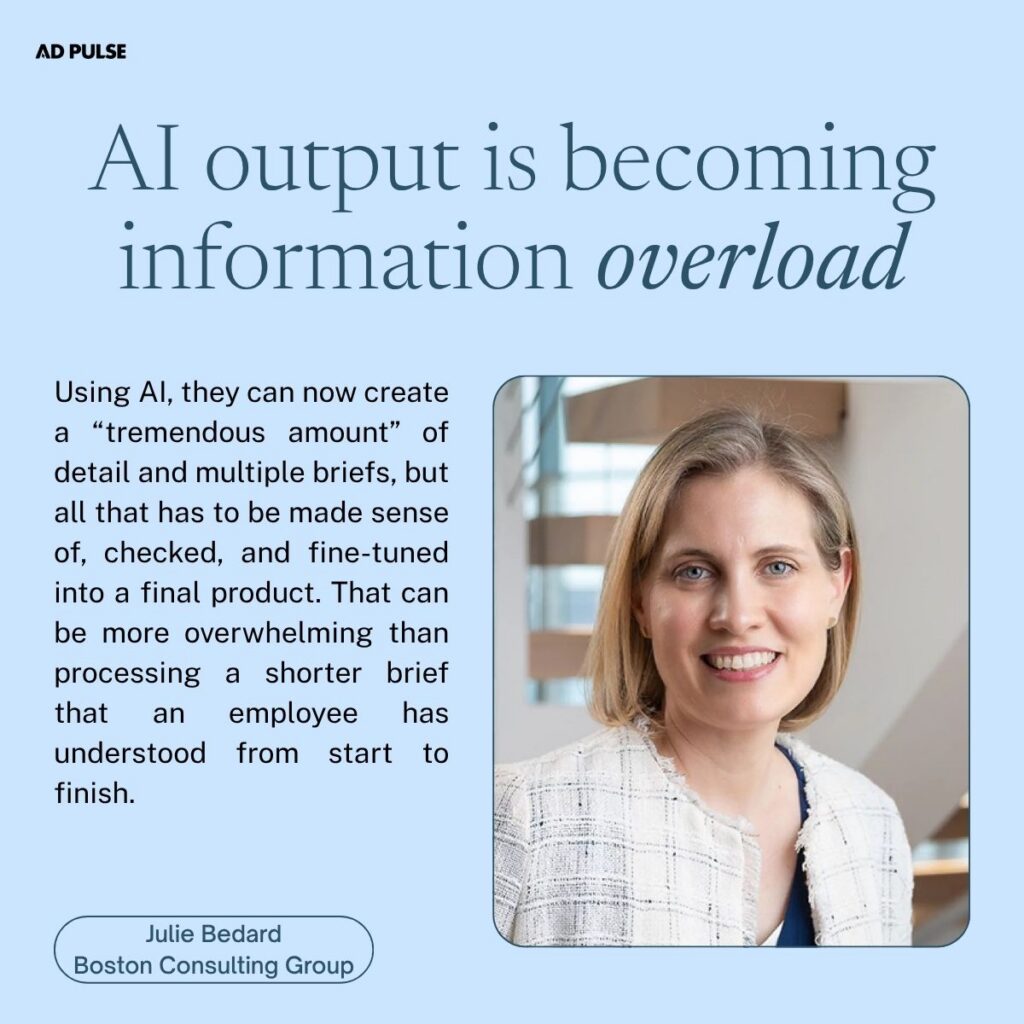
Julie Bedard, a managing director at Boston Consulting Group and a co-author of the study, makes the distinction clear. Traditional burnout, she said, is “physical and mental exhaustion” and is more emotional, involving how someone feels about their work. AI brain fry, on the other hand, stems from the cognitive load of supervising AI systems and evaluating their outputs.
One is too much work. The other can be too much cognitive supervision.
And the two can easily collide.
The BCG research found that 14 percent of workers surveyed experienced AI brain fry, but marketing stood out at 25.9 percent, making it the most affected function in the study.
The promised productivity put more work
This brings us to a bigger problem. The original AI pitch was simple: use AI to save time and become more productive. But they add more work.
Ad Pulse previously reported that while 90 percent of B2B marketers have moved beyond experimenting with AI, the productivity gains remain uneven. A Harvard Business Review field study cited in the report found that employees who voluntarily adopted AI became faster but also saw their responsibilities multiply. AI-assisted work spilled into more working hours rather than simply reducing them.
This is where the productivity promise becomes a productivity pressure.
AI has not necessarily removed work. In many marketing teams, it has raised the expected volume of work.
The same dynamic is visible in AI adoption. According to the Ad Pulse analysis of the Metadata.io and VPMarketing.com survey, 79 percent of marketers said AI functions as a productivity multiplier, while 38 percent of companies had reduced their marketing headcount in the previous year.
Cut to the chase
That is precisely why the BCG researchers describe AI brain fry as an early warning rather than an argument against AI. Matthew Kropp, one of the study’s co-authors, called it a “canary in the coal mine.”