
AI Advertising: How Generative AI Is Rewriting Creative Production
Advertisements that used to take weeks to create, optimize, and launch can be created much quicker by AI technology. But that creates a new problem: if everyone can advertise faster, what separates effective advertising from everything else?
In 2026, the most successful agencies will not be the ones that use the most advanced AI tools and software. It will be the ones that combine AI’s speed with human creativity, strategic vision, brand thinking, and ethics.
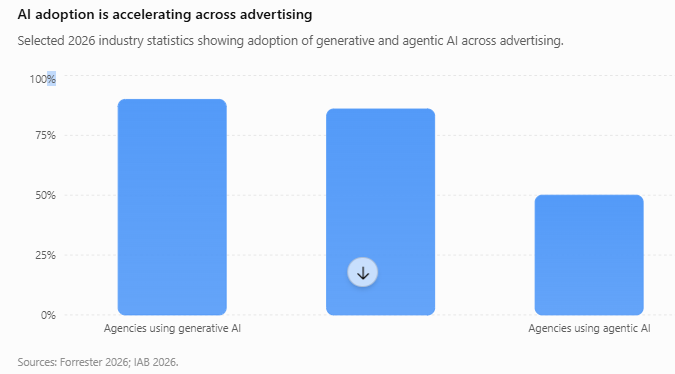
This shift is measurable. AI is already embedded in advertising: 9 in 10 U.S. marketing agencies use generative AI, while half use agentic AI for marketing execution, according to Forrester’s 2026 research. Meanwhile, 86% of digital video ad buyers are using or planning to use generative AI to create video ads, according to IAB.
AI is rewriting the rules of creativity, strategy, media buying, campaign production. Let’s explore the agency model, and why the AI advertising race is only getting started.
AI is moving from a tool to an advertising infrastructure
The initial stage of AI in advertising revolved around trial and error: creating headlines, images, research summaries, and social media posts. Advertising has always been a race against time. Agencies must learn about the target audience, invent the concept, create the proposition, purchase the media, and improve efficiency. Moreover, demonstrate the desired outcome, all before the campaign can even start.
With AI, the entire process can now be accelerated.
AI has found its way into numerous components of the marketing process, from creative processes to selection of target audience and media channels, programmatic marketing, and campaign optimization as well as measurement and production.
With the help of generative AI, it is possible to get tons of creative variations, while predictive AI models facilitate identification of target audiences and performance measurement. AI-based media platforms can automate the bid and placement process
Such changes lead to the shifting functions of advertising agencies.
While in the past the main role of an advertising agency was the creation of necessary advertising material, nowadays the agency has started to function as a marketing system, producing using AI technology.
This is why AI platforms are becoming a strategic infrastructure for agencies. A competitive advantage is shifting access to AI tools toward proprietary data, workflows, technology, expertise, and strategic intelligence.
The AI advertising race: Publicis, WPP and Omnicom
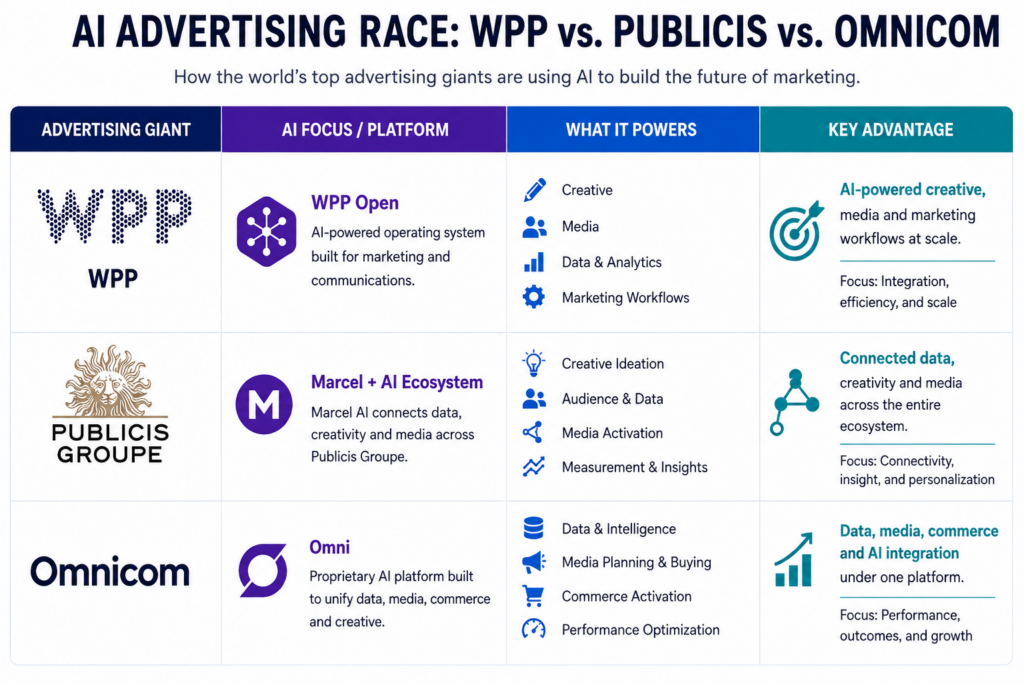
Leading advertising companies have begun to use AI for purposes beyond production; AI is starting to serve as the underlying framework for the future of advertising. The extent of this trend is exemplified by the fact that in 2026, more than 70,000 employees at WPP, or 90% of all client-centered personnel, were using WPP Open monthly.
Publicis is working on AI implementation across data, media, and creative sectors, in contrast to WPP’s strategy of expanding its service called WPP Open. Which aims to create connections between AI, data and marketing. Omnicom follows suit in creating a similar system known as Omni. Which connects data resources with media, marketing, creative work, and information processing.
Thus, it can be said that the actual competition is not merely between WPP, Publicis, and Omnicom anymore. The real challenge is to create the most efficient system of AI advertising that will make use of effective campaigns, creative ideas, and marketing.
Generative AI is rewriting creative production
Generative AI may be the most evident aspect of the ongoing transformation.
It allows the creative team to turn a single idea into hundreds of variations of images, headlines, formats, languages, audiences. And contexts without having to recreate every element from scratch.
This opens the opportunity for personalization on a scale.
However, this scale creates an irony: the presence of more content does not guarantee higher quality in advertising.
Forrester’s research predicts that in 2026 agencies will confuse effectiveness for efficiency. Jay Pattisall, VP and Principal Analyst at Forrester, explains:
“AI has fundamentally transformed marketing agencies. But the industry is at risk of mistaking efficiency for effectiveness,” said Jay Pattisall, VP, and principal analyst at Forrester.
The distinction matters because more content does not necessarily mean better advertising.
In the absence of unique ideas and insights, and with all agencies working with the same generators of images, texts, or videos.
AI will only help increase the level of similarities across advertising. Therefore, the role of creativity should shift away from production. And towards the idea, insight, cultural understanding, brand’s voice, and strategic brief.
AI in media buying and programmatic advertising
AI is revolutionizing the field of media buying. By transforming it from a manual process to an efficient decision-making process.
AI technology allows the evaluation of various parameters at the same time: campaign performance indicators, budgets, bids, ad placement, etc. It leads to idea generation related to the location of advertising, the amount of bid, and the audience to target when marketing products.
In programmatic advertising, AI technology looks for valuable audiences and adjusts bids while assessing performances in real-time. Due to such approaches. The decision-making process becomes shorter, and advertising costs decrease while the need for manual processes is eliminated.
One of the main changes brought about by AI technology is the transition from the question of how to buy advertising to the question of what to buy next. The increasing capabilities of AI agents can enable the process of media buying to become more automatic.
According to McKinsey’s 2026 research, More than half of advertisers say AI has already reshaped how consumers discover and consider products.
The new creative rule: Human judgment becomes more valuable
AI can produce numerous concepts, visuals, and variations in a matter of moments; however, more output does not equate to greater creativity.
As production evolves towards automation, scarce becomes the knowledge of what ideas should be used. According to Forrester’s study of 2026, agencies are likely to focus on efficacy rather than creativity and uniqueness of results.
The latest creative value proposition is humanity’s capability to assess understanding culture, emotions of an audience, meaning of the brand, and what works. Execution can be boosted with AI, but the ultimate decision in creativity lies with human beings.
The trust problem AI advertising cannot ignore
AI emphasizes another critical topic: transparency. The IAB’s research showed that 73% of people from Gen Z and Millennial generations believe that clearly stating that AI was used in advertising can either boost or not have any effect on the chances of making a purchase.
This means that AI disclosure is an important element of the marketing plan, and not only a requirement.
As David Cohen, CEO of the IAB, said: “Trust is a foundational element which is critical to the growth of AI across the ecosystem.” Hence, advertising agencies should create clear guidelines for the use of synthetic actors, voices, images, and data.
What happens to advertising agencies?
The upcoming agency format might not reflect a production establishment anymore, rather being an AI-powered operating system in marketing. The process of strategy formulation, creative idea generation, media selection, data analysis, and technology utilization will all take place simultaneously and cyclically from gathering insights and new ideas to measurements and optimizations.
AI will contribute to the efficiency and speed of campaigns. However, everyone will be able to access the same AI-tools, thus what really matters is the level of intelligence used by agencies when applying these tools in their job, taking into consideration the usage of specialized data, expertise of human minds, creativity and strategy.
The new rules of AI advertising
1. Compete based on brilliance rather than easy access: Now, AI tools are readily available for everyone. However, distinctiveness originates from privately held data, flows of work, and fund management.
2. Focus on efficacy, not only on efficiency: Creating an advertisement quickly is not a big deal if it looks the same as many AI-processed ads.
3. Use human judgment alongside technology instead of replacing it: AI can take care of the speed, pattern analysis, and improvement while human beings will continue to make decisions about strategies, tastes, ethics, and brands.
Cut to chase
AI is changing advertising from an episodic activity into a wise and always improved system. The true competitive advantage consists in not just having access to AI, but in the ability of ad agencies to integrate AI, creativity, data, and human judgment to create smarter, quicker, and more efficient advertising campaigns.
FAQ’s
AI advertising uses artificial intelligence to improve creative development, audience targeting, media buying, campaign optimization, personalization and performance measurement.
AI is helping agencies automate repetitive work, accelerate creative production, optimize media in real time and connect data, strategy and execution. This is shifting agencies from traditional production models toward AI-powered marketing operating systems.
The competition is increasingly about building the strongest AI advertising ecosystem. WPP, Publicis and Omnicom are developing connected platforms that bring together data, creativity, media, technology and AI to make advertising faster, smarter and more scalable.
At a Glance
- AI is becoming advertising infrastructure, transforming creativity, media buying, planning, production and optimization.
- The AI advertising race is accelerating, with WPP, Publicis and Omnicom building AI-powered platforms to connect data, creative and media.
- Generative AI is changing creative production, enabling agencies to create, test and personalize advertising at unprecedented scale.
- Human judgment remains the creative differentiator. AI can generate content, but strategy, originality, cultural understanding and brand thinking still require human expertise.
- The future belongs to intelligent, continuously learning campaigns, where AI handles scale and optimization while humans provide strategy, creativity and oversight.