

Green Advertising Without Greenwashing: 5 Achievable Goals for Agencies
Sustainability has become one of the most powerful narratives in modern marketing. Consumers increasingly want to support brands that take environmental responsibility seriously. But there is a catch: the more brands talk about sustainability, the more audiences question whether those claims are real.
This tension has created a credibility crisis. Campaigns filled with phrases like “eco-friendly,” “sustainable,” or “planet-positive” often fail to explain what those words mean. That is where greenwashing begins—and where trust collapses.
The agency playbook for green advertising
Green advertising, however, does not have to fall into that trap. When done properly, it combines responsible messaging with real environmental consideration across production, media planning, and corporate behavior.
Agencies play a critical role in shaping that shift. They influence how brands communicate, how campaigns are produced, and how sustainability narratives are framed.
To make green advertising credible rather than cosmetic, agencies must adopt five achievable goals that combine culture, creativity, compliance, credibility, collaboration, and carbon consciousness.
Build a sustainability-first agency culture
Green advertising starts long before a campaign goes live. It begins inside the agency itself.
If sustainability is treated as a campaign theme rather than a workplace priority, it quickly becomes superficial. Agencies need to embed environmental thinking into everyday operations and decision-making.
That means training teams—from creative directors to media planners—to understand the environmental impact of advertising production and distribution. Carbon-conscious workflows, reduced travel, and digital collaboration can significantly reduce emissions associated with campaign development.
A sustainability-first culture also encourages teams to question environmental claims rather than simply packaging them into appealing narratives. When sustainability becomes part of agency culture, green advertising stops being a trend and becomes a professional responsibility.
Design creativity that encourages responsible behavior
Creativity is one of the most powerful tools in advertising. When applied thoughtfully, it can shift not only brand perception but also consumer behavior.
Traditional sustainability campaigns often focus on praising the brand, highlighting recycled packaging or carbon neutrality. While these messages may build awareness, they rarely change how people consume.
Green advertising can go further by encouraging practical environmental action. Campaigns can promote product reuse, repair, recycling, and longer product lifespans. They can also emphasize responsible consumption rather than endless purchasing.
When creative storytelling moves from brand self-congratulation to behavior change, the environmental impact of advertising becomes much more meaningful.
Establish strict compliance for environmental claims
One of the biggest drivers of greenwashing is the vague language.
Words like natural, eco-friendly, and green often appear in campaigns without any measurable evidence behind them. This not only misleads consumers but also exposes brands to regulatory scrutiny.
Agencies can prevent this by implementing strict internal compliance standards for sustainability claims. Environmental statements should be supported by verifiable data such as lifecycle assessments, supply chain transparency, or third-party certifications.
Guidelines from organizations like the Federal Trade Commission and the International Chamber of Commerce provide frameworks for responsible environmental marketing. Agencies that adopt these standards reduce the risk of misleading claims and help maintain trust in sustainability messaging.
Compliance may sound restrictive, but in reality, it protects both brands and agencies from reputational damage.
Build credibility through transparent communication
Today’s audience is more skeptical than ever. They have seen too many sustainability campaigns that promise perfection while hiding limitations.
Credibility in green advertising comes from honesty rather than grand promises.
Brands do not need to claim they have solved climate change to communicate responsibly. Instead, agencies can help clients explain what progress has been made, what challenges remain, and what measurable targets they are pursuing.
Transparency about sustainability journeys often resonates more strongly with consumers than exaggerated claims of environmental purity.
When advertising communicates progress rather than perfection, it builds long-term trust instead of short-term applause.
Collaborate to reduce advertising’s carbon footprint
Advertising itself has a carbon footprint. Large-scale productions, international shoots, data-heavy digital advertising, and cloud infrastructure all contribute to emissions.
Green advertising, therefore, requires collaboration across the industry. Agencies must work with production houses, media platforms, and sustainability initiatives to reduce the environmental impact of campaigns.
Organizations like Ad Net Zero are already pushing the industry toward carbon-aware advertising practices. These include measuring campaign emissions, reducing production waste, and adopting lower-carbon media planning strategies.
Collaboration across the advertising ecosystem allows agencies to reduce environmental impact while maintaining creative and strategic effectiveness.
Green Advertising vs. Greenwashing
As regulatory pressure increases and consumers become more informed, greenwashing is becoming a risky strategy. Green advertising, on the other hand, builds credibility and long-term brand value.
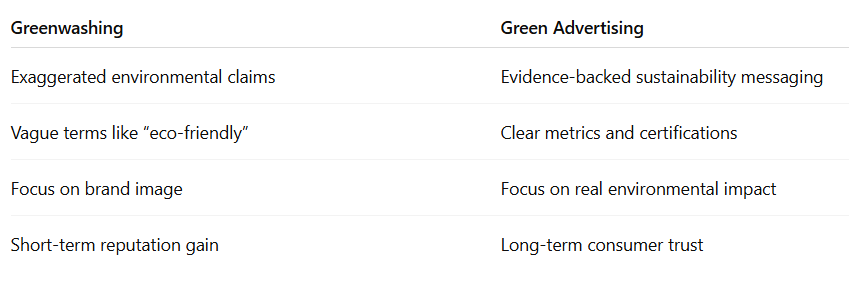
Greenwashing occurs when brands exaggerate or fabricate environmental benefits to appear sustainable while making no meaningful changes. Campaigns may use nature imagery, vague terminology, or selective statistics that hide the broader environmental impact of a product or company.
Greenwashing is essentially sustainability marketing without sustainability.
Green advertising, on the other hand, aligns communication with verifiable action. Environmental claims are supported by data, transparency, and measurable commitments. Campaigns avoid exaggerated language and instead focus on realistic progress and responsible behavior.
In an era of heightened consumer scrutiny and regulatory oversight, the latter approach is ethical and strategically smarter.
Cut to the chase
Green advertising is achievable when agencies stop treating sustainability as a messaging trend. They must start embedding strategies into how campaigns are created, approved, and delivered.
FAQs
Green advertising refers to marketing communication that promotes environmental responsibility while ensuring claims are accurate, verifiable, and transparent. It combines sustainable messaging with responsible production and media practices.
Greenwashing exaggerates or misrepresents environmental benefits, while green advertising is supported by evidence, transparency, and measurable sustainability actions.
Agencies shape campaign narratives, production processes, and media strategies. Their decisions influence how sustainability is communicated and whether claims remain credible.
Yes. Agencies can reduce emissions by adopting carbon-conscious production methods, minimizing travel, optimizing digital media formats, and collaborating with sustainability initiatives.
Consumers are increasingly skeptical of environmental claims. Credible communication supported by evidence helps build trust and protects brands from reputational damage.