
A Gen Z Marketer on Why B2B Needs More Humanity, Not Less AI
It started with Les Marketarables, a B2B take on Les Misérables on LinkedIn. Not AI-generated characters. Not a slick agency production with stock footage and a voiceover. A full musical video, studio recording, filmed in London — performed by real people to advertise an AI-integrated B2B marketing platform.
The kind of thing that makes me stop scrolling and ask: What is this?
That video belongs to Passionfruit, a platform that connects companies with vetted marketing specialists — and increasingly, with an AI tool built specifically for marketers. Anxiety, fear of losing a job, fear of AI replacing human creativity, and agencies charging more by showing an AI bot in some shiny wrapper.
And the person who worked on the Les Marketarables is Eleanor, a 25-year-old senior marketing executive who, by her own description, is the youngest on Passionfruit’s marketing team.
I spoke to Eleanor for Ad Pulse’s ongoing series on humanizing B2B brands in the post-AI era — a conversation about creativity, anxiety, and what it actually means to put people at the center of a business that is, in large part, about technology.
The AI Paradox: The irreplaceable humans
About 4 years ago, Passionfruit launched as a freelance marketplace to help companies find marketing specialists.
In the last six months, it has pivoted significantly toward an AI-powered marketing operating layer (PIP). It is building a marketing-specific AI tool that sits on top of a company’s entire marketing stack, integrating platforms such as HubSpot, Salesforce, LinkedIn, Instagram, and more into a single system trained on marketing data.
In short, Passionfruit has evolved into an all-in-one space for AI in marketing and marketing teams.
So, what does it mean for a company selling AI to keep insisting that humans matter?
The video that started it all
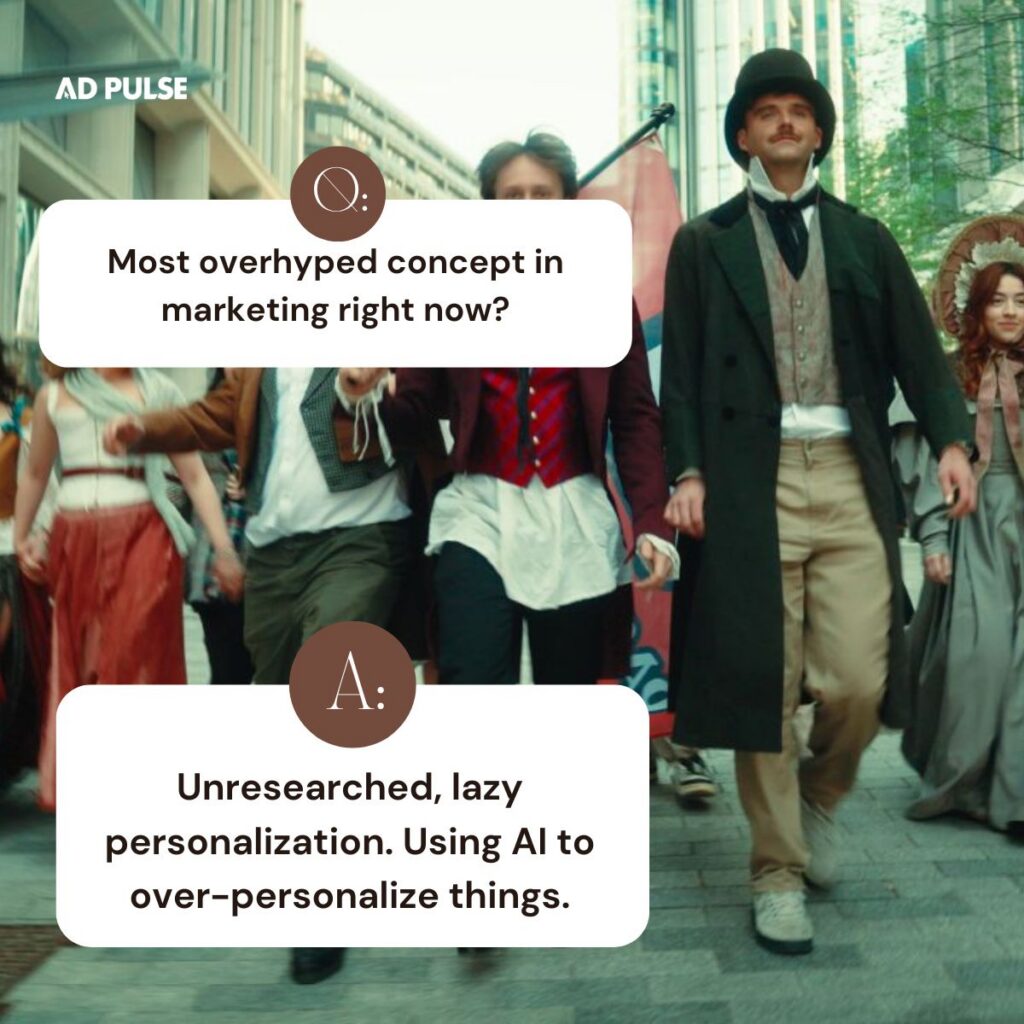
When I first saw Les Marketarables’s video, my immediate reaction was ‘wow, this is something unique, a lot of people are in it’. It was too unexpected, too human, too humorous for a B2B brand.
But Eleanor is clear with her intent, her messaging, and the contextual position.
“I wrote the score myself. We recorded in a professional studio and filmed it over a couple of days in London,”
She says. “It was about the AI revolution — trying to capture the dilemma that marketers are finding themselves in. A bit overwhelmed, understandably. But also asking: how do we use this for good?”
She points to the Les Marketarables video as living proof of the ‘humanizing business’ concept. The Les Marketarables video, costumes, script, and studio recording happened because
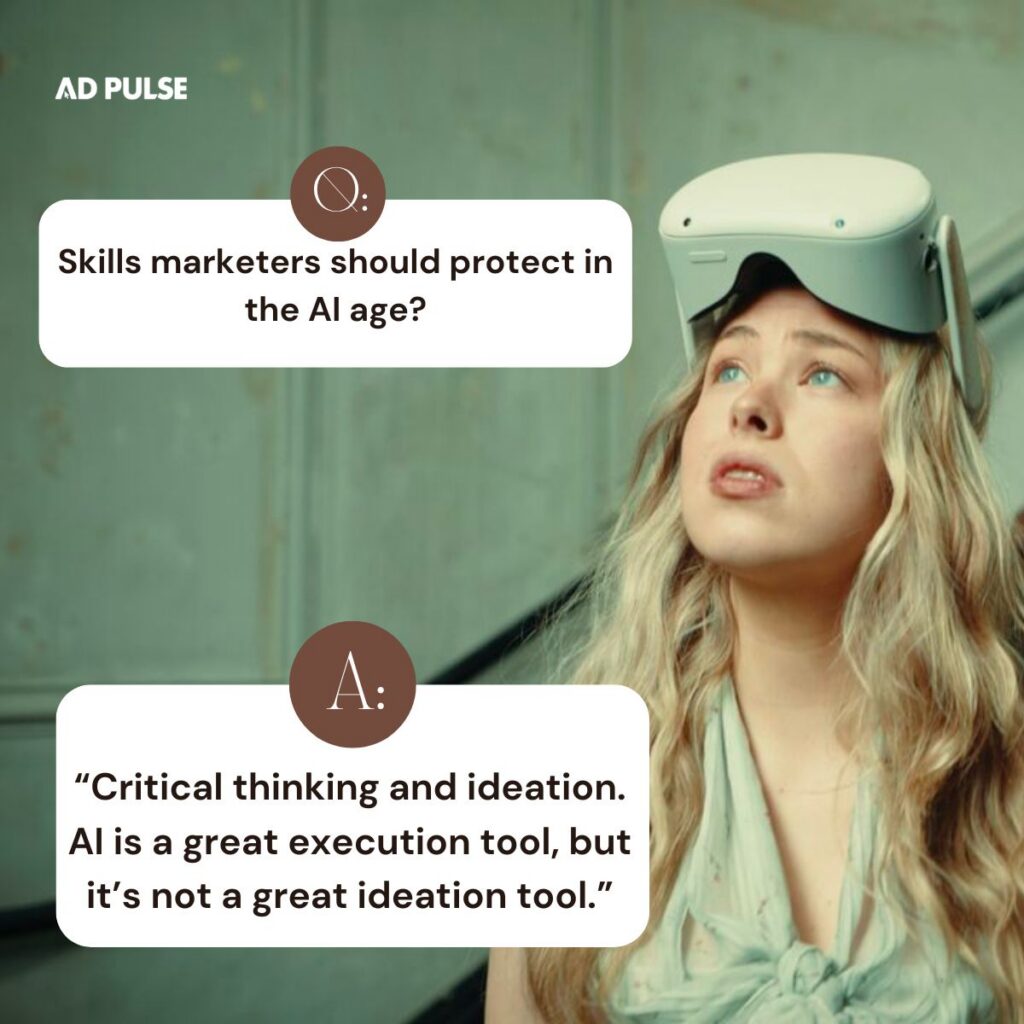
“AI can read everything on the internet, but it doesn’t have emotional intelligence. It can’t really sense-check in the same way. That’s where the human element is irreplaceable.”
Trust is paramount in the post-AI age
Passionfruit is a B2B business. Their clients are companies; their product is specialists and an AI tool, PIP, for marketing teams. It blends AI capabilities with a network of vetted marketing experts to help businesses scale campaigns and streamline execution.
Rather than functioning solely as a freelance marketplace, it aims to act as a centralized layer.
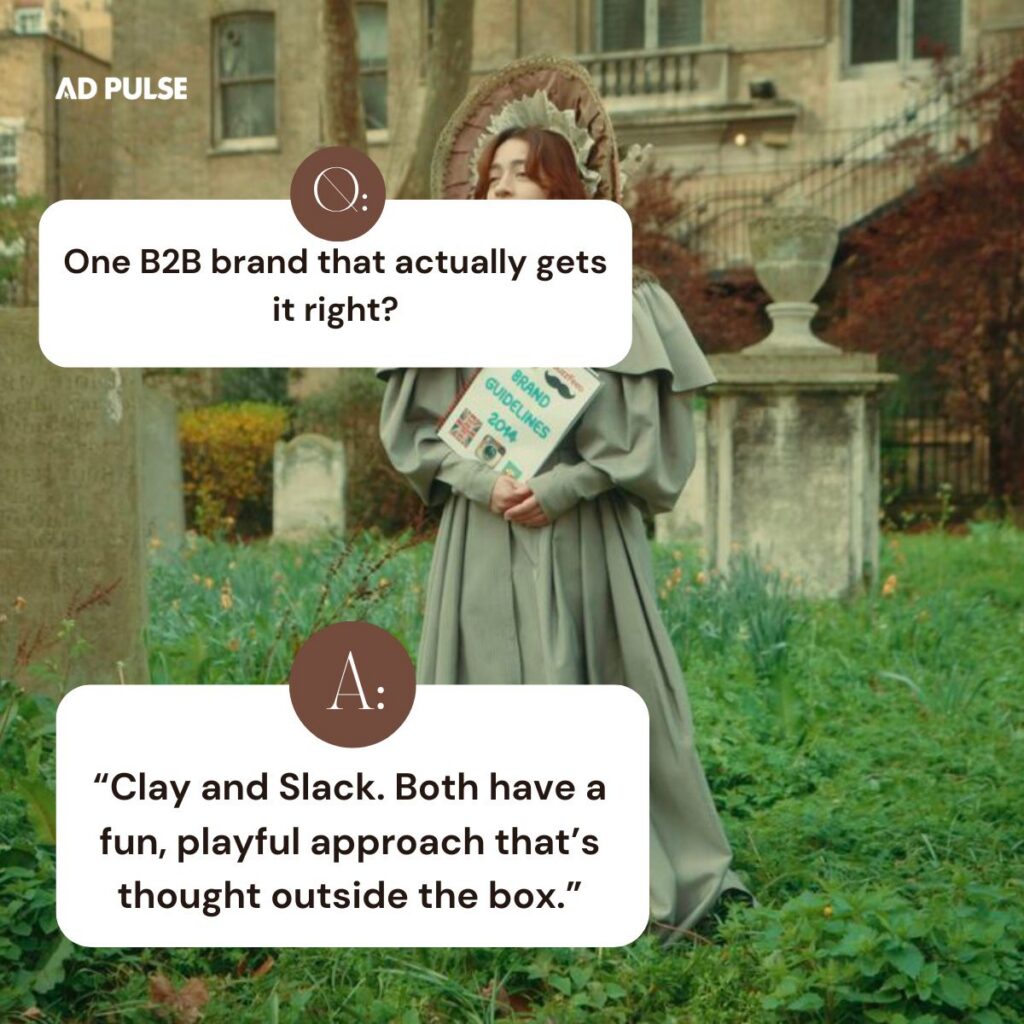
And yet their marketing approach looks nothing like a traditional B2B — no whitepapers, no feature lists, no corporate tone of voice.
“I want to be clear that I’m not anti-AI. Our company is an AI company,” Eleanor says. “But it’s all about stewarding it correctly. What our AI does is automate the grunt work — the reports, the spreadsheets, the outbounding. It frees up time for the bits that actually require humans: strategy, creativity, emotional intelligence.”
“We’re very much a B2B business,” Eleanor says, “but a lot of our marketing comes across as direct-to-consumer. We’re trying to use the creativity of D2C marketing, but for B2B purposes.”
This is a broader shift happening across the industry. The red lines of B2B advertising are blurring. Humor, creators, and emotional storytelling — tools once considered too risky for enterprise marketing — are now taking center stage. Eleanor sees this not as a trend, but as a correction.
“People still want to buy from people. Even in B2B — especially in B2B — trust is everything. And trust is built through personality, not product specs.”
AI anxieties in the market and marketers
One of the most discussed anxieties in marketing right now is AI content saturation. It is the fear that AI will flood every channel with indistinguishable output, making it impossible for human-made content to stand out.
Eleanor’s take is more nuanced than the usual doom-or-utopia binary. She argues we haven’t hit peak AI content yet, as many companies are still reluctant to fully deploy it, worried about alienating audiences.
But she sees the landscape splitting into two distinct directions.
“AI-generated content is going to improve to the point where we can’t tell it’s AI — maybe with video as the exception, where we’re still a little way off. But I also think there’s going to be a separate stream where people actively seek out analogue, human content specifically because of trust. Those two streams will exist in parallel.”
Eleanor is 25. In a sector dominated by older professionals and senior decision-makers, that’s worth noting. She is, in many ways, the exact demographic most exposed to the anxiety about AI. She is early in her career, still building expertise, watching a technology emerge that promises to automate significant chunks of the work.
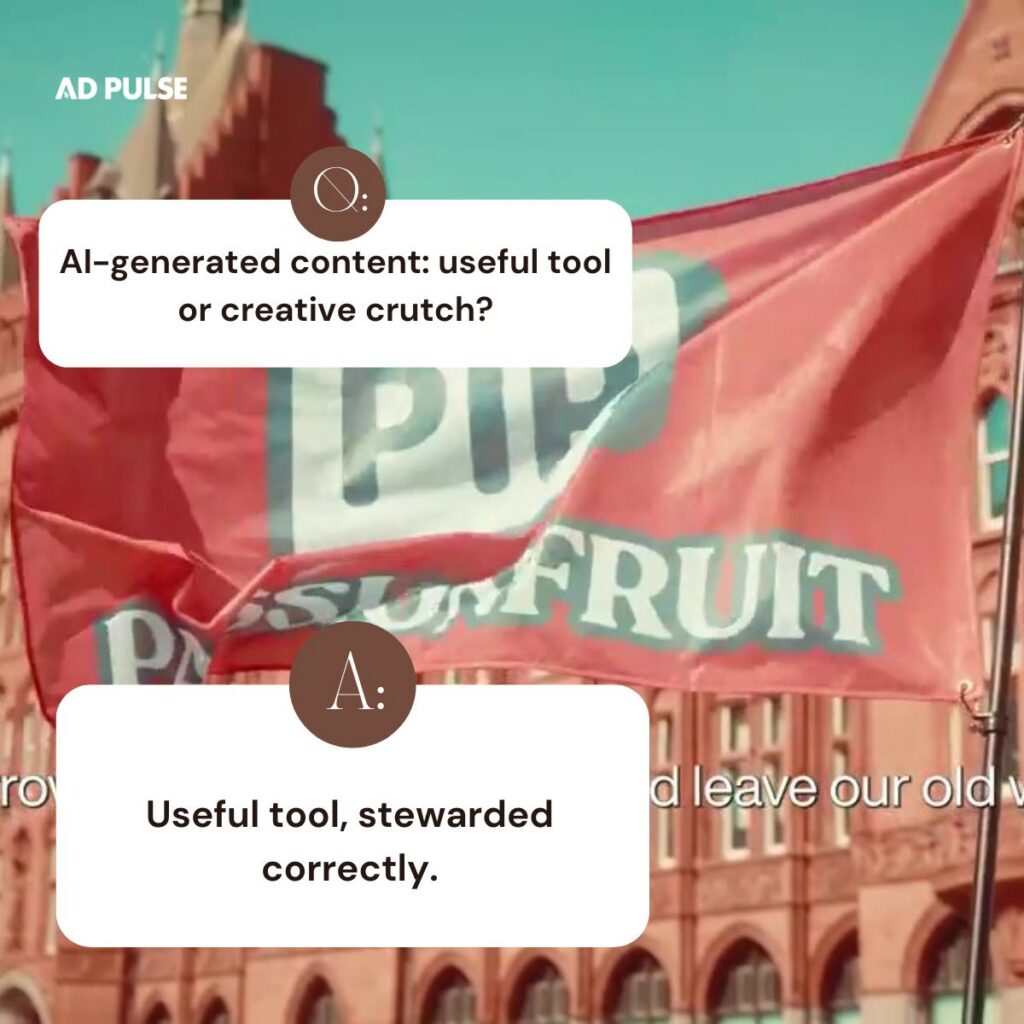
I ask her what she’d say to a young marketer who comes to her worried about being replaced.
“I’d be foolish to say no one feels anxiety about it,” she says.
“It’s a completely unknown entity in terms of where it could go. But where it’s at right now — it’s actually exciting. When I first started in marketing without AI, I was spending my creative hours on the job work. Now I can automate that and use the time to write scripts, design costumes, and make weird videos.”
She draws a comparison to previous technological shifts. “Certain roles will disappear — but AI is going to create more jobs in the same way the internet did, or the industrial revolution. There was a period of uncertainty, followed by thousands more jobs being created. Marketers need to learn to embrace AI but steward it correctly.”
Cut to the chase
What makes Eleanor’s perspective interesting isn’t that she’s anti-AI. She isn’t. She works at an AI company, and she uses AI daily. What makes it interesting is the precision of where she draws the line.
AI handles the volume. Humans handle meanings. In a post-AI world where content is abundant and trust is scarce, that distinction may be the most valuable thing a brand can understand.
And if a full Les Marketarables production filmed in London is what it takes to prove it — well, at least it got people to stop scrolling.