

Retail Media vs. Commerce Media: The Next Evolution of Digital Advertising
Consumers are engaging in activities beyond just visiting retail sites. They are purchasing flight tickets, booking cabs, making digital payments, streaming video or audio, buying groceries, booking hotels, and managing finances on dozens of apps each week. Each of these interactions creates valuable first-party data.
This shift raises an important new question for marketers: If advertising exists everywhere, there is an intention to purchase, why can’t any business that offers a product or service engage in selling advertising, and not just those in the retail space?
The answer to this question has led to the rise of commerce media, which represents a new ecosystem where banks, payment apps, airlines/travel, mobility, food delivery, and fintech companies are all entering the advertising space as advertisers.
Brands that previously thought of themselves only as a place that sells products and services are now competing against each other for advertising budgets.
This leads to a much larger question: Is retail media merely evolving, or could commerce media be the next significant digital advertising network? Let’s take a look.
Retail media was never just about selling products
To understand how commerce media works, you need to first know what Retail Media is all about.
Retail media provides retailers with the ability to turn their digital assets into revenue streams by offering Brands an opportunity to advertise on their own properties. For example, Sponsored Products on Amazon, Promoted Listings on Walmart Connect, or even Search Ads in a Grocery App.
The concept is so simple.
The consumer goes to the retailer to purchase product(s). Brands pay for advertising space so they can be seen by consumers as they make purchase decisions.
With Retail media, the effectiveness of Advertising can be measured because it links an advertising impression with an actual sale, unlike other forms of Digital Display Media, where this cannot be done. This is why Retail Media Networks (RMNs) have proliferated worldwide.
Advertising has quickly become one of Amazon’s fastest-growing businesses worldwide. Conversely, hundreds of retailers have followed suit (Walmart, Target, Instacart, Kroger, Tesco, Carrefour, and others).
The RMNs are the solution to the loss of third-party cookies and to the increasing challenges posed by Privacy Legislation.
Is retail media growing?
The number says yes, but so does the competition
The numbers back it up. Global retail media ad spend is projected to surpass $200 billion by 2027, underscoring why businesses beyond retail are investing in first-party data and media networks.
Retail media ad spend is growing worldwide because marketers want to advertise in environments where purchase intent can be measured. More and more brands are moving their budgets from traditional display ads to closed-loop attributions with retailers that can provide that information.
However, the rising success of many retailers’ ad businesses has brought a major, unexpected challenge. Currently, almost every major retailer sells advertising.
So, brands are no longer just purchasing media on Amazon; they’re running campaigns across multiple retail media networks, each with its own measurement, dashboard, reporting, and audience definitions.
As a result, we’ve seen extensive fragmentation in the retail media marketplace. Meanwhile, most consumers spend very little time on retailer websites—most of their shopping will happen through commerce media.
Commerce media is expanding the advertising playbook
The simplest way to grasp this shift is:
Retail media asks, “What happens while someone is shopping?”
Commerce media asks, “What happens before, during and after any commercial decision is made?”.
Whether it’s a payment, a ride, a hotel booking, or a salary deposit, every commercial interaction creates a signal of intent—and that signal has advertising value.
Each interaction signals consumer intent—and every signal has advertising value.
Unlike retail media, the commerce media ecosystem extends far beyond retailers. It includes companies that facilitate payments, transportation, travel, banking, food delivery, subscriptions, and other everyday transactions.
Wherever consumers make decisions, advertisers see an opportunity to connect.
Retail media vs commerce media: what’s the real difference?
While individuals frequently use these words interchangeably, they differ significantly.
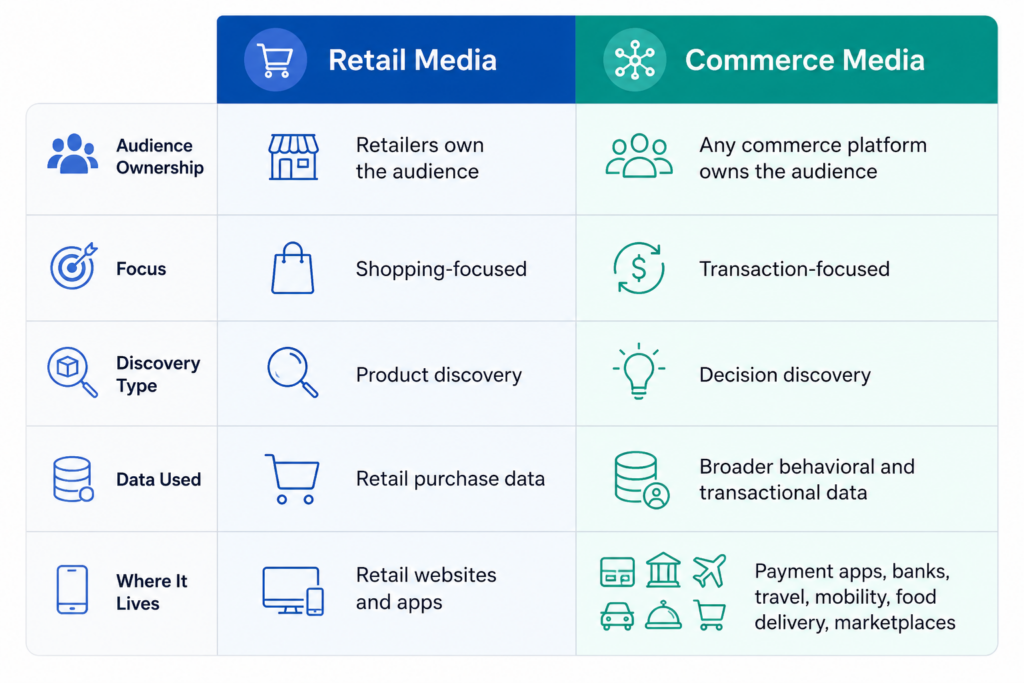
Consider retail media to be a single branch of commerce’s extensive media ecosystem.
The journey is now media inventory; it is not simply the destination.
The destination may no longer have as great a value as the journey.
Every transaction is becoming an advertising opportunity
The biggest transformation isn’t technological, it’s strategic.
Businesses are beginning to realize that they already own valuable advertising real estate through the customer interactions they facilitate every day.
Consider a few examples:
Fintech Advertising Platforms: In 2026, Mastercard Commerce Media forged partnerships with Uber, Yahoo, and Paramount, using transaction data to deliver privacy-first advertising based on real consumer behavior rather than third-party cookies.
Banking Media Networks: Chase Media Solutions now enables brands to reach more than 80 million customers through first-party banking data, demonstrating how financial institutions are becoming powerful commerce media players.
PayPal Advertising Platform: PayPal Ads continues to strengthen its commerce media offering by helping advertisers reach audiences using verified purchase data instead of relying solely on browsing activity.
Uber Ads: During Cannes Lions 2026, Uber Advertising introduced new advertising formats, including Offsite Ads and Mobility Offers, which allow brands to promote their products beyond the Uber app.
Travel Advertising Platform: Kinective Media, a United Airlines unit, helps brands connect with travelers at different points of their journey using first-party data concerning travelers.
Why brands are embracing the media strategy
Today’s marketers pursue impressions as well as relevance. An effective commerce media strategy should connect moments of influence with purchase behavior.
Rather than interrupt an individual’s consumer experience, a brand should engage with an existing consumer journey.
Example:
- A coffee company might reach commuters via a mobility application.
- A luggage company could engage with consumers after booking their flights.
- A financial services company may communicate its investment products after a salary has been deposited.
- A grocery retailer may appear during the consumer’s meal planning stage.
This means advertising is more contextual rather than disruptive. And consumers are aware of this difference.
How do commerce media networks generate revenue for businesses?
Commerce media is booming due to the diversification of businesses’ revenue streams. But how do these networks make money? There’s more than one way.
Sponsored exposure: Businesses can now pay for premium ad placement.
Audience monetization: Businesses are selling anonymized audience metrics to other businesses without violating regulations.
Data collaborations: Companies can leverage first-party data to improve targeting and measurement. This creates a lot of opportunities.
Closed-loop attribution: Because ads can be directly linked to sales, advertisers are often willing to spend more.
New revenue opportunities: Ad revenue can often be more profitable than many of a business’s core operations.
Thus, businesses can begin monetizing their customers’ attention.
The retail media ecosystem is becoming interconnected
In the beginning, every retailer set up their own advertisement platform. However, advertisers today have higher expectations and seek interoperability. It involves:
- Unified measurement
- Audiences targeting on various platforms
- Consistent reports
- Simplified management of campaigns
Currently, the traditional retail media network is maturing into a connected commerce network. Nowadays, technology suppliers offer advertisers unified solutions for buying advertisement space across different retailers, financial institutions, travel agencies, and e-commerce merchants.
But bigger isn’t always better
The swift development of commerce media brings many significant issues.
- What level of consumer information should be employed by organizations?
- How much transparency in personalization is necessary?
- Will people welcome relevant suggestions or feel that they are controlled all the time?
Privacy rules are still changing and moving around the world, making it essential for firms to find a way to ensure personalization and trust. Measurement issue is still a problem as it is not defined the same by different commerce platforms, which makes comparisons rather complicated.
It is not correct to see advertising solely as a process of getting more inventory.
The future of retail media: When commerce becomes the new media channel
Retail media in the past was restricted to companies that operated in retail, but today, banks, payment services, travel agencies, transportation providers, and many other consumer-facing organizations are using their first-party data to create advertising messages. There is now a transition from the price of goods being important to what customers consider before buying.
It is important to note that the key players will not simply be companies with the most advertising space because other firms will be able to create relevant experiences that are measurable and respectful of users’ privacy.
Cut to the chase
Retail media has transcended beyond being just about retailers and is fast becoming an intricate commerce media ecosystem where any purchase can easily be an advertisement opportunity. Everything is changing as financial institutions, payment applications, travel companies, and transportation services tap into their first-party data.
FAQ’s
Retail media enables brands to advertise on retailers’ websites and apps using first-party shopper data.
Commerce media expands advertising beyond retail to platforms like banks, payment apps, travel, and mobility services.
It helps businesses monetize first-party data while giving brands access to high-intent consumers.