
Why Did YouTube Add a Switch-Off Button to its Fastest-Growing Feature?
Social media platforms are not known for giving up their users easily, willingly, or ethically. That is what makes YouTube Shorts’ decision to add a Switch-Off button so remarkable. In an industry that is architected around maximizing screen time, handing users a clean opt-out is, at minimum, worth examining closely.
YouTube Shorts have not been struggling. Since its launch in 2021, the format has crossed 200 billion daily views. It has made a milestone after putting its reach and engagement ahead of TikTok and Reels.
Yet despite that dominance, YouTube users had been vocal about one growing frustration. Shorts were bleeding into every corner of the app, surfacing in search results, homepages, and feeds even after having its own dedicated tab. The complaints were persistent enough that YouTube could no longer ignore them.
So, is YouTube benevolent? Smart brand strategy? Or is YouTube reading a signal that the industry has been slow to act on?
What is YouTube Shorts’ switch-off button?
The feature itself is straightforward. YouTube has expanded its existing screen time management settings to let users set a daily Shorts limit, including zero minutes. Previously, the time-management tool capped viewing for 15 minutes.
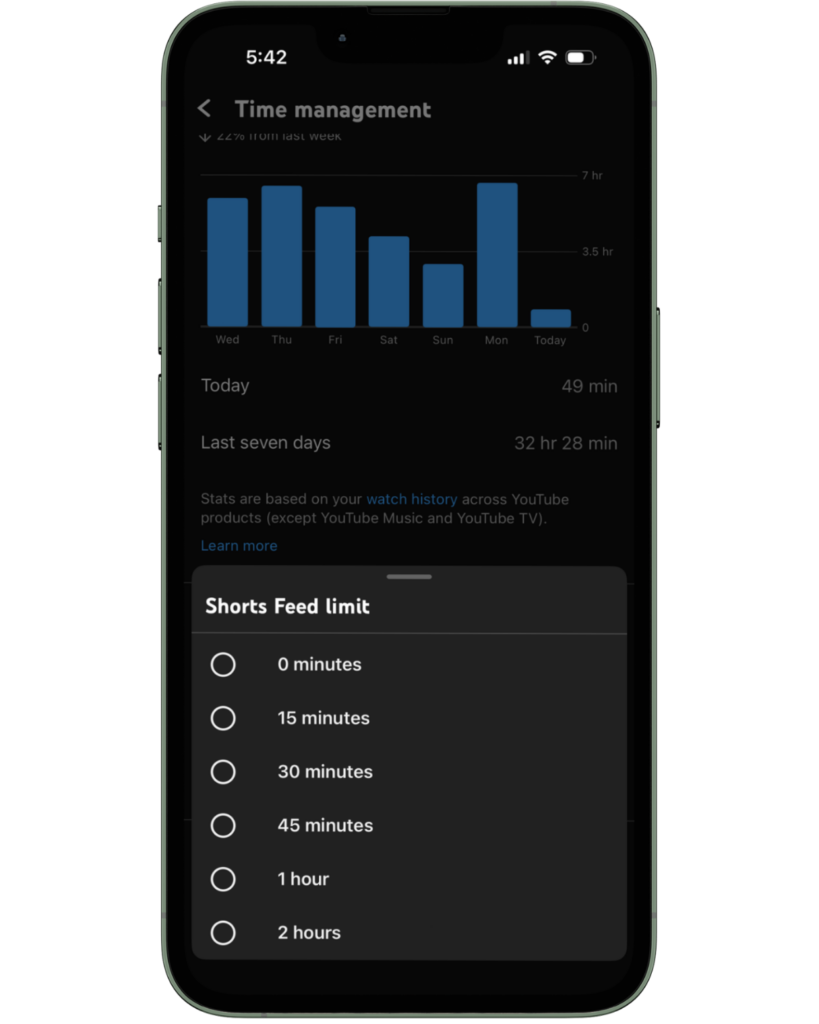
The update gives users complete control: if you do not want to see Shorts, you no longer have to.
The feature works as a time-limit enforcer tied to the YouTube mobile app’s settings panel. Once the limit is set to zero; Shorts stop appearing. They cannot re-enter the user experience unless the user changes the setting. It is not automatic; it requires the user to opt in to the restriction.
That distinction matters because YouTube is not defaulting users away from Shorts; it is making the choice easier to act on.
The context here is doomscrolling. Short-form video is engineered for compulsive viewing; the vertical scroll, auto-play, and infinite feed are not accidental design choices. They are retention mechanics. YouTube adding a hard stop to that loop is, structurally, a step in the opposite direction of how most social platforms operate.
The real driver: Children’s watching behavior
For a platform of YouTube’s size, ignoring user complaints is operationally easy. What is harder to ignore is when those complaints involve a rapidly growing demographic: children and pre-teens.
Precise TV survey said that 32 percent of US teens aged 13 to 17 report spending 30 minutes to one hour daily on YouTube Shorts. It was more than 28 percent for TikTok, and more than 21 percent on standard long-form YouTube.
Short-form video, it turns out, has the strongest grip on the youngest viewers.
That grip extends further down the age ladder. A 2024 Numerator survey found that YouTube was the top platform on which children across multiple age groups spent time.
Among parents of children aged 11 to 14, 60 percent identified YouTube as the primary platform. For children aged 6 to 10, the figure was 50 percent. Most striking was the toddler data: even among children aged 1 to 5, 26 percent of parents reported YouTube as the top platform. It became a sign that YouTube Kids is cementing viewing behavior before children can read.
That data completely reframes the Switch-Off button. This is not YouTube being generous. This is YouTube managing regulatory and reputational risk before regulators force the issue.
Children are the most susceptible to the same compulsive design mechanics that make Shorts profitable. Giving parents and older users a clean off-switch is far less expensive than a government-mandated one.
A contrast worth noting: Meta vs YouTube
YouTube’s decision lands at a specific moment in the platform economy. It has come at a time when Meta’s choices are moving in the opposite direction.
We have covered Meta’s advertising ecosystem and brand safety gaps in detail at Ad Pulse.
The pattern is consistent: internal Meta documents reviewed by Reuters revealed that the company projected roughly 10 percent of its 2024 ad revenue would come from ads for scams, illegal goods, and other prohibited content.
Users on Facebook, Instagram, and WhatsApp were exposed to an estimated 15 billion high-risk scam ads daily.
The company reportedly instructed its ad-integrity teams not to take actions that would eliminate more than 0.15 percent of projected revenue, effectively capping enforcement at around $135 million against a $90 billion base.
That is a structural choice where revenue was prioritized over user safety. Meta’s antitrust exposure, its FTC trial, and the Consumer Federation of America‘s class-action lawsuit are all downstream consequences of that choice.
Against that backdrop, YouTube’s decision to hand users a Shorts switch–off is not just a product feature. It is a positioning signal. In an environment where platform trust has eroded significantly, the ability to say ‘we gave users control’ is becoming a competitive differentiator, particularly for advertisers who care about brand safety.
The largest share of the audience is older
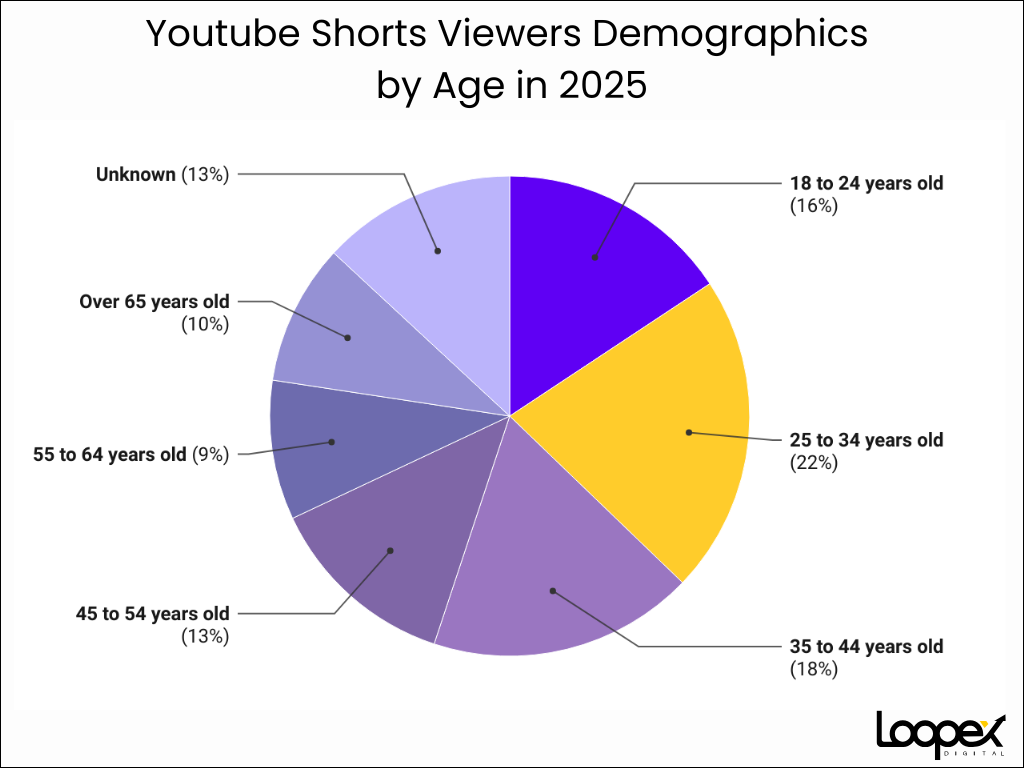
It would be easy to assume YouTube Shorts’ audience is entirely Gen Z and younger. The data tells a more nuanced story. According to Loopex Digital’s 2026 report, the largest single demographic watching Shorts is the 25–34 age group. It constitutes approximately 21 percent of the audience.
The core U.S. Shorts viewer is described as a college-educated adult.
This matters for brands and marketers because it reframes what YouTube Shorts actually is. It is not purely a Gen Z discovery engine. It is a broad-reach format with a commercially valuable adult core audience.
As we reported at Ad Pulse, YouTube Shorts advertising has been on the rise for brands. It has become a favorite among particularly small and mid-size businesses, which have found the format cost-effective and highly converting.
According to MediaScience data, YouTube Select Shorts ads are watched 90 percent longer than ads on comparable social platforms. And 38 percent of consumers have made a purchase after seeing an ad or content on YouTube Shorts.
The format converts, which is exactly why marketers should be paying close attention to how a Switch-Off option could reshape their reach.
What the switch-off button means for brand marketing
The honest answer is that the impact will be uneven. For brands running Shorts campaigns, a reduced or zeroed-out Shorts feed means fewer ad impressions among users who opt out. Heavy users — the doom-scrollers — are often the most engaged and the most likely to be restricted by parents or individuals. That audience overlap deserves careful attention.
That said, the opportunity in the Switch-Off is also real. Here is how brands can work around it:
- Earned attention over forced exposure
Users who actively choose to keep Shorts on are more intentional viewers. That is a higher-quality audience for brand messaging than someone swiping past an ad at 2 AM in an algorithmic loop.
- Lean into YouTube Select Shorts
Premium ad placements within top-performing Shorts content are less likely to be affected by broad opt-outs because opted-in users are self-selecting into the experience. Brands already using YouTube Select Shorts should consider increasing that allocation.
- Treat Shorts as a top-of-funnel discovery layer
Brands using Shorts combined with long-form YouTube content grow 41 percent faster, per Loopex Digital’s 2026 benchmarks. The Switch-Off does not affect long-form. Brands anchored in long-form are more insulated.
- Recalibrate for younger audiences
If the Switch-Off is driven by parental controls and teen screen-time concerns, marketers targeting that demographic specifically need to model reduced Shorts reach into their projections and diversify formats accordingly.
- Content quality becomes the moat
In a world where users can exit the algorithm entirely, the only Shorts content that survives is content people actively want to see. Production investment and strong creativity now yield direct returns.
Cut to the chase
YouTube Shorts, reaching 200 billion daily views in five years, is one of the most remarkable growth stories in digital media. Whether the new Switch-Off button reverses it or not, we can find it in the next quarter. However, it does signal an important trend in platform trust.
It is an extension of YouTube’s existing screen time management settings that allows users to set a daily time limit for Shorts — including a limit of zero minutes. The setting is user-initiated and applies to the YouTube mobile app.
Not in any wholesale way. The feature is opt-in, meaning most users will not activate it. It is more likely to reduce Shorts consumption among users managed by parental controls.
Brands should treat the Switch-Off as a creative quality signal rather than a threat to reach. Focus on content that earns engagement rather than relying on algorithmic repetition.
The timing aligns with sustained user complaints about Shorts appearing outside their designated tab, as well as growing regulatory scrutiny of short-form video and children’s screen time.
It could reduce impressions among users who opt out, but the affected audience — those setting zero-minute limits — is likely a small fraction of total Shorts viewers.