
Unpredictability in Marketing is a Law, while a Sedentary System is a Danger
The law of unpredictability governs both markets and business marketing. Brands, agencies, and even sophisticated AI systems cannot accurately forecast the next phase of consumer behavior or the next Instagram trend. They can study patterns, analyze historical data, and anticipate possibilities. But predicting exactly what happens next is an entirely different challenge.
I often wonder whether brands curate trends in the digital arena to avoid unpredictability. That is not necessarily a conspiracy theory. It is something we have witnessed over the last couple of years. Ghibli-image trend, Bix-figurine trend, or Nano-Banana image generations; all of these trends became super popular in 2025 but are now nowhere to be seen.
Brands increasingly participate in existing conversations, follow viral formats, and use algorithmic signals to determine what audiences might want next.
But what happens when the audience wants something completely different?
Al Ries and Jack Trout addressed this challenge through the Law of Unpredictability. The principle highlights the difficulty of forecasting competitive reactions and future market developments.
Let’s dig deep into the unpredictable market and marketing strategy to help in times of broken patterns.
The law of unpredictability in marketing
The Law of Unpredictability challenges one of the most common assumptions in business: that sufficient information can make the future predictable.
Marketers regularly use historical performance, consumer research, competitor analysis, and market intelligence to develop their strategies. These tools are valuable. However, they cannot account for every external factor that might influence a consumer’s next decision.
A competitor could introduce an unexpected product. Social media conversation could turn into a global trend. An economic disruption could change purchasing priorities. New technology could make an established advertising channel less effective.
The problem arises when businesses treat their existing marketing plans as permanent instructions rather than adaptable strategies.
Consider how quickly digital culture changes. A trend that attracts millions of interactions today could become irrelevant within a week. A brand that spends months developing a campaign around an established audience preference might discover that the audience has moved elsewhere.
The law does not require businesses to stop forecasting. It suggests that forecasting should not become a substitute for preparedness.
There is a difference between knowing where the market might move and being prepared to respond when it moves somewhere else.
Predictability in marketing systems
Marketing technology has made consumers increasingly sophisticated. Hyper-personalization enables platforms and advertisers to analyze behavioral signals, recommend products, and deliver messages tailored to individual preferences.
However, this efficiency creates another problem. The more businesses depend on predictable consumer profiles, the more they risk overlooking changes in consumer behavior.
A person searching for running shoes might continuously receive advertisements for running shoes. Someone watching crime documentaries could receive recommendations for similar content. A consumer interested in skincare might encounter an increasingly narrow selection of beauty products.
This is precisely the concern explored in Ad Pulse’s article, Hyper-Personalization Fuels the Shrinking of the Internet’s Search Diversity.
Personalization can improve relevance, but relevance does not necessarily represent curiosity, discovery, or changing interests. Consumers are not permanent behavioral profiles. Their preferences evolve, sometimes without any obvious explanation.
For marketers, this creates a strategic contradiction.
They want to understand consumers better but increasingly rely on systems that reinforce what consumers have already demonstrated. They want to discover new audiences, but their targeting mechanisms often prioritize people who resemble existing customers.
Eventually, brands might become extremely efficient at reaching their current audiences while becoming less capable of attracting new ones.
This is where unpredictability becomes commercially important. A consumer who changes interests is not necessarily an anomaly. That consumer represents an opportunity that a rigid marketing system might overlook.
Can AI predict unpredictable patterns?
AI systems can process enormous amounts of information, identify behavioral patterns, and generate forecasts based on available data. They can also help marketers respond faster to emerging trends.
However, there is an important distinction between identifying a pattern and understanding an entirely new situation.
AI models depend on information, training, contextual signals, and objectives. When the environment changes significantly, their previous assumptions might no longer produce reliable results.
The UK’s AI Security Institute examined the limitations of contemporary AI systems in its September 2025 research on AI capabilities. Its assessment identified insufficient reliability, adaptability, and capacity for original insights among the limitations of current systems.
The International AI Safety Report 2026 also highlights reliability problems, including failures when AI systems encounter unfamiliar inputs or operate outside the conditions in which their capabilities have been evaluated.
For marketing, this raises an important question.
What happens when an AI-powered advertising system continues optimizing campaigns around yesterday’s consumer behavior while the audience has already moved on?
AI can help marketers identify changes. It cannot guarantee that every unexpected cultural shift, competitive move, or consumer reaction will be understood correctly.
Human judgment therefore remains important, particularly when marketers need to question the assumptions behind automated recommendations.
Cracker Barrel’s logo change had unpredictable market reactions
Cracker Barrel’s 2025 rebranding controversy provides a useful example of the Law of Unpredictability.
In August 2025, the American restaurant chain introduced a simplified logo that removed its familiar Old Timer character. The redesign was part of a broader effort to modernize the brand and attract a wider audience.
However, the response was far more complicated than a conventional brand refresh.
The new identity triggered widespread criticism on social media. Customers and commentators questioned the decision to remove an element associated with the company’s longstanding identity. The controversy also attracted political attention.
Initially, the company defended its redesign. Within days, however, it reversed the decision and announced that the old logo would remain.
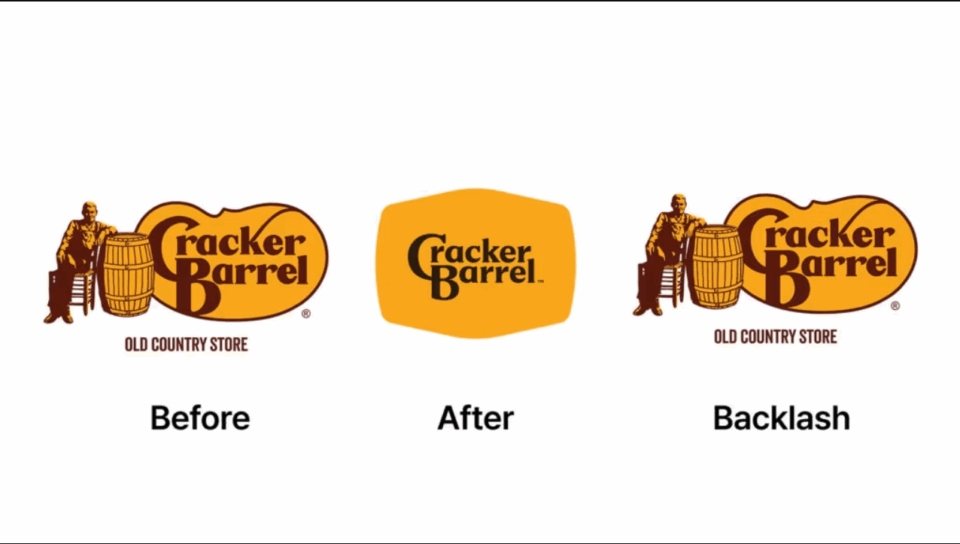
The reaction had commercial consequences. The Los Angeles Times reported citing transaction data, showed that restaurant transactions slowed following the redesign. The controversy demonstrated how quickly a brand strategy could become a larger public conversation.
Cracker Barrel had a modernization strategy, but the market response revealed a gap between the company’s intended brand direction and the emotional value of customers attached to its existing identity.
No amount of historical brand recognition could guarantee that the redesign would be accepted.
This is precisely why marketing strategies need room for reassessment.
Marketing needs adaptability rather than a predictive dashboard
The marketing industry has invested heavily in systems designed to make consumer behavior more measurable and advertising more efficient.
Yet measurement should not become an excuse to avoid experimentation.
Brands need to recognize that not every opportunity will emerge from existing audience data. Some will emerge from unexpected conversations, new consumer interests, shifting cultural preferences, or competitors’ decisions.
A flexible marketing strategy should allow businesses to experiment with unfamiliar creative formats; question established audience segments and reconsider their assumptions when performance changes.
It should also give marketing teams the authority to challenge automated recommendations rather than treating every AI-generated insight as a business instruction.
The Law of Unpredictability is not an argument against planning. It is a reminder that planning without flexibility can become a competitive disadvantage.
Cut to the chase
Marketing has always operated in an unpredictable environment. What has changed is the industry’s growing dependence on systems that promise greater control over consumer behavior.
Businesses cannot eliminate unpredictability. They can, however, build systems that respond to it.