

AI in Advertising: What Happens When Human Judgment Is Missing?
An AI-powered advertising campaign can analyze audiences, generate multiple creative variations, optimize media spending, and personalize messages at scale. But what will happen when AI delivers false conclusions?
What happens when an ad is exposed to harmful content, or a customer gets the impression that they are being surveilled, rather than being understood as an individual through a personalized ad?
This is the new problem marketers face. AI can make advertising faster, but speed does not guarantee sound judgment. A campaign may achieve strong click-through rates while damaging a brand’s reputation through cultural missteps, inappropriate ad placements, or messaging that erodes consumer trust.
The issue is no longer just about bringing AI into advertising. The challenge is to use technology without sacrificing human insight and intelligence that make advertising effective and meaningful.
The shift is already happening. According to the World Federation of Advertisers (WFA), 96% of major brands surveyed were using generative or agentic AI in marketing in 2026, compared with 45% in 2023. Yet 75% of the surveyed brands required human oversight of AI-generated outputs.
These figures highlight a major shift in advertising: human judgment is no longer limited to creative development or final approvals. It is becoming an essential layer of ad-tech, helping brands evaluate the context, risks, and consequences of AI-driven decisions.
Let’s examine the impact of AI on advertising the importance of human control, and how marketers can use AI alongside human decision-making to ensure brand safety, deliver high levels of personalization, and build consumer trust.
At a Glance
- Human Judgment Is Essential in AI Advertising: AI can automate targeting, creative production, and campaign optimization, but human judgment ensures decisions align with brand values and audience expectations.
- AI Brand Safety Needs Human Oversight: Human reviewers help identify misleading content, inappropriate ad placements, cultural sensitivities, and reputational risks that automated systems may overlook.
- Personalization Must Respect Consumer Privacy: AI-driven personalization should improve customer experiences without making consumers feel monitored, manipulated, or uncomfortable.
- Human-AI Collaboration Delivers Better Results: Combining AI’s speed and analytical capabilities with human creativity, emotional intelligence, and critical thinking can lead to more effective advertising.
- Consumer Trust Matters More Than Automation: Brands should measure success beyond clicks and conversions, prioritizing transparency, accountability, responsible AI use, and long-term consumer relationships.
AI is changing advertising faster than brands can adapt
AI technology has progressed beyond producing ad content or social media images. It has begun to play a major role in identifying audiences, planning campaigns, bidding, selecting media, testing creatives, and estimating performance.
The 2026 WFA research illustrates how widely these capabilities are spreading. Among the brand owners surveyed, 80% used AI for content creation, 72% for research and insights, 54% for media buying and optimization, and 48% for strategy and planning.
The impact is that campaigns can be modified more quickly, marketers have access to vast amounts of data, and creative processes can experiment with more concepts without requiring additional production time.
One issue with increased automation is that AI can optimize its targets but may not take into account all their effects.
A marketing algorithm may prioritize low-cost impressions, but those impressions may also involve misinformation. The personalization engine may effectively identify a consumer’s likely interests for specific messages, but it could breach privacy boundaries. Generative AI might create a stunning campaign, albeit inadvertently reinforcing a stereotype.
Technology may carry out the assigned task with success, while the campaign might fail the brand.
Thus, AI technology in advertising should not be concerned only with running metrics; it should also rely on people to assess the context and question assumptions.
Can AI replace human judgment in advertising?
AI can generate headlines, assess campaign success, and propose budget changes, yet it still lacks the ability to exercise sound judgment. Humans demonstrate their understanding of brands’ culture, emotions, and values, which cannot be captured by algorithms.
For instance, AI might suggest using a sensational message. The tool ensures greater engagement but also makes a human mind realize what kind of condemnation the brand can face. The same can happen with campaigns that were previously successful but no longer have appeal.
Gartner’s 2026 research shows that customers are increasingly concerned about AI-generated advertising messages due to trust issues. It is clear that AI is not meant to take on responsibility for making decisions but to assist people instead.
Why human judgment is becoming a new Ad-tech layer
The ad-tech industry has evolved based on data, software, targeting systems, bidding models, and measurement techniques. Throughout this time, human judgment also played a role; moreover, this judgment was applied to systems not through technology itself, but rather during project evaluation, in discussions of strategy, in compliance checks, and in the approval of campaigns.
Artificial intelligence is changing this perspective.
There is a need to integrate human judgment into the operational process, as systems can now create content, select customers, manage the budget, and optimize delivery with minimal human intervention.
An AI may be faced with three types of decisions, which include:
The Right Audience
Which creator or audience is most likely to generate the highest number of conversions?
The Right Message
Does the message suit the target audience, media channel, timing, and cultural environment?
The Right Decision
Do the expected business benefits outweigh the potential reputational, privacy, and ethical risks?
According to WFA’s State of AI in Marketing 2026 report, 57% of surveyed brands require review and approval of AI-generated outputs, highlighting the importance of human oversight in AI-driven marketing.
The purpose of AI technology is to help humans in advertising while keeping human control over the process.
AI brand safety is no longer just about where ads appear
Historically, brand safety has aimed to keep ads away from dangerous or false content. With the emergence of AI, however, the risks now include inaccurate AI-generated images, unauthorized synthetic stars, and automatic placements next to misinformation.
A 2026 report by eMarketer underlines new concerns around misinformation, authenticity, and brand safety. Almost 60% of surveyed digital advertising experts in the US indicated they make efforts to keep their ads away from places that include inaccuracies or hallucinations.
Marketers will continue to need human help before, during, and after the campaign. While AI is capable of alerting them about any questionable content or placements, human beings still need to assess the risks, safeguard the brand image, and take action if the automation fails.
The personalization problem: When relevant advertising feels intrusive
With AI, marketers can better understand customer behavior, offer product recommendations, and customize their messages. However, ads that target customers too narrowly may seem intrusive to consumers, particularly if they contain private information or appear to be a form of surveillance.
The IAB 2026 study found a disconnect between what advertisers expect and how people feel about AI ads. Namely, while 82% of marketing executives believe that Gen Z and millennials have positive feelings toward AI-powered advertising, only 45% of consumers agree.
It should also be noted that AI personalization should not be limited to product suggestions. It should take into account factors such as privacy, consent, relevance, and the value a particular ad adds for customers.
The future of Ad-tech is human-AI collaboration
AI is making the advertisement creation process faster, more personalized, and more automated.
However, the role of human judgment is vital for recognizing cultural sensitivities, protecting brands, and ensuring campaign compliance with consumer expectations.
The next competitive edge will be the ability to pinpoint where automation should be used and where human involvement is mandatory.
What human-AI collaboration should look like in practice
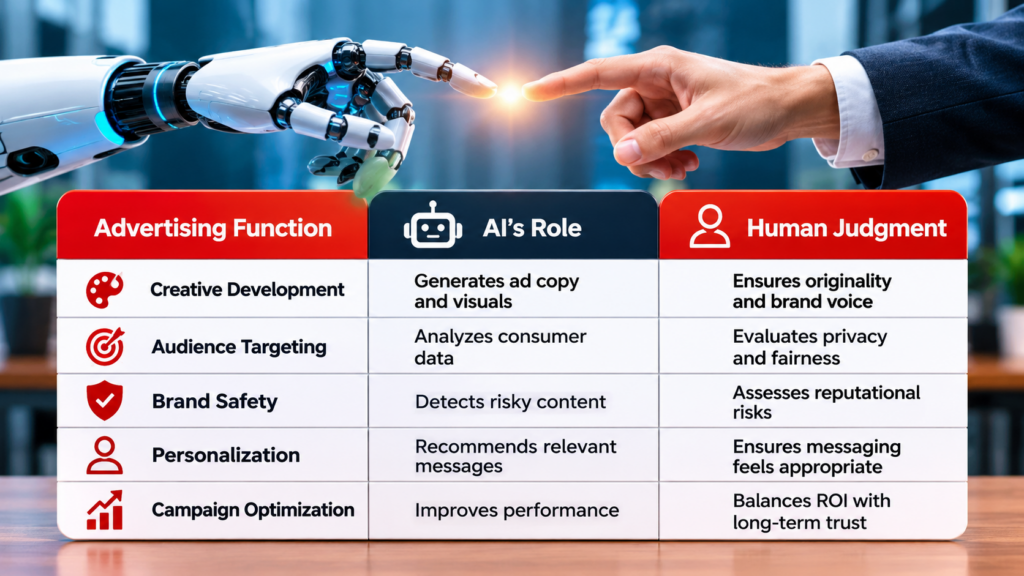
Advertisers need to strike a workable balance between automation and oversight. AI can create creative variations, identify audiences, optimize media spending, and analyze campaign effectiveness.
Human teams should check whether the creative aligns with the messaging. Assess privacy and brand safety risks and ensure campaigns align with business objectives. Oversight should be proportional to the potential impact of the decision. Brands should determine which processes are safe for automation.
Which outcomes require approval, and for what types of damaging outcomes should action be taken? Reviewers should be able to question and refuse AI recommendations rather than merely approve them.
How advertisers can protect brand trust in an AI-driven world
With the increasing prevalence of AI use among advertisers, marketers are prompted to shift their focus from impressions, clicks, and conversions. Although a campaign might be successful in the short run, it might harm customers in the long run.
Trust can be preserved by implementing appropriate AI governance and ensuring that automated content aligns with brand values. Being open about AI usage and analyzing customers’ responses. Additionally, brands should consider brand sentiment, complaints, placement quality, and the long-term effects of personalization.
The point is not to involve humans in making every decision. But to ensure that decisions in question are made responsibly. The use of AI, combined with human effort, can help achieve that.
Cut to the chase
While AI is speeding up the advertising process and tailoring advertisements, investing in automation alone will not ensure responsible advertising, ethical decision-making, or consumer confidence.
Learn how human judgment is establishing itself as an integral component of ad-tech and how human-AI synergies can lead to better and more secure ad campaigns.
FAQ’s
No. AI can automate creative production, audience analysis, and campaign optimization, but human judgment remains important for ethical decisions, cultural context, brand safety, and consumer trust.
Human oversight helps identify misleading content, inappropriate targeting, privacy concerns, and brand-safety risks that automated systems may overlook. It also ensures that AI-driven decisions align with business objectives and brand values.
Brands should establish clear AI governance, review sensitive creative outputs, use personalization responsibly, disclose AI involvement when appropriate, and measure consumer trust alongside campaign performance.