

The Risk of Looking Wrong: TBWA\NEBOKO’s CCO on Centraal Beheer’s Typo Play
Advertising today is obsessed with perfection. Perfect kerning, perfect timing. Perfect brand safety decks. And yet, most of it slides past people. TBWA\NEBOKO and Dutch insurer Centraal Beheer did the opposite—and that’s exactly why people stopped, stared, and argued about it.
At a packed PSV Eindhoven football stadium, a massive banner went up with a glaring typo. Not a clever wink. Not a fake “oops.” A very real, very public mistake.
And that was the point.
Centraal Beheer’s long-running tagline Even Apeldoorn bellen (“Just call Apeldoorn”) has always been about moments where things go wrong, awkward, recognizable, human screw-ups that spiral.
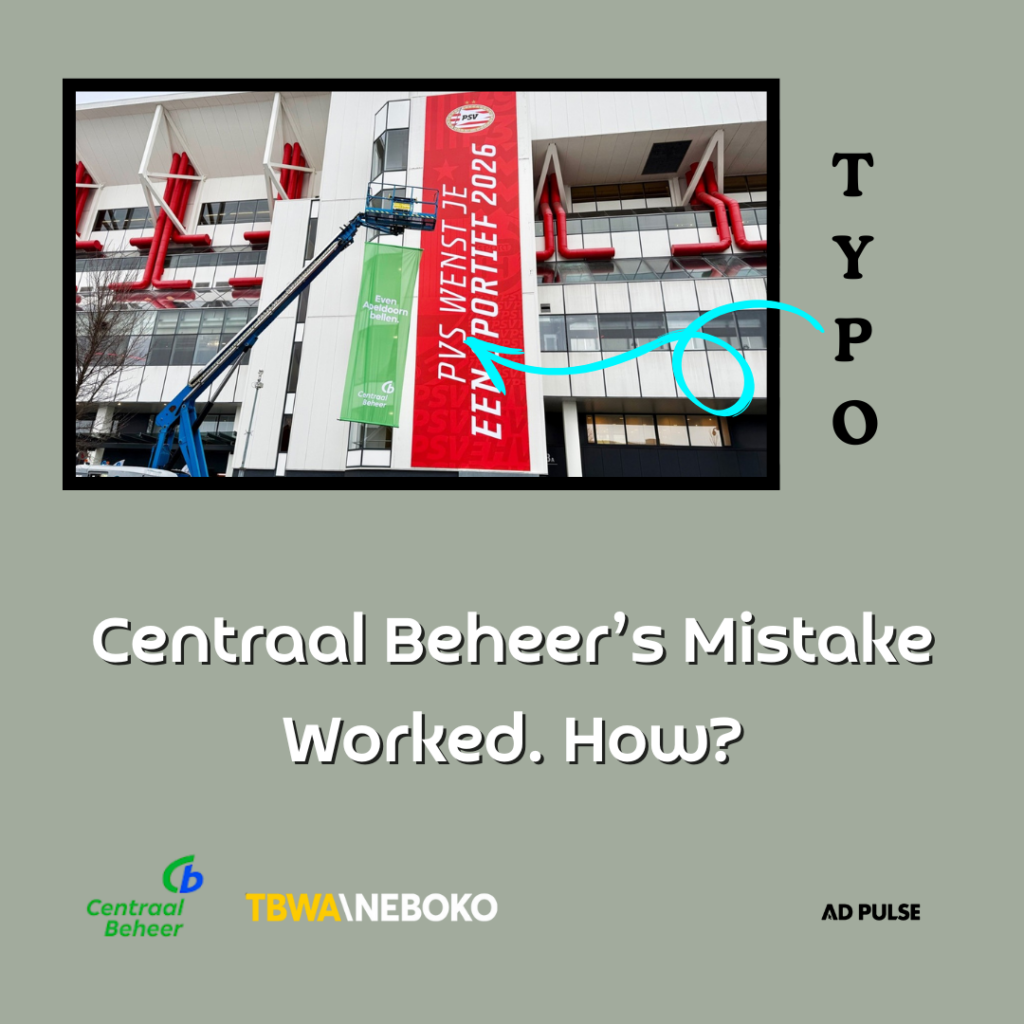
But how did the idea of going wrong on purpose originate?
Talking exclusively to Ad Pulse, Darre van Dijk, Chief Creative Officer at TBWA\NEBOKO, revealed that the idea collapsed if the error wasn’t real.
“From the start, the idea only made sense if the mistake actually happened. If people immediately sensed it was staged, the entire point would be lost.”
That’s a risky sentence in a world where brands panic over lowercase logos. But they leaned into it anyway.
Letting the internet sit with the awkwardness
For US audiences used to hyper-controlled brand moments, this is the part that really matters: they didn’t rush to explain.
When the banner went live, reactions began to roll in. Fans noticed. The Dutch media picked it up. The typo was treated exactly as a genuine blunder, which made football fans and sports fans uneasy.
Van Dijk admits there was a moment when it got tense.
“There was a moment where it felt genuinely tense — when the banner went live and reactions started coming in before we explained anything.”
That tension was the metric.

Instead of chasing immediate clarity (the default move in modern marketing), the team let people experience doubt first. Only once the typo had been fully processed as a real mistake, did they reveal the second banner that reframed the moment under the Even Apeldoorn bellen idea.
“Waiting longer would have shifted the focus from recognition to frustration.”
Wait too long, and it’s a prank.
Wait too long, and people get annoyed.
That restraint is the quiet flex here.
Why imperfection cuts through polished content
This campaign lands harder because it understands something many brands don’t want to admit: audiences are extremely good at spotting ads.
Perfect executions are everywhere. And because of that, they’re often processed emotionally at arm’s length.

Deliberate imperfection does the opposite.
“Deliberate imperfection, when used thoughtfully, pulls people closer because it feels human,” Van Dijk says.
But here’s the key warning he adds—this isn’t about sloppiness as a trend.
“Imperfection for its own sake quickly becomes a trick. In this case, the mistake wasn’t decoration — it was the message itself.”
That’s the difference between using a typo and earning one.
Don’t kill the joke by explaining it
The final trap most brands fall into is over-explaining. And yes, there was fear that spelling it out would flatten the humour.
“Humor lives in the space where people connect the dots themselves.”
Van Dijk to Ad Pulse
So the reveal stayed minimal. No campaign thesis. No brand monologue. Just a reframing that clicked instantly for those familiar with the platform.

Some people didn’t even need the reveal.
“Some people had already started making that connection themselves before the reveal. That was exactly what we were hoping for.”
The bigger takeaway for US marketers
This isn’t a case study about typos. It’s a reminder that experience beats execution.
Centraal Beheer didn’t create attention by shouting louder or polishing harder. It did it by trusting a decades-old brand of truth and letting the audience sit inside a mistake before resolving it.
In a landscape addicted to control, uncertainty is disruptive.
And sometimes, the smartest brand move isn’t correcting the error—it’s standing confidently behind it, knowing your audience already understands what you mean.