
The End of Big Brand Moments? How Always-On Branding Is Taking Over in 2026
In 2026, attention is constantly being shared across many different platforms. Consumers pay more attention to the way brand behaviors can be perceived than to how often they see a brand’s campaign. Brands that continually show up and have an identity will be more easily recognized as they are able to fit seamlessly into the conversation.
Hence, brands that have smarter, more effective strategies are shifting from a strategy that seeks maximum exposure to one that builds a consistent presence. Always on branding does not mean being pervasive.
It means being identifiable everywhere that makes sense to the consumer, and therefore never to be forgotten.
From high-rise to long-term visibility
The major change in branding in 2026 is the frequency of contact versus how a brand makes its presence known.
Today’s customers are rewarded for frequent interaction with brands rather than for familiarity. Customers want small, frequent interactions from brands that have consistent messages across all channels and will be there when they need them, as well as being continually provided with product-related information, sales, launches, and tie-ins, rather than just being interruptive.
Always on branding is an evolution of the old model.
- From campaign-led exposure to always-on visibility
- From short-term buzz to long-term brand value
- From sending spikes of business to building cumulative trust
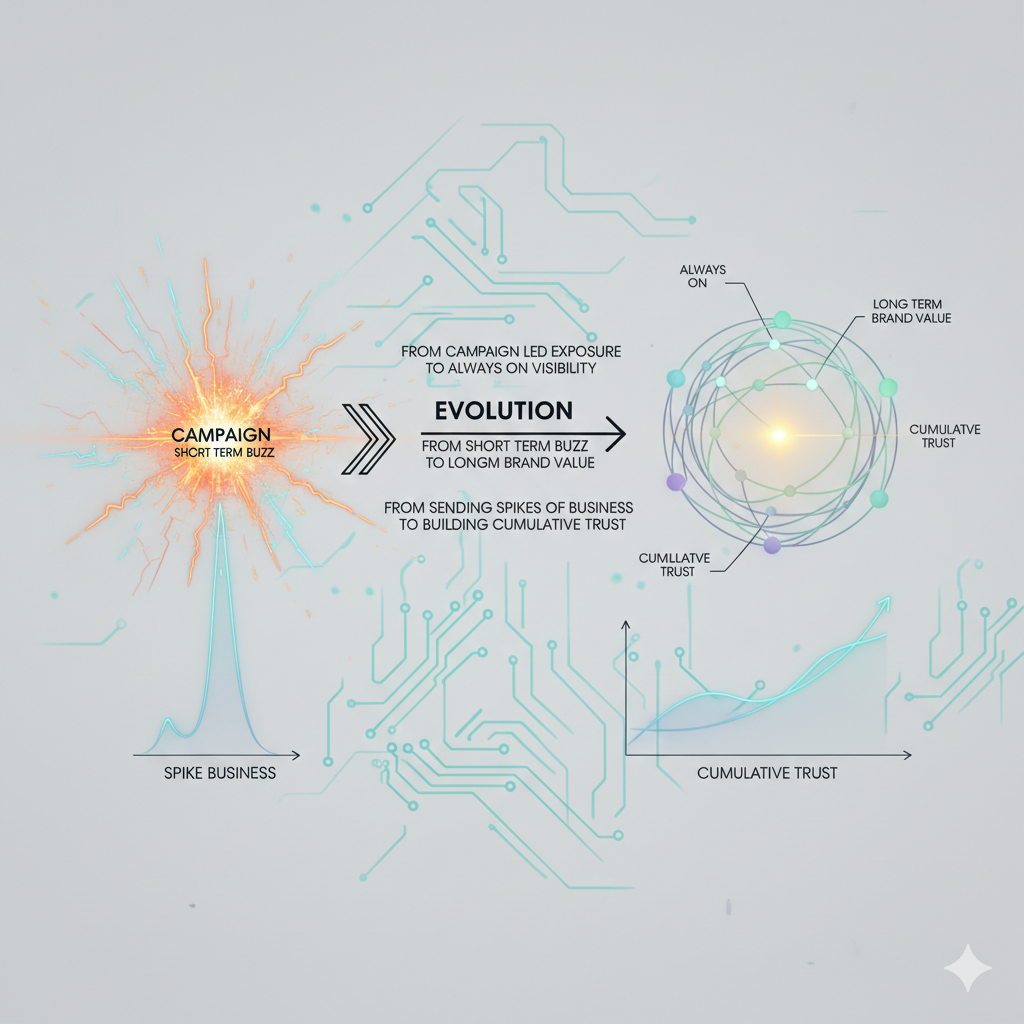
This change has not happened by accident; it is the result of increased fragmentation of people’s attention and the escalating costs associated with moment marketing.
What always-on branding actually means (and what it doesn’t)
The term “Always-On Branding” is frequently misinterpreted. It does not mean posting every day just to have presence, to “clutter up” a feed, or to ONLY create performance-based advertising.
Always-on branding is focused on three things:
- Consistency (as opposed to Intensity): The brand voice, values, and visual cues remain the same when viewed across platforms (LinkedIn, YouTube, podcasts, and email footers).
- Presence (without Pressure): Brands will appear even when they are not actively selling, by providing perspective, reacting to cultural events, and adding value through many small, yet frequent, actions.
- Recognition (before Conversion): The goal of the brand is NOT to get people to click immediately. Instead, when someone is ready to make a purchase, they will remember your brand BEFORE they select the one to purchase from.
Think of it as a brand’s muscle memory. When a decision is made, the consumer will already have a level of comfort with your brand. Being familiar with the brand is an important factor in getting consumers to choose your brand.
Growing brand presence doesn’t need constant reinvention
Building successful brand awareness should not require a complete overhaul for each campaign. The advantage of using an always-on branding model is that it reduces creative exhaustion for creatives who execute the same style and message repeatedly.
When producing large-scale campaigns, each position requires a complete conceptual redesign from the original. However, with an always-on branding model, brands can evolve those same core brand concepts over time without needing to start from scratch each time.
Brands that will have success beyond 2025 will be:
- Continuing to use the same core brand concepts in different ways
- Taking one piece of insight and producing multiple content outputs from it
- Creating familiarity for their audience through repetition, rather than scaring them with repetition.
Whereas repetition was once taboo, today it is a strategic decision. With so much clutter in the marketplace today, the clear message will always trump a new concept.
Consistent branding strategy in an algorithm-first world
Algorithms don’t reward sporadic brilliance. They reward predictable presence. Compared to brands that appear inconsistently, those that present consistently across channels have up to 3.5 times greater brand visibility.
Platforms are increasingly favoring businesses and creators who:
- Post often
- Keep your topical authority clear.
- Maintain audience interest over time
This fact is a great fit for an always-on branding strategy. Without requiring every piece of content to “go viral,” it gives marketers additional surface area for discovery.
Brand building vs performance marketing: the false choice
There has been a debate for several years over how to allocate resources between brand building (long-term) and performance marketing (short-term). Strong brands can lower cost-per-acquisition by up to 50% over time, according to studies, because familiarity reduces friction at the conversion point.
In 2026, that debate is losing relevance. Always on branding sits between the two.
- It supports performance by warming audiences before conversion
- It supports brand building by maintaining mental availability
- It lowers acquisition costs over time by reducing friction
Why “big moments” feel riskier than ever
Big brand moments haven’t disappeared—but they’ve become at a higher risk.
Why?
- Attention is dispersed between time zones and platforms.
- Cycles of cultural backlash are more severe and swift.
- Months of goodwill might be undone by a single misinterpretation.
- The expense of paid amplification is rising.
Brands should have a consistent “on-brand” presence so that they can develop an overall identity separate from individual campaigns.
Long-term brand strategy is back (quietly)
For a while, long-term brand strategy felt unfashionable. Growth hacks were faster. The metrics were immediate. Boards wanted numbers. However, the brands with consistent growth in 2026 are those that made early investments in:
- Clear positioning
- Distinctive brand assets
- Repeated storytelling
- Cultural relevance beyond trends
Fireworks don’t appear overnight with always-on branding. It provides compounding gains, which manifest as resilience in recessions, pricing power, and preference. It’s not thrilling. It works well.
Cut to the chase
Though they are no longer the strategy, big-brand moments remain relevant. They only function in 2026 when they are based on a constant presence that is drawing notice. Because a week of excitement isn’t a true victory. It has been at the forefront of people’s minds for years.
Always-on branding: FAQs
Always-on branding is a strategy in which brands maintain consistent visibility and messaging across channels rather than relying on one-time campaigns.
Campaigns are short-term. Always-on branding is continuous and focused on long-term recognition.
No. It strengthens them by building familiarity before and after the campaign.