T-Mobile Commercials Turn Humor into Brand Recognition
T-Mobile commercials make humor the central point for their ads while keeping the wireless services in between. The telecommunication brand puts celebrities, familiar pop culture references, comedy, and unexpected situations at the center of its storytelling.
The purpose of T-Mobile’s ad campaigns is to turn routine and monologue conversations about phone plans, network coverage, and connectivity into entertainment. Recognize and remember; that’s how T-Mobile rolls.
The company’s 2026 Big Game commercial featured the Backstreet Boys, alongside appearances from Druski, Machine Gun Kelly, and Pierson Fodé. The campaign reimagined the group’s hit song I Want It That Way to promote T-Mobile’s wireless experience. It continued a tradition of using entertainment and celebrity recognition to make telecommunications advertising more distinctive.
But what makes T-Mobile commercials so popular? In this article, we will seek the answer, as well as how the company uses celebrities without letting the entertainment overshadow the product.
Mantra of successful T-Mobile commercials
T-Mobile’s advertising strategy combines three elements: humor, celebrity recognition, and straightforward product messaging.
Each serves a different purpose in the process.
Humor attracts attention and makes advertisements more enjoyable to watch.
System1’s work has long emphasized the importance of emotional resonance in advertising. Vanessa Chin, in conversation with Ad Pulse, put humor as a grossly underused creative tool.
Why humor? Because it sparks joy, and happiness is the single biggest predictor of long-term brand growth.
Celebrities provide recognizable faces to audiences to establish connections.
This approach is particularly useful in telecommunications, where competing brands frequently advertise similar benefits. Price, coverage, speed, and additional services can be difficult to distinguish through conventional product demonstrations alone.
T-Mobile uses entertainment to give those messages a recognizable identity. Rather than presenting every advertisement as a technical explanation, the company creates situations that make its products part of a larger story.
However, celebrity appearances and humorous scripts do not automatically translate into sales or engagement growth. Their effectiveness depends on whether audiences remember the brand, understand the offer, and consider the product.
T-Mobile’s recurring campaigns demonstrate a consistent creative strategy, although individual campaign performance requires separate measurement.
Let’s check out 5 major T-Mobile commercials
1. Pinch of nostalgia factor
T-Mobile’s 2026 Super Bowl ad, titled Tell Me Why: T-Mobile’s Version, uses nostalgia and music to introduce its wireless proposition.
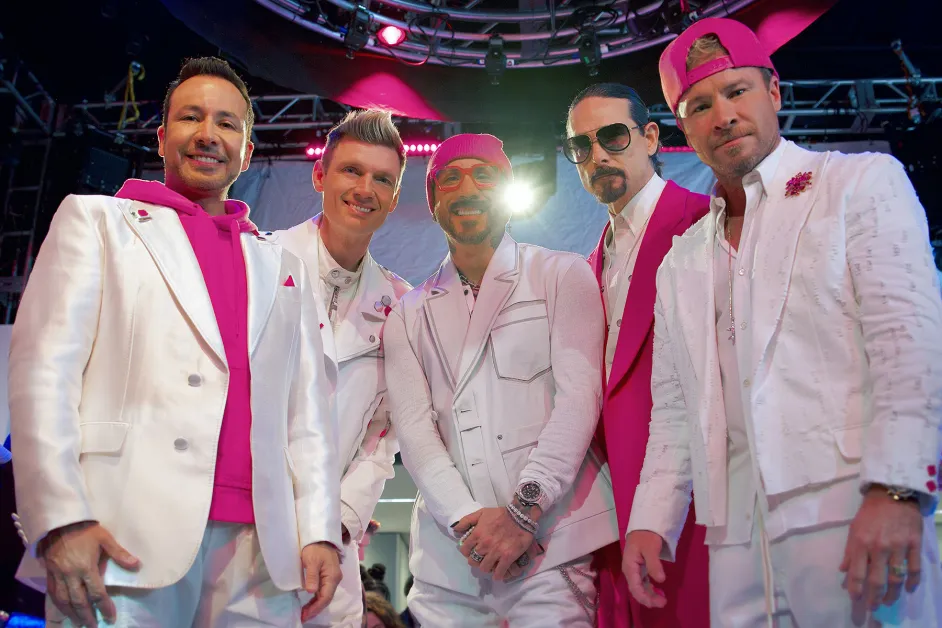
Announced on February 6, 2026, the commercial features the Backstreet Boys performing a reimagined version of their famous song I Want It That Way.
The creative concept begins with a question about why T-Mobile is the better choice. The Backstreet Boys then turn the setting into a performance, using the recognizable song to reinforce the brand’s message about its network, value, and benefits.
The campaign works on multiple levels. Fans recognize the group and its music, while the performance provides a memorable structure for the commercial. The song’s familiarity also makes the advertising message easier to connect with the entertainment.
2. Mix with comedy
T-Mobile’s recent iPhone advertising featuring Jeff Bridges and Zoë Saldaña illustrates another approach to celebrity-led storytelling.
The 2025 campaign for the iPhone 17 Pro places the actors in a playful scenario built around the idea of making a T-Mobile commercial.
Bridges brings a recognizable presence, while Saldaña provides the central connection to the product narrative. The contrast between the performers helps create an entertaining setup for communicating the offer.
This is an important distinction in celebrity advertising. A recognizable actor can attract viewers, but the commercial still needs a creative idea that gives it purpose.
T-Mobile’s approach allows celebrities to participate in the story rather than simply delivering a scripted endorsement. The resulting format can support multiple advertisements, with different scenes and product messages built around familiar characters.
3. Easier to understand business
Not every T-Mobile advertising campaign targets individual consumers. The company’s business advertising also uses storytelling to communicate more specialized services.
In August 2025, T-Mobile for Business launched a national campaign starring Kevin Bacon to promote SuperMobile, a business phone plan combining intelligent performance, built-in security, and satellite connectivity.
The creative approach turns abstract business connectivity benefits into situations viewers can understand. Instead of relying entirely on technical descriptions, the campaign shows how connectivity matters across different environments.
Bacon’s recognizable screen presence gives the campaign a consistent personality, while the changing locations support the product’s practical message.
4. Packaged star power
T-Mobile’s 2022 Big Game advertising featuring Dolly Parton and Miley Cyrus demonstrates how celebrity advertising can combine entertainment with a broader message.
The campaign, associated with the company’s 5G network, used the two performers to promote compatible phones and encourage audiences to consider the benefits of 5G connectivity.
Parton and Cyrus brought different audiences and recognizable public personalities to the same campaign. Their relationship as godmother and goddaughter also gave the pairing a natural connection beyond their celebrity status.
The advertisement used humor and the performers’ contrasting personalities to make the product message more engaging. At the same time, the campaign connected the phone upgrade to the network experience T-Mobile wanted to promote.
5. Recurring recognizable identity
T-Mobile’s advertising history includes multiple celebrity partnerships, from its Super Bowl campaigns to its recurring product and service advertisements.
The company has used personalities such as Zach Braff and Donald Faison in earlier campaigns, while other advertisements have featured performers including Justin Bieber, Martha Stewart, and Snoop Dogg.
Recurring celebrity appearances can also help a brand maintain continuity across different product launches.
According to Chin, creative consistency will remain critical for earning consumer trust in 2026, especially when it’s used positively through fluent brand devices. These include recurring characters, familiar slogans, or recognizable brand worlds that allow audiences to identify the advertiser faster and earlier.
However, celebrity continuity only works when the creative idea remains relevant. Repeating a famous face without a strong narrative risk makes the advertisement more memorable for the performer than the advertiser.
Why are T-Mobile commercials so popular?
Several elements help explain the brand’s advertising approach.
First, commercials offer entertainment value. Humorous situations, musical performances, and celebrity interactions give viewers a reason to watch beyond the product information.
Second, familiar faces reduce the effort required to attract attention. Recognizing an actor, musician, or comedian can establish immediate interest, although that attention still needs to translate into brand recall.
Third, storytelling makes technical benefits easier to communicate. Network coverage, wireless plans, and business connectivity can be difficult subjects to address in conventional advertising. A well-constructed scenario gives those benefits a more accessible context.
Finally, the creative style supports differentiation. Telecommunications brands compete in a crowded category, and a consistent advertising identity can help consumers distinguish one provider from another.
These elements explain the logic behind T-Mobile’s strategy. They do not, on their own, establish that every commercial generates higher engagement, better conversion rates, or stronger sales. Those outcomes require campaign-level evidence.
Cut to the chase
T-Mobile commercials show how celebrity recognition and humor can make a functional product category more entertaining. For marketers, the lesson is straightforward: celebrities can attract attention, but the creative idea must do the harder work.