
Product-Led Growth: Letting the Product Sell Before the Sales Team Does
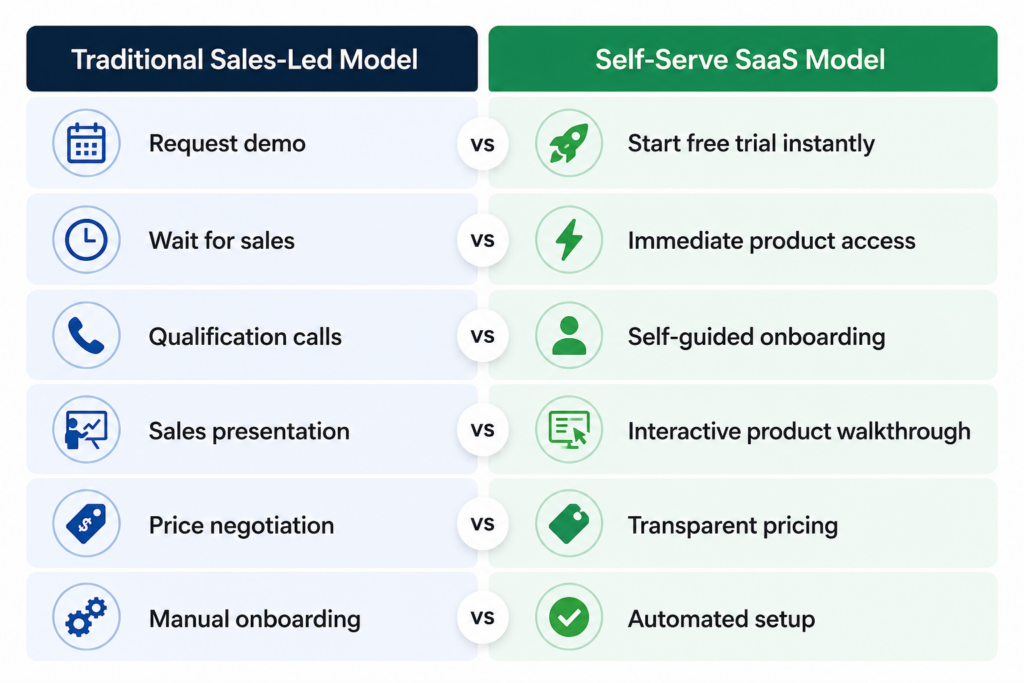
Look for the software tool that looks appealing. Visit a page to learn more about pricing, try the product, and see if it suits your business. Instead, you will see this common message: “Schedule a demo.” You have to fill out a lengthy form, wait for an email, make phone calls, listen to presentations, and answer qualifying questions before you can find out whether the software is useful.
Today’s buyers have stopped tolerating such friction in their customer journey. The journey has changed dramatically, as modern buyers are better informed, more likely to conduct extensive independent research, and more likely to compare products on review sites and expect a seamless experience. They prefer product exploration before communicating with sales representatives, while buyers expect the same experience they get when communicating with sellers.
This shift is forcing B2B brands to rethink their marketing, customer acquisition, and go-to-market strategies. Let’s take a closer look at what’s driving this shift.
The modern B2B Buyer journey starts long before sales
The classic sales model was based on the idea that buyers required sales representatives to educate them about the product. Now, we know this to be untrue.
The current B2B purchasing approach is essentially self-initiated and self-directed. According to Gartner’s 2026 Sales Survey, 67% of people prefer to make purchases without an agent, while 70% are interested in purchasing through an online platform.
By the time they reach out to the sales department, they have already:
- Read some product reviews
- Compared different options available in the market
- Watched online videos about the product or service
- Asked colleagues for advice
- Tested alternatives
- Estimated prices
The sales process has transformed from being the first step to the final one of confirmation. As a result, companies need to radically alter their view of the B2B buyer journey. Before, they used to ask: “How do we get buyers to meet with us? Now they are asking: “How can we help buyers succeed even before they contact us?”
Why B2B buyers prefer self-service
There are several market changes that drive such behavior.
Buyers prefer Independence: Modern customers appreciate making their own research into the software instead of entering into a sales conversation. A self-service B2B platform gives them the opportunity to learn about pricing, characteristics, and documentation whenever they feel like it.
Availability has become a selling point: Now, customers expect to use the software immediately after the demonstration, trial, or self-service onboarding. In case the customers see the value quickly, they are less likely to turn to another company.
Buyers trust products more than sales presentations: Instead of watching the presentation conducted by a salesperson, the customers would like to see the product in action. The interactive trial or easy onboarding process has a better effect because it shows actual experience with the product.
There is a trend toward the joint decision-making process: When it comes to B2B purchases, multiple people are involved in the decision. The self-service option allows teams to evaluate the program without scheduling multiple meetings with sales representatives.
The rise of the self-serve SaaS model
The self-serve SaaS model removes unnecessary barriers between product discovery and purchase. Take Canva as an example. Users can create an account, design projects, invite team members, and upgrade to a paid plan—all without interacting with a salesperson. The product itself guides users from discovery to purchase.
The process typically goes like this:
Product-led growth is reshaping SaaS
One of the main reasons behind this transformation is product-led growth (PLG). Unlike traditional sales-led companies, the PLG approach works by putting the product at the core of gaining customers, expanding the clientele base, and keeping them.
PLG relies less on selling and more on the product doing the selling. Companies like Slack, Canva, and Atlassian offer users the chance to sign up for free, get familiar with the features, collaborate with friends, and upgrade when they want to.
Some of the principles of PLG are:
- Free trials
- Freemium plans
- Product-led onboarding
- In-app guidance
- Usage-based upgrades
- Viral team collaboration
- Simple purchasing
How PLG reduces sales dependency
Numerous companies inquire regarding the effect of PLG on sales reliance. PLG doesn’t eliminate sales, it changes its role. Sales teams spend less time explaining basic features and more time helping qualified buyers solve complex business problems.
As a consequence, the following benefits are achieved:
- Lead quality is improved
- Sales cycles become shorter
- Conversations are better qualified
- Costs of acquisition are decreased
- Customer satisfaction is increased.
Self-service software is becoming a competitive differentiator
The self-service software currently available in the marketplace has evolved beyond just providing a sign-up page. Businesses spend large sums of money to make purchasing processes digital, including:
- Interactive tours
- Automated onboarding through artificial intelligence
- Help centers
- User forums
- User manuals
- Customer education facility
- In-app help
- Information about software usage
The simpler it is to evaluate the software, the simpler it is to buy it. Customer experience should begin prior to any conversations.
Self-service vs sales-led growth: It’s not either-or
The debate over self-service versus sales-led growth tends to be presented as a rivalry. However, most triumphant SaaS firms leverage both techniques.
Product-led is the right approach when:
- The product is straightforward
- The pricing is affordable
- The team can start using it without help
- The implementation is easy
Sales-led is vital when:
- Enterprise deals require many decision-makers
- Products need customization
- Security and compliance checks are lengthy
- Huge contracts need to be negotiated
More and more companies employ the sales-assisted product-led approach. Customers get started on their own and later bring sales in only when they need expertise.
Atlassian follows this model by enabling smaller teams to purchase products like Jira through self-service while offering enterprise sales support for larger, more complex deployments.
What this means for B2B SaaS marketing strategies
The concept of self-service has altered the methods of marketing in the B2B SaaS industry. Marketers are now tasked with enabling potential customers to see the product’s value before contacting the sales department. The change in assignments has shifted content marketing priorities.
Content marketing professionals no longer focus on creating downloadable documents and instead devote their time to the following tasks:
- creating product comparison sites;
- developing virtual demos;
- preparing video tutorials;
- creating success stories;
- designing ROI calculators;
- developing feature definitions;
- developing templates;
- post case libraries.
Marketing can now provide support for discovery, not just lead generation. Companies that focus on supplying software to startups and small businesses can benefit greatly from this approach, as these customers often make quick purchasing decisions without a procurement process.
Building a modern B2B SaaS go-to-market strategy
An efficient B2B SaaS go-to-market strategy is increasingly built around combining all aspects of the customer’s journey, including marketing, product, customer success, and sales.
Primary components include:
Open pricing: Prices that aren’t disclosed cause unnecessary suffering. Direct pricing allows buyers to qualify themselves more quickly.
No-hassle onboarding: The first five minutes are when users are most likely to change their minds. Onboarding that involves interactivity facilitates activation.
Product education: Knowledge centers, webinars, tutorials, and FAQs build customer confidence and improve adoption.
Data-driven personalization: Businesses can analyze relevant behavior and offer necessary recommendations, updates, and assistance based on how the product is being utilized.
Human assistance when needed: Self-service technology doesn’t exclude personal interaction; it only makes it optional.
A stronger SaaS customer acquisition strategy
The most effective SaaS customer-acquisition plan no longer begins with scheduling meetings. Rather, it is about eliminating any potential barriers. Companies should inquire:
- Are customers able to understand the product without the sales team’s help?
- Is it possible for potential clients to experience the value of the service?
- Are the prices clearly listed?
- Is the onboarding process simple?
- Are customers able to buy the product online?
Every affirmative answer means that you bypass another obstacle in your path to making a sale. The harder it is to understand the service, the harder it is to acquire customers.
Cut to the chase
Buyers in B2B are demanding that software be easy to find, test, and buy without unnecessary complications that take time. Companies that ease this process will earn customer trust more easily and receive more responses. Sales will always mean something, but its effectiveness depends on the stage of the process.
FAQ’s
A B2B self-service model allows buyers to research, evaluate, try, and purchase software independently without relying on sales representatives.
Product-led growth is a business strategy where the product itself drives customer acquisition, activation, and expansion through free trials, freemium plans, and self-service onboarding.
B2B buyers prefer self-service because it offers greater control, faster evaluation, transparent pricing, and the flexibility to explore products before engaging with sales.