Inside LinkedIn’s Advertising Platform: What’s Changing?
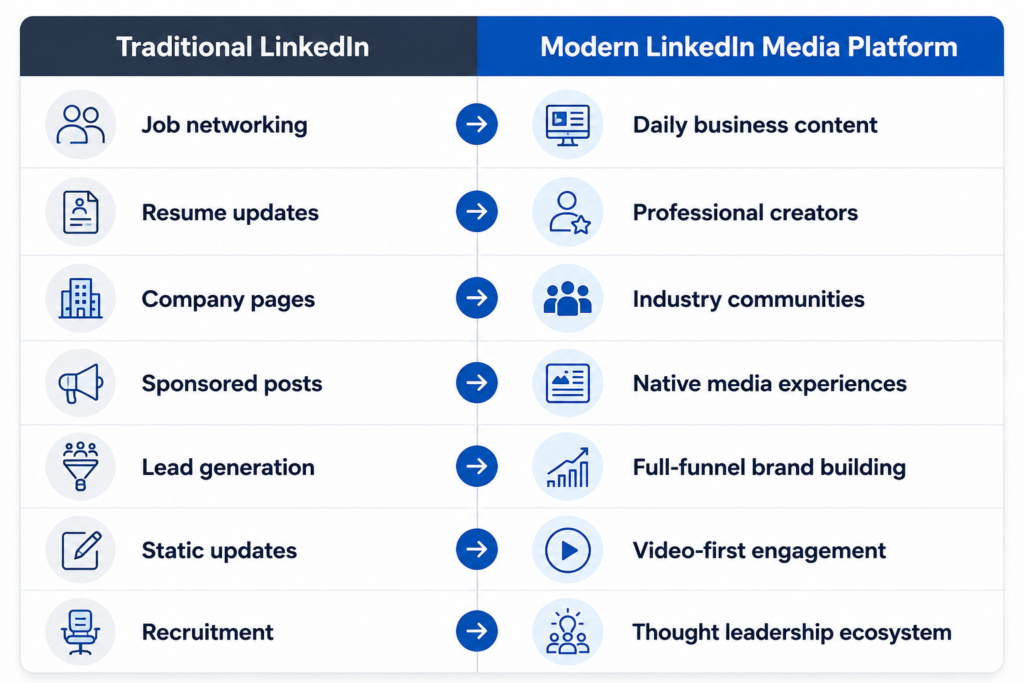
LinkedIn used to be where you went to update a resume, humble-brag about a promotion, or quietly browse job listings on a Sunday night. That LinkedIn is gone. What’s left is one of the most influential arenas for business conversation, industry insights, and professional content online, a platform that has outgrown its own job description.
Call it what it is: LinkedIn isn’t a networking utility anymore. It’s a media company that still verifies your employment history. And like every media company, it runs on a simple bargain: being seen isn’t enough. The old rules of feed placement and ad impressions are giving way to a blunter standard: does your content actually give the audience something worth their time?
We’re breaking down what’s driving this shift, how AI and video are reshaping LinkedIn’s advertising playbook, and what companies need to do now to stay ahead of a platform that no longer plays by its old rules.
LinkedIn has quietly changed its identity
For the last few years, LinkedIn has been changing nearly all aspects of its platform.
The feed has changed, and it is now much more interactive and interesting. Videos now autoplay in Stories. The newsletter section has more than some hundreds of thousands of subscribers. Live events, content creators’ tools, AI features, and media in the LinkedIn feed have dramatically enhanced the user experience.
Now, people on LinkedIn worry not about whom they could work for but ask:
- Which industry leaders should I follow?
- What AI trends are shaping my industry?
- Which companies are worth watching?
People’s behavior is definitely more like that of a media consumer than of a social media platform user. This means that LinkedIn is not just competing with other social media or job-hunting platforms; it has entered the media sphere, competing with YouTube, Twitter, newsletters, and all manner of magazines.
Why are professionals spending more time on LinkedIn?
Professionals no longer visit LinkedIn only to network or find jobs. They open it daily to stay informed, learn from experts, and keep up with industry trends.
As referenced in the Global B2B Marketing Outlook 2026, LinkedIn explains the connection between trusted experts and B2B purchasing decisions. There has been a change in B2B marketing: B2B buyers increasingly prefer to seek guidance from credible experts and high-quality content rather than relying on standard advertisements.
The emergence of professional creators
Users prefer people over brands since they trust them more. The platform enables executives, entrepreneurs, consultants, and experts to join the conversation.
Instead of relying on traditional media, users regularly share their research, insights, and experiences to reach their audience directly. 83% of B2B marketers say credibility matters more than traditional brand messaging, while 70% report that buyers rely more on peer voices and industry experts than brand-produced content.
The rise of video as the hottest format
Video is changing how business content gets consumed and expanding viewing options for professionals. Today, short videos are making it easier to learn, track the latest trends, and compare brands. In this situation, companies are more inclined to go beyond standard posts and take part in executive thought leadership, customer testimonials, product showcases, and educational videos.
Why LinkedIn is investing so heavily in content
The response is straightforward, even if the platform would rather you not think about it too hard:
Attention is the product, and everything else is downstream.
More time spent on the platform means more opportunities to slot in ads, paid placements, and those “native” experiences that try very hard not to look like ads (they are ads). This is not a LinkedIn-specific insight; it’s the operating logic of every attention platform since the feed replaced the homepage. But LinkedIn spent its first decade acting like a filing cabinet for resumes, so watching it retrofit itself into an engagement machine has been a genuinely interesting piece of platform theater.
This is why Microsoft keeps pouring resources into the creator ecosystem, tuning the recommendation algorithm, pushing video, and bolting on AI features and ad products at a pace that would’ve seemed frantic for a “professional networking” site five years ago. LinkedIn stopped being a place you visit to find a job.
It’s now a place you’re supposed to linger, and lingering, not job-hunting, is what pays Microsoft’s bills.
The tell is in what LinkedIn optimizes for. A platform built for job-seeking would want you in and out fast: find the role, submit the application, log off. A platform built for ad revenue wants you scrolling past the tenth “I got laid off and here’s what I learned about resilience” post before you even notice you’ve been on the app for twenty minutes.
Those are two very different products wearing the same UI.
The business model behind LinkedIn’s growth
While subscriptions and recruiting remain important revenue streams, advertising has become one of LinkedIn’s fastest-growing businesses. To support that growth, LinkedIn now offers:
Currently, the platform provides:
- Sponsored Content
- Video Ads
- Conversation Ads
- Thought Leader Ads
- Dynamic Ads
- Event Promotions
- Advertising within newsletters
- AI-driven audience expansion
Every new content format creates additional advertising opportunities. As engagement grows, so does the value of LinkedIn’s advertising ecosystem.
What makes LinkedIn the best choice when it comes to B2B marketing
LinkedIn combines professional data, AI, and high-value content to help brands reach, engage, and influence business buyers more effectively than traditional social platforms.
- Effective Advertising That Reaches Influencers: Unlike other social media platforms, LinkedIn provides advertisers with immense targeting opportunities based on a person’s profession and not just browsing behavior, thus helping brands reach their target B2B audience.
- AI Helps Make Marketing More Effective: Thanks to AI, brands can target more effectively, optimize campaigns more efficiently, and find buyers most likely to engage.
- Content Serves as the Advertisement: It has been proven that the most successful advertisements sell by educating. Quality content generates much more trust than promotional messages.
- Supports Every Stage of the Buying Cycle: Through LinkedIn, brands can connect with customers throughout the buying process, from initial discovery to the final purchase.
What brands should do now?
Creating a winning strategy on LinkedIn does not necessarily entail purchasing advertising space at the outset.
- A successful strategy begins with generating awareness.
- Companies must act as publishers rather than advertisers.
- Instead of relying solely on paid advertising, companies should create original research and analysis related to their industry.
- Firms should also take the initiative to establish a solid video content strategy.
- Advertisements should supplement educational content rather than supersede it.
- Another consideration for the firm is to employ AI-based strategies to optimize campaigns.
In measuring effectiveness, firms need to analyze both immediate outcomes and the campaigns’ long-term effects on the audience.
The future of LinkedIn marketing
The events in LinkedIn marketing are expected to unfold more dynamically than in the past. The next few years will see the development of several key trends, namely:
- AI-Made Content: Social media feeds will become increasingly tailored to users’ professional interests.
- Influencer Marketing: Companies will rely more on partnerships with executives and influencers rather than just on their corporate webpages.
- Video-Centric Content: The use of interviews, podcasts, live discussions, product demos, and vertical video content will be on the rise.
- Improved Measurement: The focus will shift from total impressions to engagement, decision-making, and profits.
- Interactive Content for Businesses: Polls, live Q&As, AI-facilitated discussions, and interactive learning will be widely employed.
Cut to the chase
LinkedIn has evolved from a professional networking site into a media hub where innovative ideas, engaging videos, and AI-driven content influence how B2B consumers discover and evaluate brands. With this change, marketers have to focus less on advertising campaigns and more on producing relevant content that earns their audience’s trust.
FAQ’s
LinkedIn now focuses on creator content, video, newsletters, and AI-powered recommendations, making it a destination for professional news and industry insights.
It enables brands to target professionals based on job title, industry, seniority, company size, and skills, resulting in more precise B2B campaigns.
The future of LinkedIn marketing will be driven by AI, video-first content, creator partnerships, and thought leadership that builds trust with business buyers.