Gaming Advertising in 2026: How Brand Partnerships, Esports Sponsorships and ROI Are Changing the Game
Gaming has transformed from being merely entertainment into one of the best opportunities for brands to connect with audiences. Nevertheless, gaining gamers’ attention and winning their trust are two very different things. Brands may invest in several million dollars on sponsorships in esports, put ads inside popular video games, and establish cooperation with gaming influencers, but might still be unable to uncover the answer to the only important question: is gaming advertising really paying off?
This is becoming an increasingly important concern as advertising budgets move towards gaming environments.
According to WPP Media’s Global Midyear Forecast, gaming advertising is projected to grow by 33.1% in 2026, reaching $13.3 billion. Yet, the opportunity comes with a challenge: brands must understand which gaming platforms, partnerships, and advertising formats can turn audience engagement into measurable business results.
From mobile gaming advertisements and ads in video games to esports sponsorship and influencers’ marketing in the gaming industry, brands have so many choices to promote their products in the gaming ecosystem. The major challenge is to select the most suitable method and gauge its effectiveness.
Grab your favorite coffee mug and let’s discuss how marketing in the gaming industry works, the way advertising agencies use various partnerships in gaming, and how it would be possible to measure gaming marketing ROI in 2026.
What is gaming advertising?
Gaming advertising refers to the promotion of goods and services through video games, mobile gaming apps, esports competitions, gaming platforms, and creator communities. Instead of depending solely on traditional marketing channels, brands use gaming environments to connect with their target audiences while they play games, watch tournaments, and interact with gaming influencers.
Unlike conventional digital advertisements, gaming marketing focuses on interactive experiences. Gamers can engage with branded merchandise, participate in sponsored competitions, watch rewarded advertisements, and explore brands through virtual experiences.
The opportunity is considerable. According to EMARKETER’s analysis, nearly 60% of the US population plays digital games, while gaming accounts for less than 5% of worldwide media investment. This gap highlights the potential for advertisers to reach audiences in an environment that still receives a relatively small share of media budgets.
How does in-game advertising work?
In-game advertising involves embedding promotional messages directly into video games or their surrounding environments. The format varies depending on the type of game, the platform, the target audience, and the campaign objectives.
Common types of in-game advertising are:
- Intrinsic in-game advertising: natural presence of brands through virtual advertisements, billboards, or the placement of products in the game.
- Rewarded video advertising: players willingly watch ads to receive in-game bonuses such as extra lives or points in the game.
- Interstitial advertising: Various types of ads appear on the whole screen when no action is taking place in mobile versions of a game (often between the levels).
- Branded virtual experiences: brands create their own worlds, challenges, and impressions in game-playing platforms.
- Sponsored virtual products: companies introduce virtual clothes, appliances, or cars for players in the game.
For example, a sportswear company could sponsor virtual football uniforms, while a food brand could launch a branded challenge in a popular mobile gaming app. Through these integrations, brands can become part of the gaming experience rather than interrupting it.
Gaming brand partnerships and esports sponsorships: Why are brands investing?
Gaming partnerships go beyond displaying brand messages in video games. They create opportunities for companies to engage in gaming communities through competitions, professional players, gaming teams, and interactive events.
Esports sponsorships
Esports sponsorships involve collaborations with professional gamers, tournament organizers, teams, and gaming events. Brands can sponsor team jerseys, tournament events, livestreams, and exclusive experiences for players and fans.
For example, adidas partnered with the Esports Foundation to become the official kit partner of the Esports Nations Cup, designing custom jerseys for teams representing more than 100 countries and territories. Similarly, Campa Energy partnered with Indian esports organization S8UL as its title sponsor for the Esports World Cup 2026 campaign, securing visibility across team jerseys, digital content, and fan engagement activities.
Such collaborations showcase the ability of brands to use esports sponsorships to enhance brand awareness among gamers and create relationships.
Gaming influencer marketing
Streamers and gaming influencers have established communities based on gameplay, entertainment, tutorials, and product reviews. Collaborating with such creators enables brands to target consumers in a way that is more engaging than traditional ads.
For instance, Smyths Toys’ Nintendo Switch 2 creator campaign. Developed with Feenix Group, the campaign involved five gaming creators across multiple promotional phases, combining short-form videos and livestreams on platforms such as Twitch and TikTok. It generated over 350,000 video views and achieved a 5.4% engagement rate.
This initiative illustrates how brands may utilize gaming influencers to keep their audience entertained with a variety of creative projects carried out by multiple individuals instead of waiting for a single promotional post.
Brand partnerships in gaming environments
Brands can establish direct ties with gaming developers and platforms for launching branded clothing, virtual items, limited collectible items, or sponsored gaming challenges.
For example, Red Bull partnered with EA SPORTS FC through branded in-game objectives, team kits, and athlete ambassador collaborations. According to EA, the activation generated more than 128 million matches played and 1.2 million completed objectives. Mountain Dew also introduced DEW University, a playable branded team experience in EA SPORTS College Football 26, featuring a custom stadium, mascot, and rewards.
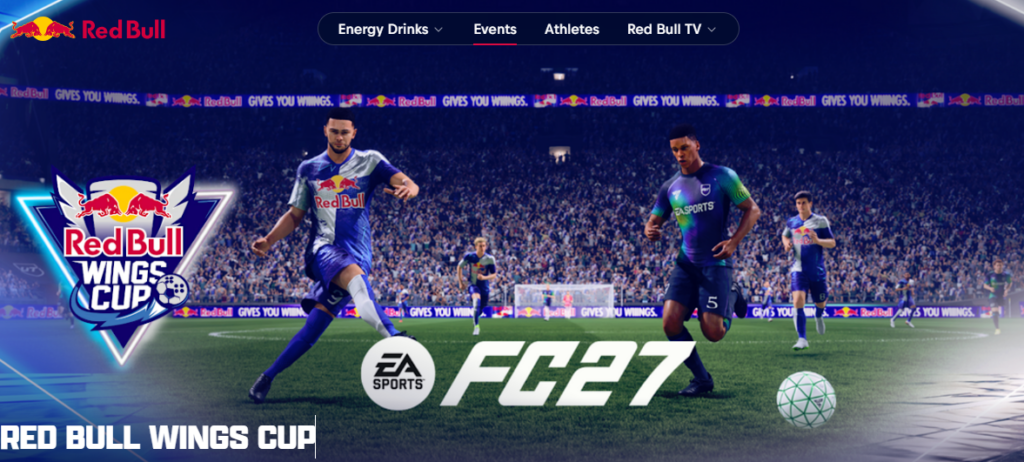
These partnerships show how brands can become part of the gaming experience, encouraging players to interact with branded content rather than simply viewing advertisements.
Gaming advertising campaigns: What can brands learn from 2026?
According to Ipsos GameTrack research consisting of 37,000 gamers across 16 different European countries, it has been found that in-game advertising campaigns generate an average of a 31% increase in brand affiliation and a 96% rise in the advertisement awareness rate of the players who have seen such advertising campaigns.
Some specific examples of the advertising campaigns include the following:
- Beats achieved 97% brand affinity increase through supporting the EA Sports FC tournaments.
- Pepsi and Visa achieved a respective boost of 26% and 18% in brand affinity through virtual stadium advertising.
- Nike used its Air Zoom product line in the gaming environment.
These campaigns have proven that the usage of gaming advertising can bring significant increases in brand awareness and affiliation. However, brands still need to assess such campaigns in terms of their conversion and revenues to determine their real financial ROI.
What is the ROI of gaming advertising?
The return on investment (ROI) for gaming marketing shows the financial and promotional value accrued by companies making investments in gaming promotion through partnerships, sponsorships and advertising.
However, calculating gaming advertising ROI can be complex because the consumer journey is not always easy to track. For instance, a customer might see a branded billboard while playing a football game, remember the advertisement, and purchase the product weeks later from a retail store. Standard click-based attribution methods may fail to capture this entire journey.
It is, therefore, important for brands to analyze both immediate performance as well as long-term marketing impact.
Some important metrics include:
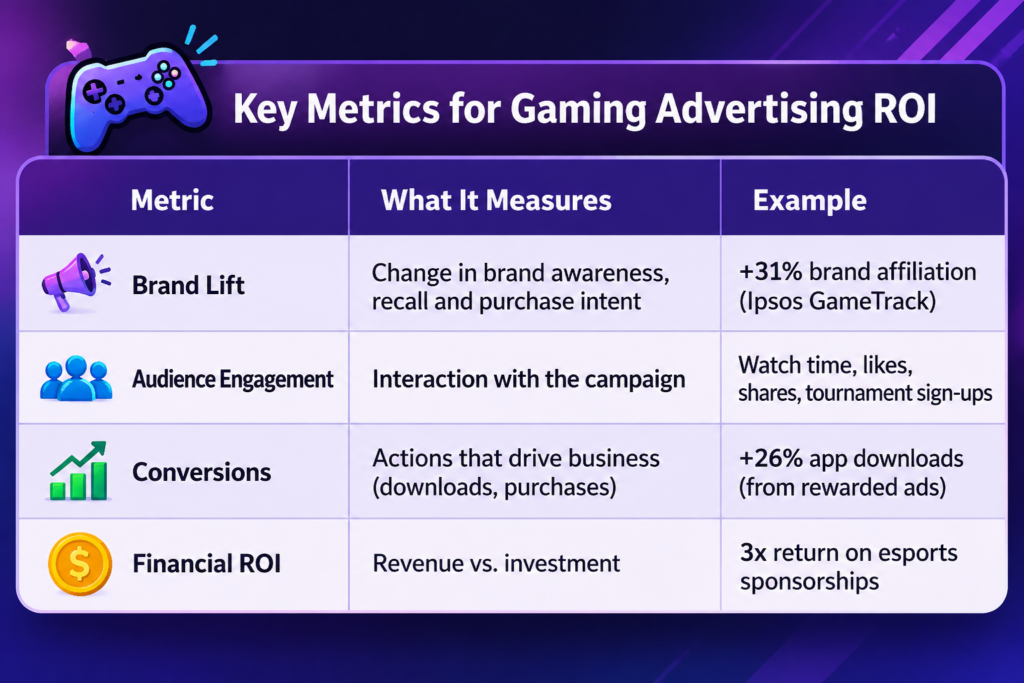
To illustrate, despite having a lesser impact on actual sales, an esports sponsorship could yield a lot of brand awareness, while rewarded mobile gaming ads might help businesses get more app downloads in a shorter period of time.
Both options are valuable, but they need to be compared against different performance metrics.
How can brands measure esports sponsorship ROI and brand lift?
Brands need to dig deeper than mere tournament figures to determine if esports sponsorship is effective in a business sense. The process can be broken down into four main metrics. These include:
- Brand lift: Measure the change in brand awareness, recall, and the intention to purchase based on pre- and post-campaign surveys.
- Audience engagement: Look at metrics such as watch time of the livestreams, participating in the tournament, hashtag activity, and the number of interactions on social media.
- Conversions: Track purchases and registrations by creating special promo codes and affiliate links.
- Financial ROI: Calculate the revenue collected after the sponsorship investment.
What are the best gaming advertising strategies for brands in 2026?
Achieving success in gaming advertising requires brands to integrate creativity, audience insights, and measurable results. Here are five tactics to utilize.
1. Select appropriate gaming platforms: It is critical to choose platforms that coincide with the target audience, whether it be mobile games, games on computers or consoles, or even esports communities.
2. Focus on natural brand placement: Brands can use virtual billboards and sponsored challenges, as long as it doesn’t disturb the gaming process.
3. Collaborate with gaming influencers: Building partnerships with streamers and professional players can help in increasing trust and consumer engagement.
4. Apply AI and Data Analytics: Study the behavior of players, identify your target audience and test your creative approach. According to Sensor Tower’s State of Game Advertising 2026, starting from 2021, the leading mobile game advertisers in the US have been expanding their creative production considerably.
5. Monitor performance: Brands should consistently measure the performance of their campaigns in terms of brand recognition, conversion rates, and financial revenue.
The future of Gaming Advertising: Beyond visibility to real business impact
The gaming world is helping brands reach their target audiences in ways that traditional advertising cannot. Brands have many opportunities to enter the gaming realm—from mobile game ads and esports sponsorships to working with influencers and partnering with virtual brands.
However, spending more money does not always lead to tangible results. Brands must understand their target audiences and pick the right games. Effective partnerships and measuring results go a long way in the gaming industry.
The future of gaming marketing will come down to how well brands can connect their entertainment with their business goals. Successful brands will not just advertise but give gamers something to talk about.
Cut to the chase
Gaming advertising allows companies to reach an audience that has a strong interest in their products via in-game marketing, sponsoring different esports competitions, and working with influencers. But the success is more than visibility, since businesses need to deliver real gaming experience and also measure the impact by tracking brand lift, engagement, conversions, and ROI.
FAQ’s
Gaming advertising involves promoting products and services through video games, mobile gaming apps, esports tournaments, gaming influencers, and virtual brand experiences.
In-game advertising places promotional content within video games through virtual billboards, rewarded video ads, branded products, sponsored challenges, and interactive experiences.
Gaming advertising ROI measures the financial and marketing returns generated through gaming campaigns. Brands evaluate metrics such as brand awareness, engagement, conversions, revenue, and return on ad spend (ROAS).
Brands can measure esports sponsorship ROI by tracking brand lift, audience engagement, tournament participation, website traffic, conversions, and revenue generated against sponsorship investments.
At a Glance
- 1. Gaming advertising is expanding: Brands can reach highly engaged audiences through mobile games, video games, esports, and gaming communities.
- 2. In-game advertising offers multiple formats: Virtual billboards, rewarded videos, branded experiences, and sponsored virtual products create opportunities for interactive promotion.
- 3. Brand partnerships build connections: Esports sponsorships and gaming influencer collaborations help companies increase brand visibility and engage gaming audiences.
- 4. Measuring ROI requires multiple metrics: Brands should track brand lift, audience engagement, conversions, customer acquisition, and financial returns.
- 5. Authentic experiences drive success: Successful gaming marketing combines relevant partnerships, natural brand integration, AI-powered optimization, and measurable business outcomes.